If your previous attempt was not up to your expectations, do not worry, you are in the same boat. In each attempt cycle, thousands of CA Foundation, CA Inter, and CA Final students register as repeaters, and a few of them opt to skip the attempt as droppers. However, repeaters and droppers have one thing in common: they don't need the lectures they used during their first attempt. Instead, they need a CA repeaters/droppers batch focused on revision, gap-filling, and practice-oriented exams.
This article provides detailed information about what CA lectures for repeaters and droppers should be like, what the difference is between a repeater/dropper batch and a regular batch, how to select the appropriate faculty, and how to make a clearing attempt out of your second or third attempt.
Who is a Repeater and Who is a Dropper?
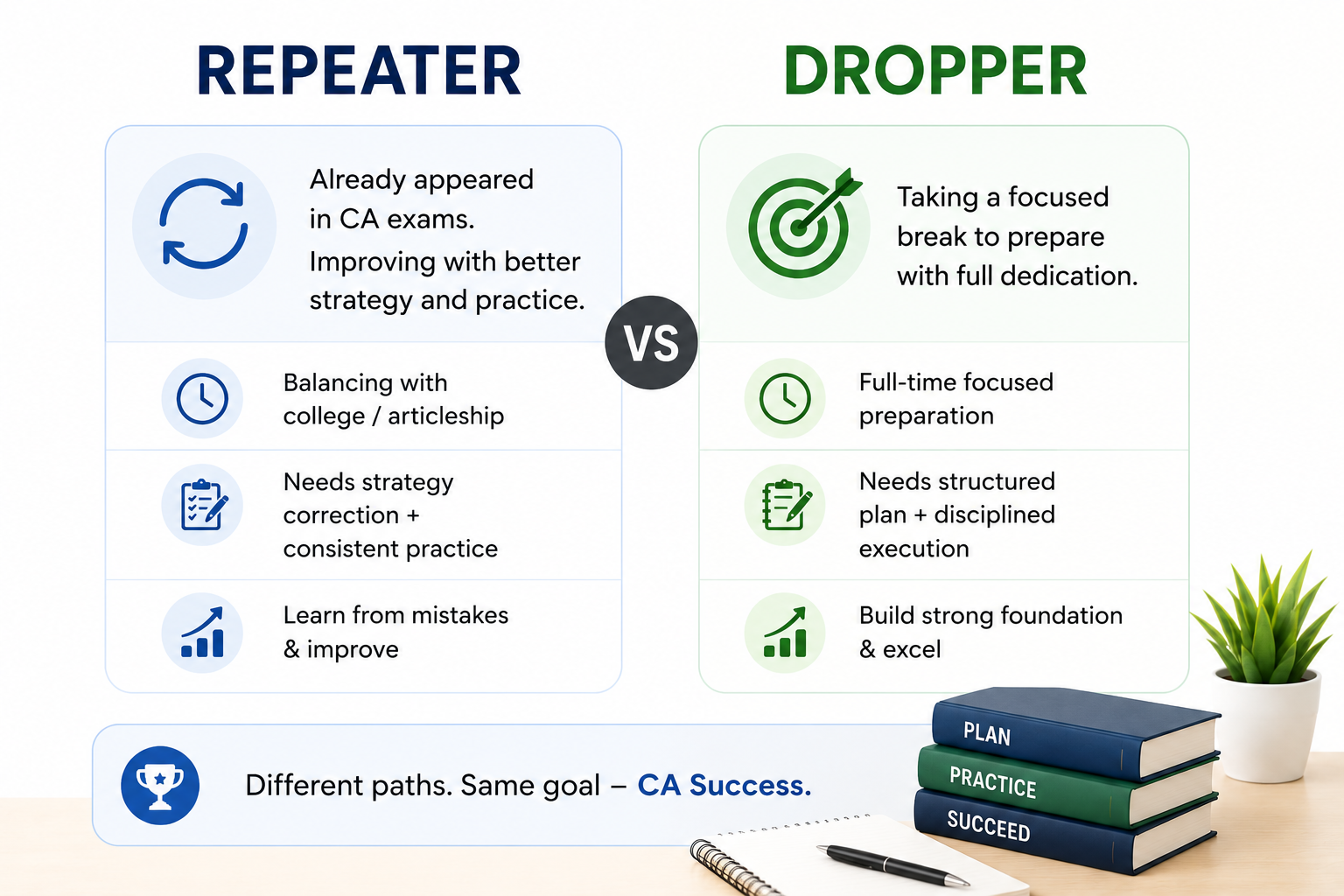
The repeater is a person who has already taken CA examinations (Foundation, Inter, and Final) one or more times before and who now plans to reappear – usually during the same period as their articleship/college/study/work.
There are distinctions between droppers and dropouts. The dropout is a student who has given up the course altogether. On the contrary, the dropper is a student – usually a Foundation or Inter student – who is taking an intentional break from college/articleship/study/work to prepare thoroughly, especially after one or more unsuccessful attempts.
Also, students may encounter the term partial dropper, which is basically a student who is pausing one or two papers out of the group while pursuing articleship/college/study/work in others – somewhere in between a repeater and a dropper.
Whichever category you fall into, you likely already know your syllabus in general, but haven't yet converted that knowledge into marks. That calls for a shift in how you approach lectures — from "learning everything from scratch" to "fixing exactly what went wrong last time."
Why Regular CA Lectures Don't Work for Repeaters?
The initial student would require anywhere between 80 and 100+ hours per subject on the conceptual level from scratch. However, the repeater is someone who has the basics covered. The process of attending long-hour lectures, once again, generally results in 3 major drawbacks:
Wastage of time on those concepts with which you are already familiar.
Feeling satisfied by watching old lecture content again and thinking that it will solve all of your problems.
Not diagnosing why you scored low in the previous attempt.
And that is precisely the reason why there is a need for a repeater/dropper batch.
What a Good Repeaters/Droppers Batch Should Include?
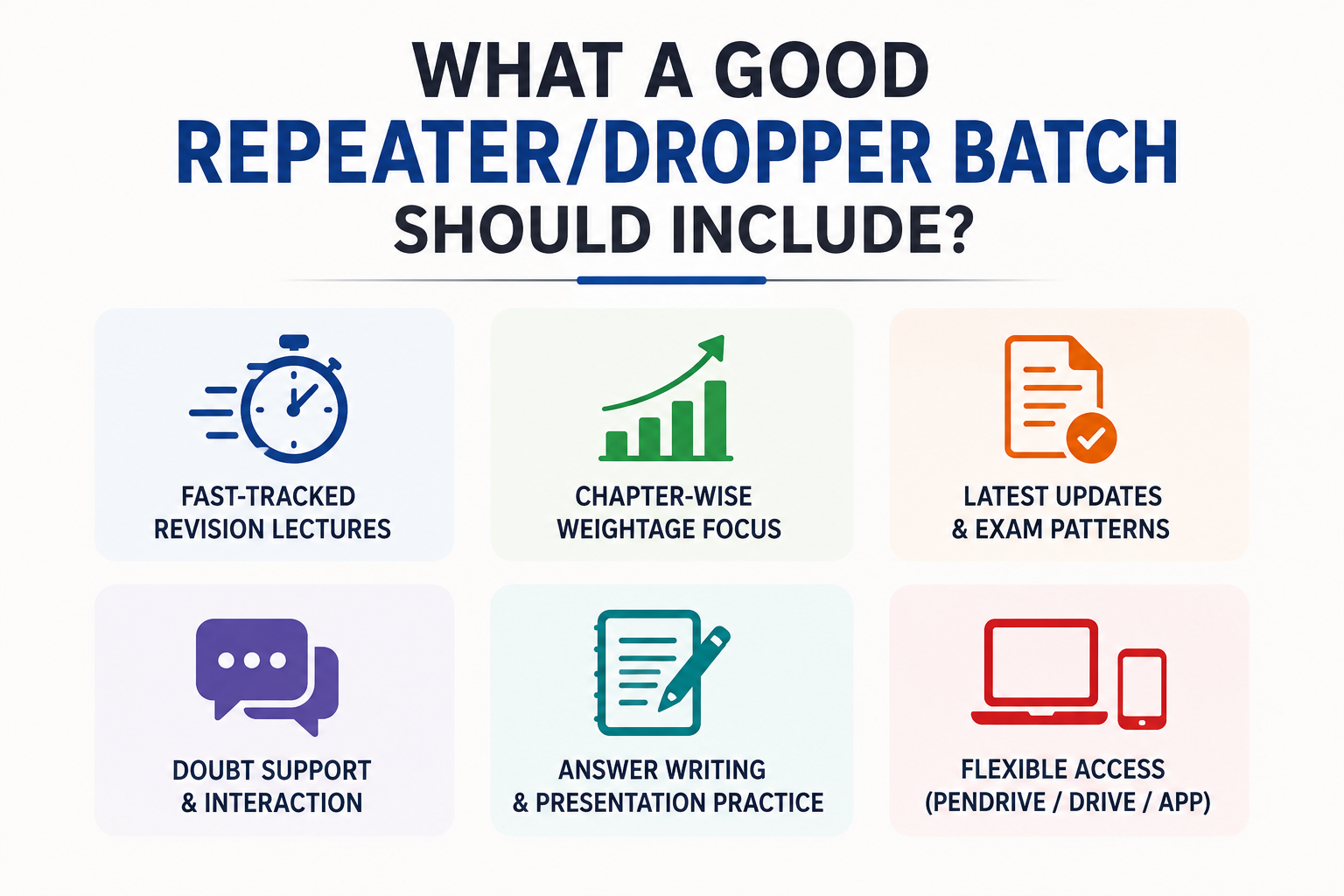
Before joining any lecture package, make sure it provides the following:
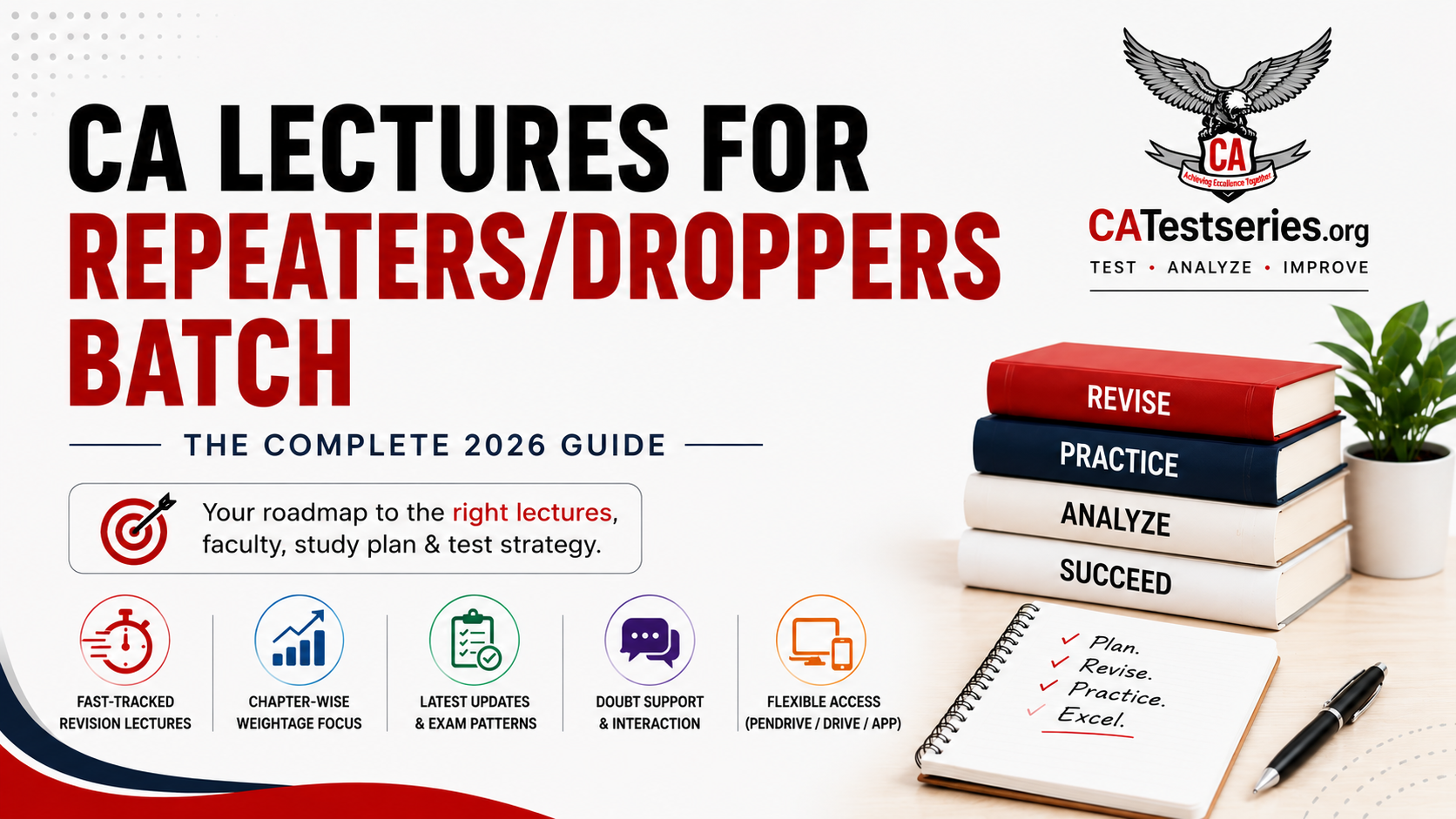
Fast-tracked revision lectures (30-50 hours per subject as compared to 90-100+ hours) that start from the assumption that you have already understood the fundamentals.
Analysis of weightage chapter-wise according to the latest trend in ICAI examinations, so that the time spent in revision is in proportion to marks.
Coverage of the latest amendments and Revision Test Papers/Mock Test Papers, because the reason most repeaters lose marks is due to using outdated content. You can always cross-check the latest amendments on the official website of ICAI.
Opportunity to clear their doubts in forums, WhatsApp groups, or in live sessions because repeaters mostly prepare alone or in an unstructured manner.
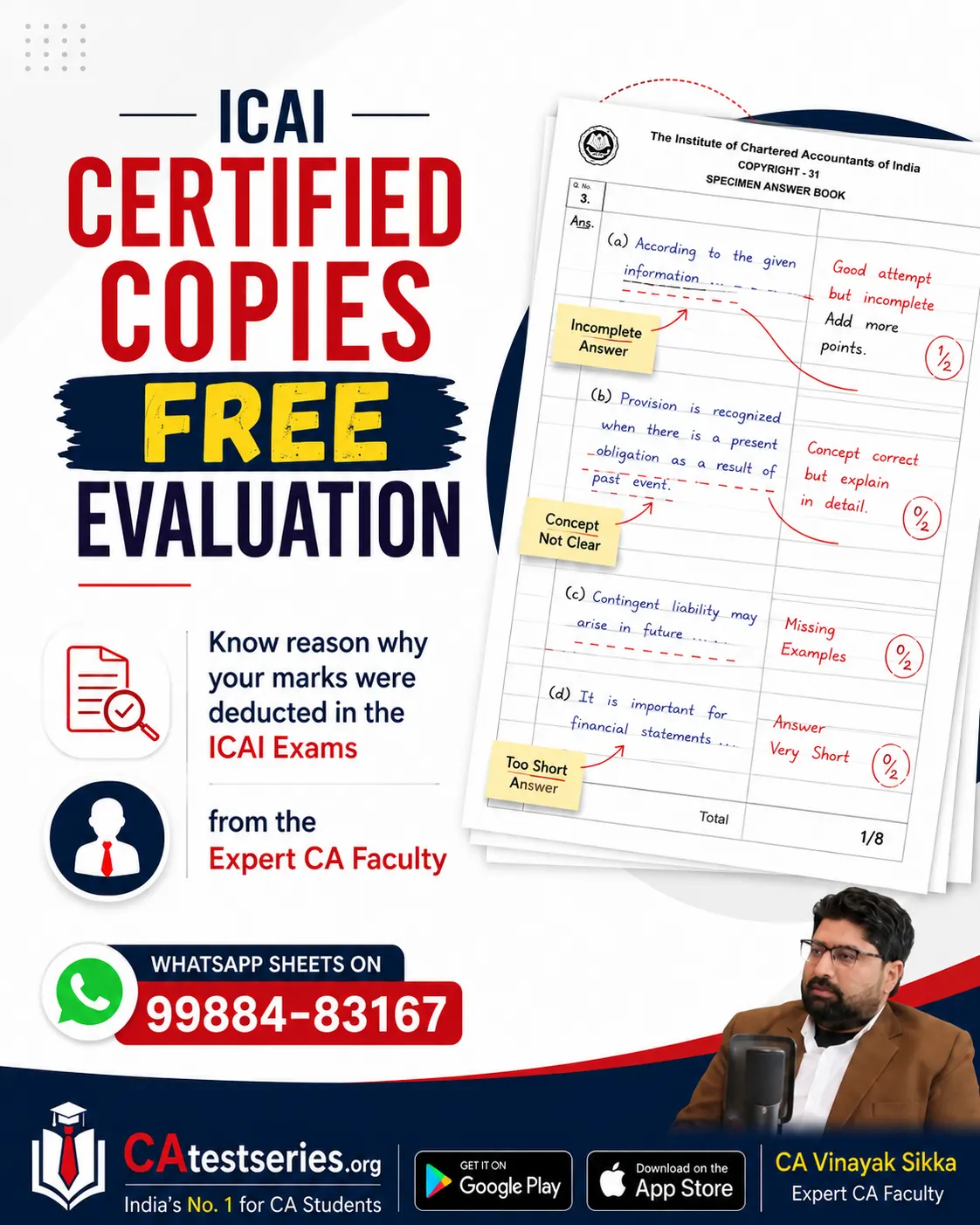
Practice of writing answers and presentation, not only the explanation of concepts, as this is what repeaters lack in subjective exams.
Flexibility of access: Pendrive, Google Drive, or mobile application according to articleship, job, or self-study schedule.
CA Foundation, Inter, and Final Repeater Lecture Plans
CA Foundation Repeater Batch
Repeaters of CA Foundation are normally poor in the concepts of Accounting, provisions of business law, and quick solving in Quantitative aptitude. Instead of covering all the chapters from scratch, the repeaters’ batch at this stage should concentrate on solving formulas in Maths/Stats/LR, answering according to the provisions of the law, and solving the accounts problems within time limits.
CA Inter Repeater Batch
In the CA Inter stage, normally, the repeaters tend to get marks deducted because of the presentation pattern (provision, facts of the case, reasoning, and conclusion), and not due to a lack of information. The repeaters' batch at this stage should particularly emphasize these aspects of answering, along with the chapter-wise weighting of papers from Groups 1 & 2.
CA Final Repeater Batch
Normally, the CA Final repeaters have adequate content knowledge but are weak in application, time management, and answering skills in the subjective papers such as financial reporting, strategic financial management, and direct and indirect tax. Lectures for revision are most effective if accompanied by evaluation in the form of a mock test paper.
Best Faculty for CA Repeaters: How to Choose the Right Faculty?
It’s at this point of faculty selection that repeaters stumble. Note these things:
Go for the demo lecture before making any purchase – never choose a faculty member based on recommendations and ratings.
Pick a faculty member who builds concept clarity from the basics and uses an exam-based approach, even in the case of a revision batch.
Ensure that the language and speed used by the faculty match your mode of learning, not that of a topper.
Keep the number of faculty members to one for each subject rather than keep changing it. This disrupts continuity in notes and revisions.
As a repeater, go back to see where you lost your marks previously and select faculty according to these criteria only.
Repeater Batch vs Regular Batch: Quick Comparison
Parameter | Normal Batch | Repeater/Dropper Batch |
Time spent by each student | 80-100+ hours | 30-50 hours (at revision speed) |
Area of concentration | Building concepts from scratch | Fill gaps and application |
Speed | Slow and in-depth | Fast and prerequisite-based |
Practice | Questions at the end of the chapter | RTP/MTP/old question papers/mocks |
Writing answers | Gradually introduced | Drilled thoroughly from day one |
Ideal for | Students learning the subject for the first time | Repeaters, Droppers, & Partial Droppers |

Cost of a CA Repeaters/Droppers Batch
Lectures for the repeater/dropper batch would be more economical compared to a complete first attempt package, considering that they involve less number of hours. The fees may vary depending on the following:
Nature of the subject (Foundation, Inter, or Final)
Teacher popularity/merit
Mode of lecture availability (pendrive, Google Drive, or app access)
If a test series or doubt-clearing facility is included along with it
Whether you choose a single subject package or a group package
Factors That Can Influence Final Cost
Format - The price for the pendrive package can be slightly higher than for the Google Drive and/or app package, as there is an additional cost involved in physically delivering the package to the learner.
Validity Period - A package that gives access for two attempts can cost more than a single-attempt package.
Test series included - Packages that contain test series/mock tests are always costlier than the packages without test series/mock tests. However, such packages always turn out to be cheaper than purchasing lectures and test series/mock tests separately.
Faculty Tier - Lectures by senior faculty will have a slightly higher fee than those by new faculty.
Is a Repeater Batch Justified in Terms of Cost?
Because a CA repeater batch or CA dropper batch takes up 30-50 hours instead of 80-100+ hours, the fee for each individual is generally lower than that of a first-attempt batch. Consider how much you need – if you are just struggling in one or two chapters of a subject, some services provide chapter-based prices as well.
Visit CAtestseries.org for further information.
Building a Study Plan Around Your Repeater Lectures
Lectures alone are not enough to complete an attempt; rather, the study strategy surrounding these lectures is just as important:
Diagnose first. Review your old mark sheet or answer sheet (whichever is available), chapter by chapter, before deciding which revision lectures to prioritize.
Set time limits for each subject. Stick to a fixed time limit for lecture watching, as repeaters are known to watch too many videos instead of practicing.
Practice after each lecture. Try to solve at least one previous year’s or RTP question immediately after completing each topic.
Take weekly tests. Tested performance can expose problems of presentation and time management, which are difficult to find out on your own.
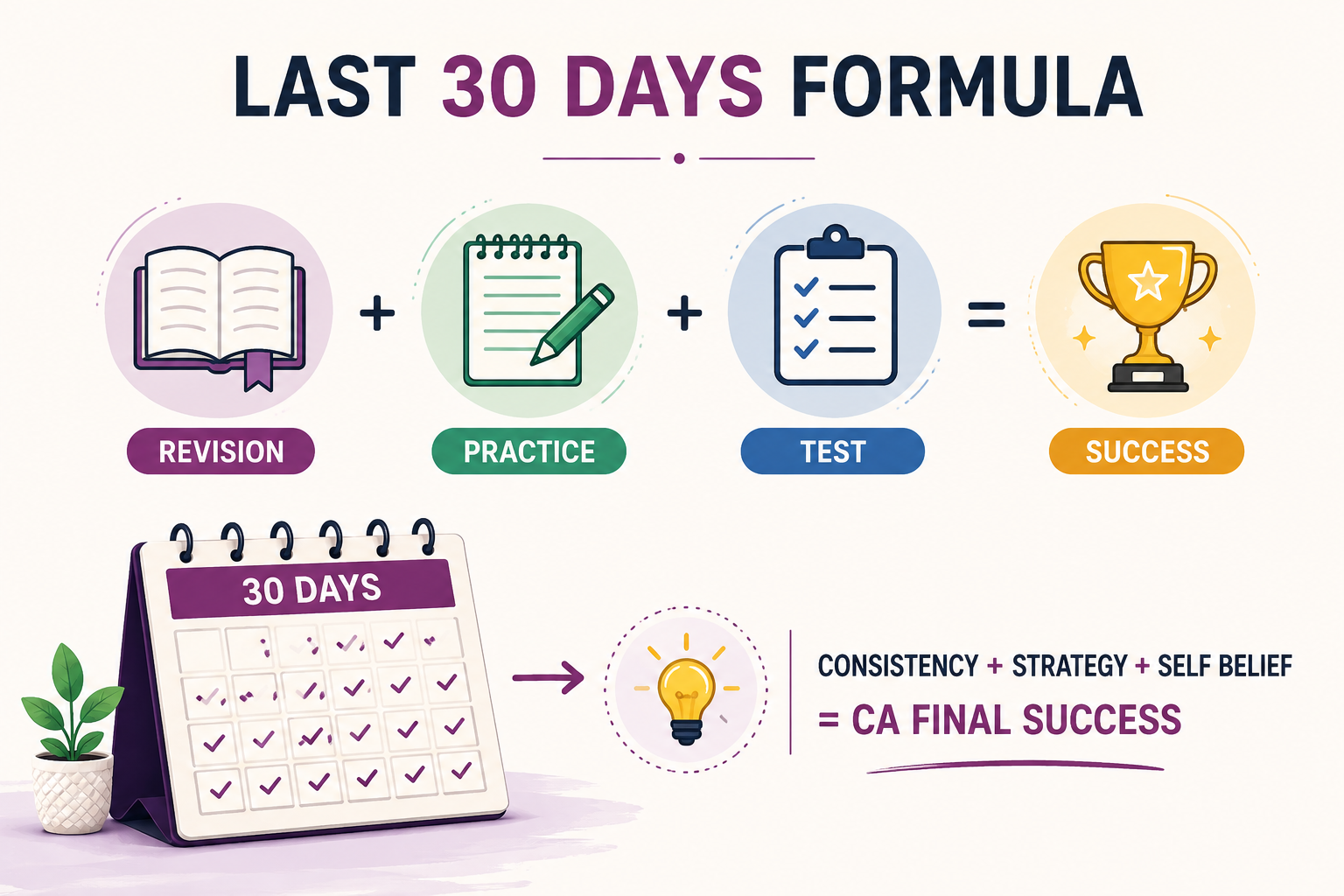
Cover weak chapters twice. Once in the lectures phase and once again in the last month of preparation.
Common Mistakes Repeaters Make With Lectures
Revising by watching an entire course "to be on the safe side" instead of a revision-based selection.
Purchasing lecture videos from several departments on the same subject with notes that are not consistent.
Skipping amendments/RTPs because "I have done this before."
Passively watching lectures without writing, especially those involving subjective subjects such as Law, Tax, and FR/SFM.
Not compiling a list of mistakes from the previous attempt as a direct guide for revision.
Pendrive, Google Drive, or App — Which Format Suits Repeaters?
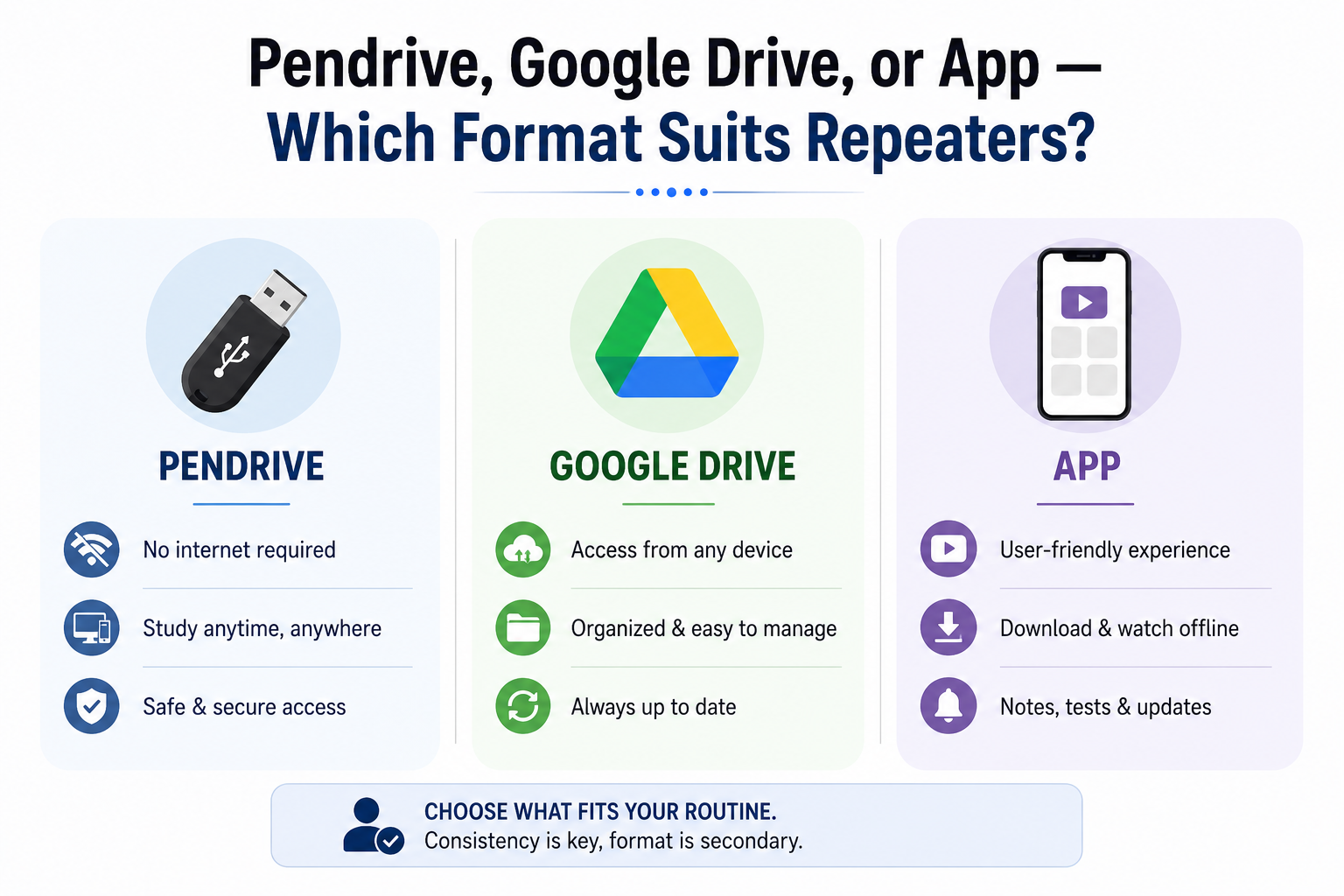
As most repeaters manage articleship, job, or college along with preparation, flexibility in accessing materials is more important than it is for a fresher:
Pendrive – It is helpful in offline mode in areas with poor connectivity; however, not very helpful when preparing on more than one device at once.
Google Drive – Helpful when revising on laptops. Easy to organize the material chapter-wise.
Mobile Application (Android/iOS) – Most suitable for those repeaters who prepare during their travel time, during office hours, or during breaks between articleships.
Make your selection based on your routine rather than your habit – a working repeater has more advantage with a mobile app than a pendrive arrangement.
Combining Repeater Lectures with a Test Series
The reason why lectures alone never seem to be enough to bridge the gap for repeaters is that evaluated practice is what they are actually lacking. The process of taking a test series, including chapter-wise tests, complete mocks, and RTP/MTP evaluation from a practising Chartered Accountant, will bring out the errors at the presentation level that a repeater would not be able to notice themself. As far as repeaters go, it is generally content knowledge that they possess; the gap lies either at the level of presentation or time management.
This is precisely the reason why repeater/dropper batches usually tend to perform better when lectures and tests are taken together rather than separately.
Conclusion
CA repeater batch lectures and dropper batch lectures must be attended only if they are used as a revision-cum-correction tool and not as another shot at learning from the beginning. Identify the shortcomings in your earlier attempt, select a quick repeater/dropper course that updates regularly, follow a single faculty member for each subject, and ensure you attend lectures and review the evaluated test papers.