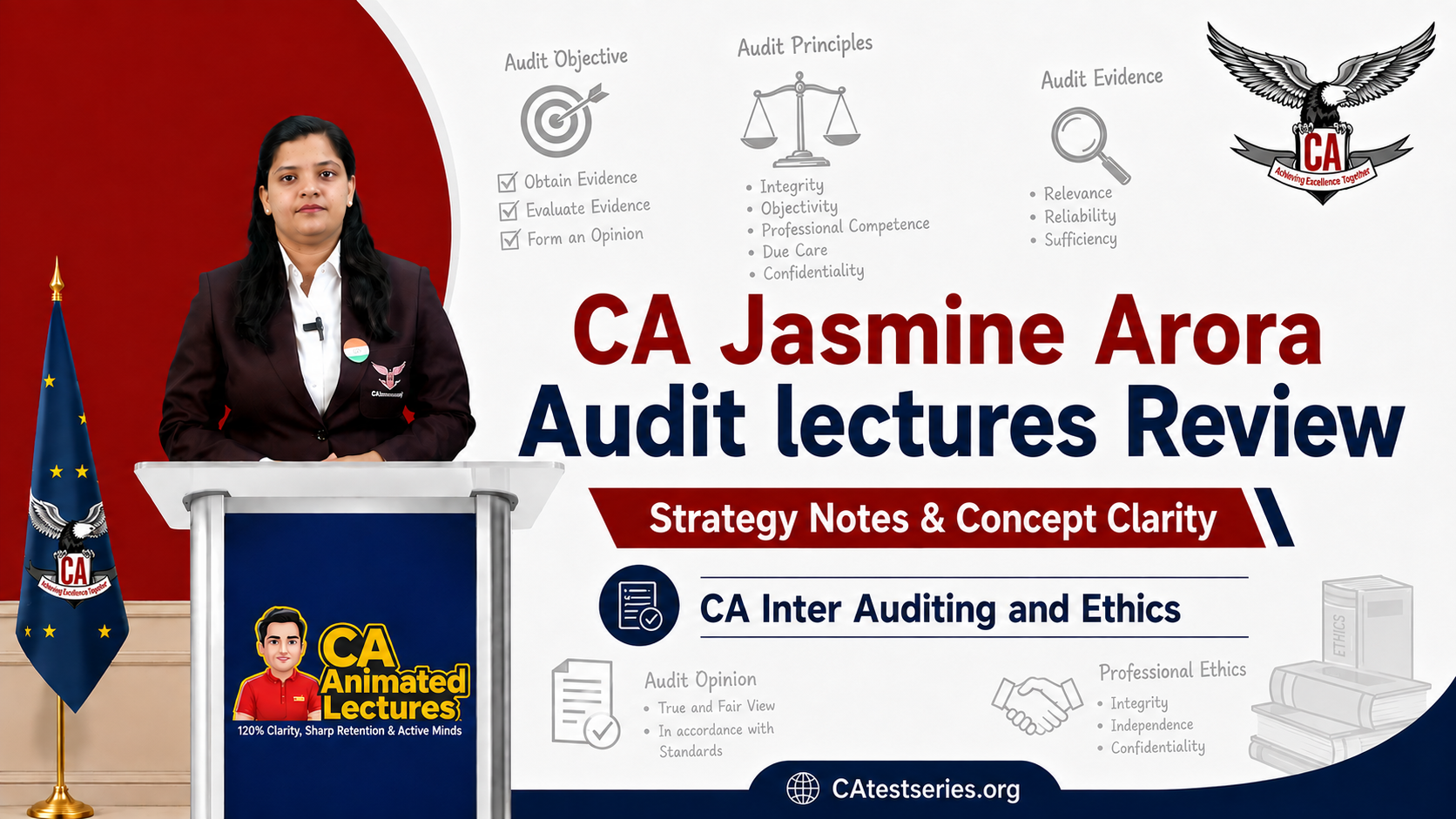
CA Jasmine Arora Audit Lectures Review — Notes, Tests & Fees
While preparing for CA Inter Auditing & Ethics, you may have come across the name of CA Jasmine Arora Audit lectures, especially on the CA Test Series. But before choosing your audit faculty, there’s one important question you need an honest answer to: Is CA Jasmine Arora the right faculty for your attempt?
Auditing and Ethics has a reputation among CA Inter students as a "scoring but scary" paper — scoring because it rewards conceptual clarity and keyword-based answer writing, scary because most students try to mug up Standards on Auditing (SAs) word-for-word and forget them the moment they walk into the exam hall. The right faculty can make the difference between treating Audit as dead theory and treating it as a subject you can actually think through.
Who is CA Jasmine Arora?
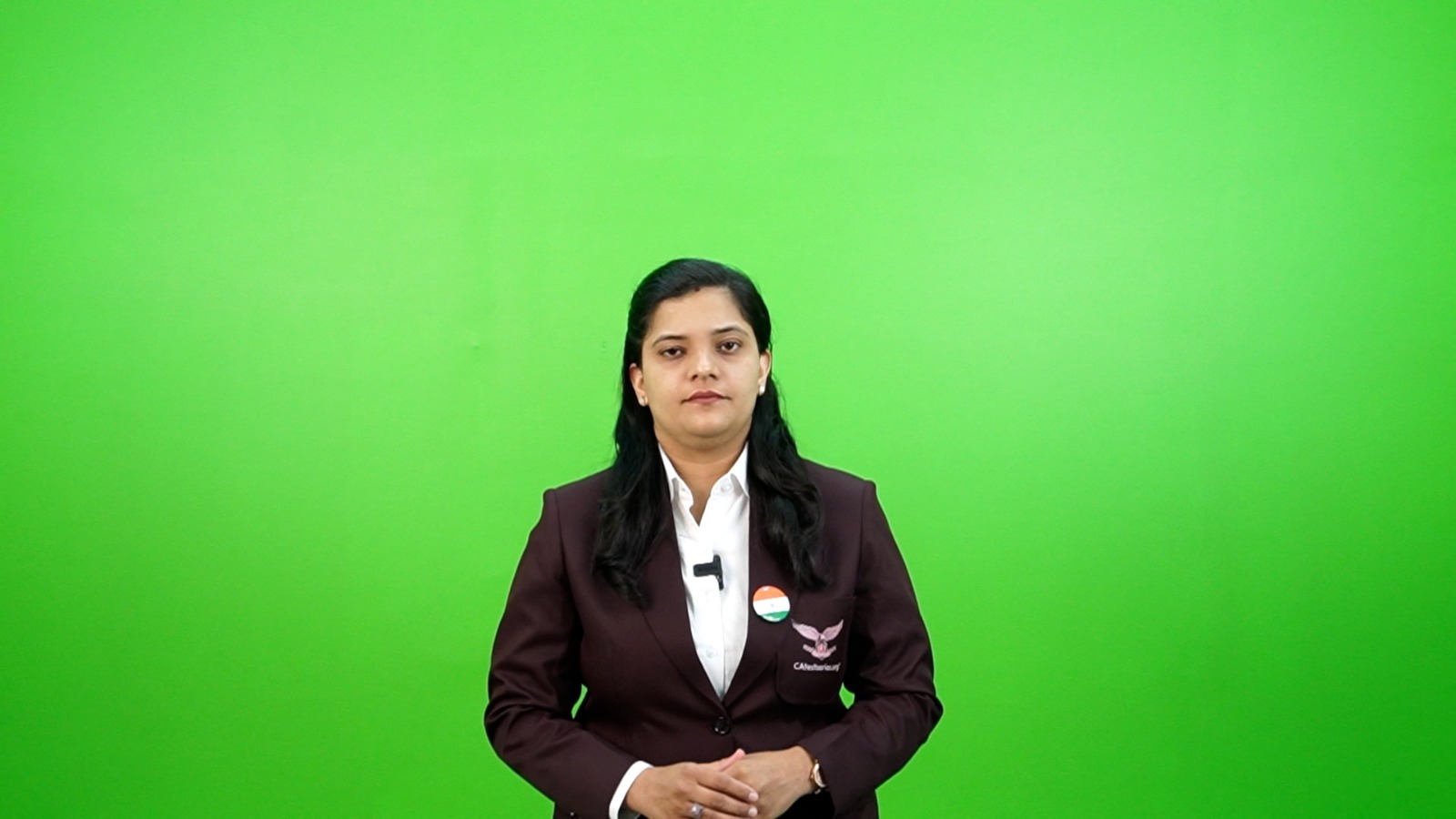
CA Jasmine Ma’am is a highly qualified Chartered Accountant with an outstanding academic record and a strong command over the subject of Auditing. CA Jasmine Ma’am believes in making Auditing conceptual, practical, and examination-oriented. Her teaching methodology focuses on developing conceptual clarity, professional judgment, practical case-based understanding, and effective answer presentation — enabling students to understand not just what an auditor does, but how an auditor thinks and applies auditing standards in real-life situations. She provides mentorship to the students through practice sessions, evaluation methods, revision approaches, and exam preparation so that the students gain a true understanding of the subject and are not only memorizing information.
Jasmine Arora’s Approach to Teaching
Students commonly point to the following as defining traits of her teaching style:
Concept-first approach. In CA Jasmine Arora Audit lectures, rather than opening a chapter by reading out the definition, she tends to build understanding through a real-world audit scenario first, then connect it back to the relevant Standard or provision.
Memory techniques and mnemonics. SA numbers and provisions are notoriously easy to mix up under exam pressure. Her classes build in recall tricks specifically designed to reduce this kind of numbering confusion.
Interactive delivery. Even in a recorded/online format, the lectures maintain a classroom feel rather than reading flatly from slides — this keeps a traditionally "dry" theory subject more engaging over long study sessions.
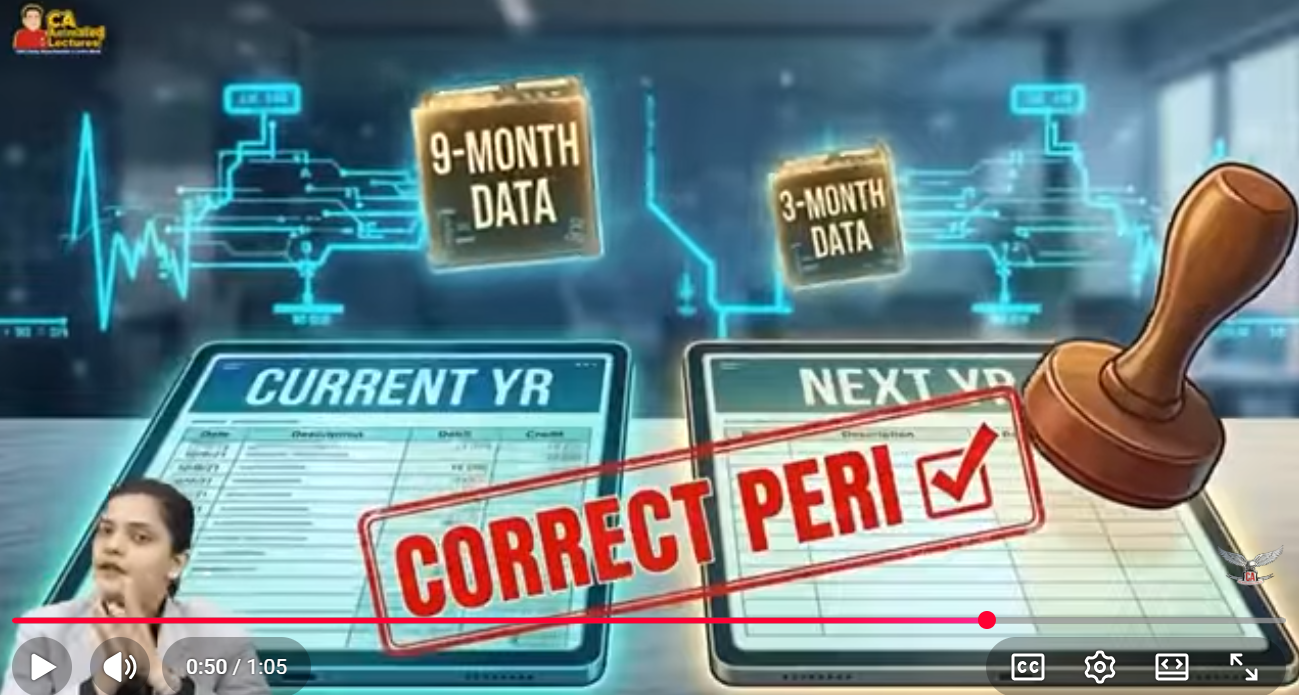
Animated visuals for stronger recall. Rather than relying purely on verbal explanation, key processes — such as audit workflows, internal control checkpoints, and step-by-step audit procedures — are shown through animation.
Exam-oriented pacing. Time spent on each topic is roughly proportionate to ICAI's chapter-wise weightage rather than treating every chapter as equally important — a subtle but important difference for students with limited revision time before the exam.
What You’ll Learn in Her Video Lectures
CA Jasmine Arora's video lectures are structured around the complete CA Inter Auditing and Ethics syllabus under ICAI's New Scheme and typically include:
Chapter-wise concept videos aligned to the ICAI study material, covering each topic in the sequence ICAI itself follows
Standards on Auditing (SA) concepts are illustrated using real-life case-study examples, not through abstract definitions that have to be committed to memory.
Integration of professional ethics throughout the paper. Ethics is now examined as an integral part of the Auditing paper under ICAI's New Scheme, rather than as a separate topic.
Amendment updates: CA Jasmine Arora audit lectures provide the latest ICAI notifications or clarifications issued after the base study material was published
Animated visual explanations for concepts like audit flow, internal control processes, and the sequence of audit procedures — helping students build visual memory for topics that are otherwise easy to forget in plain-text or verbal form
The lecture format is designed to be watched at the student's own pace — useful for repeaters who want to skip chapters they've already mastered, and equally useful for first-timers who may need to pause and re-watch dense provision-heavy sections like company audit or auditor's report formats.
What’s Included in CA Jasmine Ma’am’s Audit Resources
Animation Video Lectures for Each Chapter
Learn complex Audit concepts through engaging, chapter-wise animated video lectures designed for clear understanding and better retention.
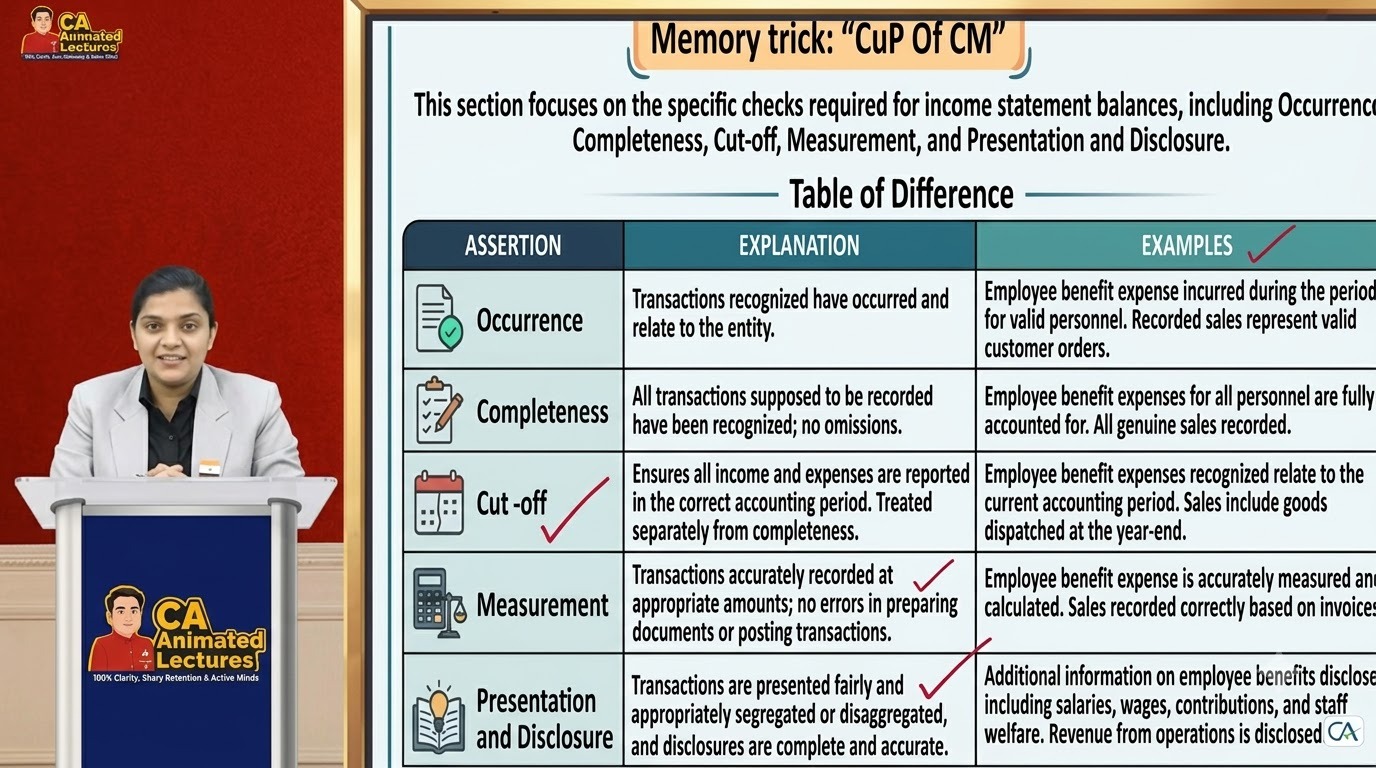
Chapter-wise Animated Lectures for better understanding and engagement.
Concept-focused explanations to simplify difficult Audit topics.
Visual learning approach to make important concepts easier to remember.
Exam-oriented coverage aligned with the CA Inter Audit syllabus.
Watch the Demo Lecture to get a better understanding of the course, teaching methodology, and other details.
Free Resources for Smarter Audit Preparation
Access a curated collection of free Audit resources to strengthen your concepts, practice questions, and prepare more effectively
Resource | Access |
CA Inter Audit Charts | |
CA Inter Concept Notes | |
CA Inter Question Bank | |
CA Inter Subject Strategy |
Chapter-wise Handwritten Notes for CA Inter Audit
Revise every chapter with easy-to-understand, chapter-wise handwritten notes designed for quick revision and effective exam preparation.
Chapter | Handwritten Notes |
Chapter 1 – Nature, Objective & Scope of Audit | |
Chapter 2 – Audit Strategy, Audit Planning & Audit Programme | |
Chapter 3 – Risk Assessment & Internal Control | |
Chapter 4 – Audit Evidence | |
Chapter 5 – Audit of Financial Statements | View Notes |
Chapter 6 – Audit Documentation | |
Chapter 7 – Completion & Review | |
Chapter 8 – Audit Report | |
Chapter 9 – Special Features of Different Types of Entities | |
Chapter 10 – Audit of Banks | |
Chapter 11 – Ethics and Terms of Audit Engagement |
Test Series for Your Upcoming Attempt
Prepare smarter and test yourself at every stage with our faculty-designed Test Series, created to help you build confidence and stay exam-ready.
Chapter-wise Test Series – Strengthen your preparation topic by topic
Full-Test Series – Experience the complete exam pattern
Chapter-wise test series and full-syllabus tests are prepared by our experienced CA; detailed evaluation is also provided with our mentorship program.
CA Jasmine Audit Faculty vs Other Audit Faculties
Criteria | CA Jasmine Arora | Other Established Audit Faculty |
Teaching Approach | Practical approach that connects auditing concepts with real-life situations. | Generally focused on explaining concepts and completing the prescribed syllabus. |
Memory Techniques | Uses mnemonics and recall techniques | Memory techniques may depend on the faculty's methodology. |
Visual Learning | Uses animated visuals to explain audit procedures, internal controls, etc | Primarily relies on conventional board, notes, or slide-based explanations. |
Exam Orientation | Focuses on ICAI-oriented preparation, answer presentation, revision, and chapter-wise importance. | Exam preparation is generally incorporated alongside regular conceptual teaching. |
Practical Understanding | Uses case-based and real-world examples. | Depending on the teaching approach used by the faculty |
Revision Support | Provides chapter-wise resources, handwritten notes, charts, concept notes, and question banks for revision. | Revision resources differ according to the faculty or course. |
Learning Flexibility | Recorded lectures allow students to pause, replay, and revisit difficult topics according to their preparation level. | Flexibility depends on whether the faculty offers recorded or live classes. |
Who Should Join This Batch?
First-timers who want to build Audit from the ground up with strong conceptual clarity rather than starting with rote memorization
Repeaters who struggled in a previous attempt with retaining SA numbers and provisions using pure textbook study
Students who are weak in theory subjects generally respond better to memory techniques and applied examples than to long paragraphs of definitions
Working professionals or self-study students who need a structured, exam-weighted approach rather than open-ended lecture hours they have to prioritize themselves
Students who want strong answer-writing feedback, since the evaluated test series is one of the stronger components of this offering
Students who specifically want the largest possible volume of lecture hours, or who strongly prefer studying under a faculty member with a decades-long track record and a very large existing student community, may want to weigh that preference against the more concept-first, efficiency-focused approach described here.
How to Do Preparation for CA Inter Audit

A successful CA Inter Audit preparation requires a balance of conceptual understanding, regular revision, and written practice. Instead of relying only on memorisation, students should understand the concepts, learn important Standards on Auditing, and practise presenting answers in an exam-oriented manner. A structured approach can make Audit easier to retain and revise.
Follow ICAI Study Material: Study each chapter systematically and understand the concepts before memorising provisions.
Build Conceptual Clarity: Understand the logic behind audit procedures and Standards instead of learning everything word-for-word.
Use Memory Techniques: Use mnemonic devices and memorization methods for SA questions, provisions, and key ideas.
Make Short Revision Notes: Create revision notes chapter-wise using handwritten notes and charts to do last-minute revisions quickly.
Practise Answer Writing: Solve questions regularly and concentrate on keywords, structure, and conclusion.
Attempt Mock Tests: Attempt mock tests chapter-wise and full-length tests.
Revise Multiple Times: Revise at regular intervals so that the key ideas and provisions stay fresh till the time of your exam.
Last 10-day exam strategy
Day | Chapters / Topics | What to Do |
Day 1 | Chapter 1: Nature, Objective & Scope of Audit | Understand the basic concepts, objectives, principles, and audit planning process. Make short notes of important definitions and revise them at the end of the day. |
Day 2 | Chapter 3: Risk Assessment & Internal Control | Focus on audit risk, risk assessment procedures, and internal controls. Understand the relationship between risk, control, and auditor's response. Practice important questions. |
Day 3 | Chapter 4: Audit Evidence | Study types and sources of audit evidence, sufficiency and appropriateness of evidence. Prepare a quick-revision sheet and practice exam-oriented questions. |
Day 4 | Chapter 5: Audit of Items of Financial Statements – Part 1 | Start the chapter systematically and understand the audit procedures for major financial statement items. Highlight important procedures and keywords for answer writing. |
Day 5 | Chapter 5: Audit of Items of Financial Statements – Part 2 | Complete Chapter 5 and revise Chapters 1–5. Practice important questions and test your recall without looking at the book. |
Day 6 | Chapter 6: Audit Documentation Chapter 7: Completion & Review | Understand documentation requirements, completion procedures, and review. Focus on important concepts, distinctions, and exam-oriented questions. |
Day 7 | Chapter 8: Audit Report | Focus on audit reporting, important requirements and auditor responsibilities. Create a concise revision chart and practice answer-writing questions. |
Day 8 | Chapter 9: Special Features of Audit | Study entity-specific audit requirements and banking audit. Make entity-wise and bank-audit short notes for quick revision. |
Day 9 | Chapter 11: Ethics & Terms of Audit | Complete Chapter 11 and revise Chapters 6–11. Focus on important provisions, keywords, and frequently tested concepts. Attempt a Module 2 test. |
Day 10 | Full Syllabus Revision – Chapters 1–11 | Rapidly revise the entire syllabus. Review short notes, important questions, and mistakes from previous practice. Finish with a full-syllabus mock/test under exam conditions. |
Conclusion
CA Jasmine Arora Audit lectures on CA Test Series focus on conceptual clarity, notes as per the ICAI, and an exam-oriented test series — a good choice for those CA Inter candidates who have trouble understanding the subject as part of the textbooks and prefer to learn from someone who focuses on the high-scoring chapters instead of giving equal attention to all of them.