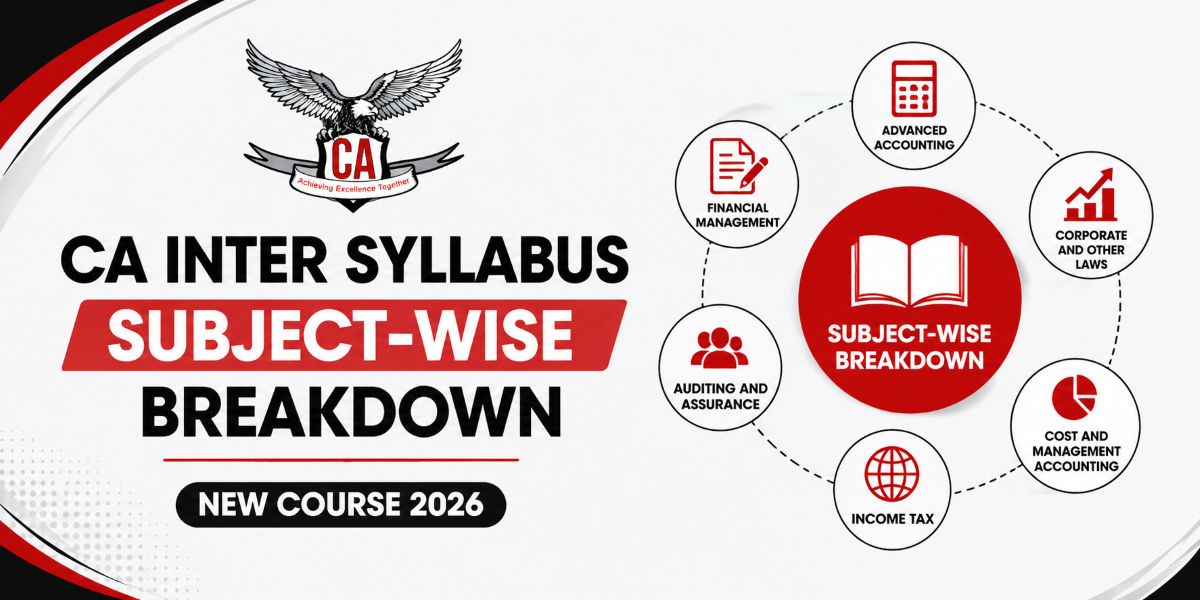
CA Inter Syllabus Subject-Wise Breakdown: New Course 2026
CA Inter Syllabus Subject-Wise Breakdown: New Course 2026
The transition from CA Foundation to CA Intermediate is one of the biggest academic jumps in the Chartered Accountancy journey. Students often hear that CA Inter is more challenging, but what makes it difficult is not just the level of concepts—it's also the depth and volume of the syllabus.
With the New Scheme of Education and Training, ICAI has redesigned the CA Intermediate curriculum to make it more practical, application-oriented, and aligned with professional requirements. As a result, students need a clear understanding of each subject before beginning their preparation.
This guide provides a complete subject-wise breakdown of the CA Intermediate New Course 2026 syllabus, helping students understand what to expect and how to plan their studies effectively.
Understanding the CA Intermediate New Course Structure
Under the current ICAI scheme, CA Intermediate consists of two groups containing six papers in total.
The subjects are designed to build a strong foundation in:
- Accounting
- Taxation
- Corporate laws
- Cost management
- Auditing
- Financial management
Unlike CA Foundation, where the syllabus introduces basic concepts, CA Intermediate focuses heavily on practical application and professional problem-solving.
Group 1 Subjects Overview
Group 1 contains three papers that form the foundation of professional accounting and taxation knowledge.
Advanced Accounting
Advanced Accounting is often considered the backbone of CA Intermediate.
The subject develops accounting concepts learned at the Foundation level and introduces more complex accounting standards and financial reporting requirements.
Key topics generally include:
- Accounting Standards
- Company Accounts
- Branch Accounts
- Special Transactions
- Financial Statements
- Amalgamation and Reconstruction Concepts
Students who build strong conceptual clarity in this subject often find future CA levels easier to manage.
Corporate and Other Laws
This paper focuses on legal provisions relevant to business and corporate environments.
Major areas include:
- Companies Act provisions
- Corporate legal framework
- Business laws
- Regulatory compliance
- Legal interpretation
Unlike Foundation Law, Intermediate Law requires deeper understanding and application-based answers.
Students should focus on understanding provisions rather than memorizing them mechanically.
Taxation
Taxation is one of the most important subjects in CA Intermediate.
The paper introduces students to India's taxation system and develops practical tax computation skills.
Major areas include:
- Income Tax
- Heads of Income
- Deductions
- Tax Computation
- GST Fundamentals
- Indirect Tax Concepts
Taxation requires both conceptual understanding and extensive practical problem-solving.
Regular practice is essential for success.
Group 2 Subjects Overview
Group 2 introduces subjects that are closely connected with real-world professional responsibilities.
Cost and Management Accounting
Costing helps students understand how businesses measure, control, and analyze costs.
Important topics generally include:
- Material Costing
- Labour Costing
- Overheads
- Process Costing
- Marginal Costing
- Budgeting
- Cost Control Techniques
Students often find Costing challenging initially because it combines theory with numerical application.
However, consistent practice usually leads to significant improvement.
Auditing and Ethics
Auditing introduces students to the principles of professional assurance and verification.
Major areas include:
- Audit Fundamentals
- Audit Planning
- Internal Control Systems
- Audit Documentation
- Professional Ethics
- Audit Evidence
Unlike accounting subjects, auditing requires analytical understanding and conceptual clarity.
Students should focus on understanding why audit procedures exist rather than merely memorizing points.
Financial Management and Strategic Management
This paper combines two important areas of professional practice.
Financial Management
Financial Management focuses on financial decision-making.
Key topics include:
- Time Value of Money
- Capital Budgeting
- Cost of Capital
- Leverage Analysis
- Working Capital Management
- Investment Decisions
Students with strong mathematical skills often perform well in this section.
Strategic Management
Strategic Management focuses on organizational planning and business decision-making.
Topics typically include:
- Business Environment
- Strategic Planning
- Competitive Strategy
- Organizational Management
- Strategic Analysis
This portion is theory-oriented but highly practical in nature.
Which CA Inter Subject Is the Most Difficult?
There is no universal answer.
Difficulty depends on a student's strengths and weaknesses.
Generally:
- Accounting-heavy students may find Taxation easier.
- Students comfortable with theory may prefer Law and Audit.
- Students with analytical abilities often excel in Costing and Financial Management.
Most students consider Taxation, Costing, and Auditing among the more demanding subjects due to their depth and application requirements.
Which Subjects Require the Most Practice?
Not all subjects require the same preparation strategy.
High-Practice Subjects
These subjects demand continuous problem-solving:
- Advanced Accounting
- Taxation
- Cost and Management Accounting
- Financial Management
Daily practice improves speed, accuracy, and retention.
High-Revision Subjects
These subjects require repeated revision:
- Corporate and Other Laws
- Auditing and Ethics
- Strategic Management
Frequent revision helps retain provisions, concepts, and professional terminology.
How to Study the CA Intermediate Syllabus Effectively
Understanding the syllabus is only the first step.
Students must also create an effective preparation strategy.
Prioritize Conceptual Clarity
Avoid rote learning.
Focus on:
- Understanding concepts
- Connecting topics
- Solving practical problems
Strong fundamentals make revision easier later.
Study Both Groups Together
Many successful students study subjects from both groups simultaneously.
This creates balance between:
- Theory subjects
- Practical subjects
It also prevents preparation fatigue.
Use Regular Self-Assessment
Self-assessment helps identify weak areas before examinations.
Students should regularly evaluate:
- Conceptual understanding
- Question-solving ability
- Revision progress
The Importance of Mock Tests in CA Intermediate
CA Intermediate is not just about studying.
It is also about applying knowledge under examination conditions.
Mock tests help students:
- Improve time management
- Develop answer-writing skills
- Build confidence
- Identify weaknesses
Many students use structured mock tests from platforms such as CATestSeries.org to evaluate preparation levels and gain practical exam experience before attempting ICAI examinations.
Common Mistakes Students Make While Studying CA Inter
Many students struggle because of avoidable mistakes.
Ignoring Difficult Subjects
Students often postpone challenging subjects such as Taxation or Costing.
This usually creates stress closer to exams.
Focusing Only on Reading
Reading alone is not enough.
Practical subjects require consistent question-solving.
Delaying Revision
Revision should begin long before the examination period.
Waiting until the final month often leads to incomplete coverage.
Skipping Mock Tests
Students who never practice under exam conditions frequently face time-management issues during actual exams.
Subject-Wise Study Priority Recommendation
A balanced approach works best.
Suggested priority order:
- Advanced Accounting
- Taxation
- Cost and Management Accounting
- Financial Management
- Corporate and Other Laws
- Auditing and Ethics
- Strategic Management
The goal is to start with concept-heavy subjects early while maintaining consistent revision of theory papers.
Final Thoughts
The CA Intermediate New Course 2026 syllabus is designed to prepare students for real-world professional responsibilities. Each subject serves a specific purpose and contributes to the knowledge required for becoming a Chartered Accountant.
Students who understand the syllabus structure, plan their studies strategically, and practice consistently often find the transition from Foundation to Intermediate much smoother.
Rather than focusing on which subject is hardest, focus on building conceptual clarity, maintaining discipline, and practicing regularly. Over time, even the most challenging topics become manageable.
Frequently Asked Questions
How many subjects are there in CA Intermediate under the New Course?
CA Intermediate consists of six papers divided into two groups.
Which CA Inter subject is considered the toughest?
Many students find Taxation, Costing, and Auditing challenging due to their depth and application requirements.
Is CA Intermediate significantly harder than CA Foundation?
Yes. The syllabus is larger, concepts are deeper, and questions require more practical application.
Which subject requires the most numerical practice?
Advanced Accounting, Taxation, Cost and Management Accounting, and Financial Management require substantial practice.
Should I study both groups together?
Yes. A balanced preparation strategy covering both groups often improves overall performance.
How important are mock tests for CA Intermediate?
Mock tests are extremely important because they improve time management, exam confidence, and performance evaluation.
Can I clear CA Intermediate through self-study?
Yes. Many students clear CA Intermediate through disciplined self-study, regular revision, and consistent practice.