CA Inter MTP vs RTP: How to Prioritize Them in the Last 60 Days
CA Inter MTP vs RTP: How to Prioritize Them in the Last 60 Days
As the CA Intermediate exam approaches, students often find themselves facing a common question:
Should I focus more on RTPs or MTPs?
The confusion is understandable. Both Revision Test Papers (RTPs) and Mock Test Papers (MTPs) are released by ICAI and are considered important resources for exam preparation. However, many students either spend too much time on one and ignore the other or start solving both without a clear strategy.
The final 60 days before the examination are critical. At this stage, the goal is no longer just syllabus completion. The focus shifts to revision, application, exam readiness, and identifying weak areas.
Understanding how RTPs and MTPs serve different purposes can help students use their time more effectively and maximize their chances of success.
What Is an RTP?
RTP stands for Revision Test Paper.
ICAI releases RTPs before each examination cycle to help students understand:
- Important amendments
- Recent syllabus updates
- Expected question patterns
- Conceptual revisions
- Practice questions
An RTP is essentially a bridge between the study material and the upcoming examination.
It highlights areas ICAI believes students should revise carefully before the exam.
What Is an MTP?
MTP stands for Mock Test Paper.
Unlike RTPs, MTPs are designed to simulate actual examination conditions.
Their primary purpose is to help students:
- Practice full-length papers
- Improve time management
- Test conceptual understanding
- Identify weak areas
- Build exam confidence
Think of an RTP as a revision tool and an MTP as an exam simulation tool.
Both are important, but they serve different purposes.
RTP vs MTP: Key Differences
Understanding the difference makes prioritization much easier.
| Factor | RTP | MTP |
|---|---|---|
| Primary Purpose | Revision | Exam Simulation |
| Focus | Concepts and Amendments | Full Paper Practice |
| Coverage | Important Topics | Entire Syllabus |
| Timing | During Revision | After Revision |
| Difficulty Level | Topic-Oriented | Exam-Oriented |
| Main Benefit | Strengthens Concepts | Improves Performance |
Students who understand these differences usually create more effective study plans.
Why RTPs Matter in CA Inter Preparation
Many students underestimate RTPs.
This is a mistake.
RTPs Reflect ICAI's Current Focus
RTPs often include:
- Newly amended provisions
- Recently emphasized concepts
- Updated illustrations
- Important practical questions
These areas frequently become relevant in examinations.
RTPs Help Students Prioritize Revision
The CA Inter syllabus is extensive.
RTPs help narrow your focus by directing attention toward topics ICAI considers important for the upcoming attempt.
RTPs Improve Conceptual Clarity
Many RTP questions are designed to test understanding rather than memorization.
Students who solve RTP questions often discover gaps in their knowledge before the actual examination.
Why MTPs Matter in CA Inter Preparation
MTPs serve a completely different purpose.
MTPs Build Exam Temperament
Knowing concepts is one thing.
Applying them under examination pressure is another.
MTPs help students experience:
- Time pressure
- Question sequencing
- Stress management
- Answer presentation
MTPs Reveal Weak Areas
Many students assume they understand a chapter until they attempt a full paper.
Mock tests expose weaknesses that ordinary revision often misses.
MTPs Improve Time Management
Time management remains one of the biggest challenges in CA examinations.
Regular mock test practice helps students learn:
- Which questions consume excessive time
- Where mistakes occur
- How to improve answer-writing speed
The Biggest Mistake Students Make
A common mistake is treating RTPs and MTPs as interchangeable.
They are not.
Some students solve only RTPs.
Others focus exclusively on MTPs.
Both approaches create preparation gaps.
Students who ignore RTPs may miss important amendments and conceptual updates.
Students who ignore MTPs often struggle with time management and exam execution.
The most effective preparation combines both resources strategically.
How to Prioritize RTPs and MTPs in the Final 60 Days
The ideal balance changes as the examination approaches.
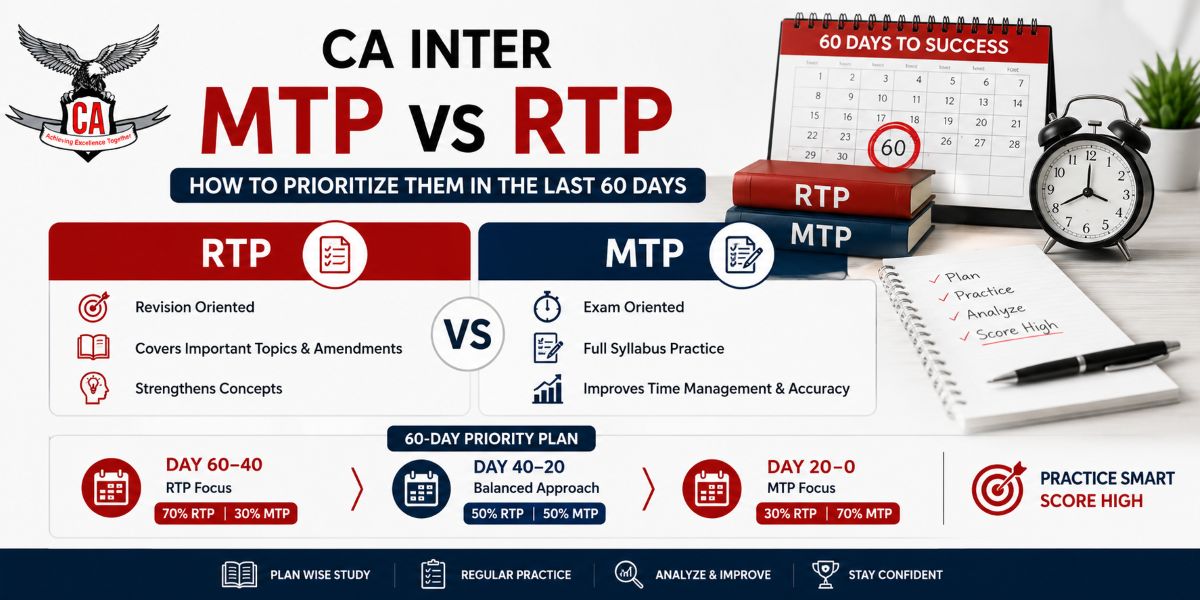
Days 60–40 Before Exam
At this stage:
- Complete pending syllabus areas.
- Focus heavily on RTPs.
- Revise concepts chapter-wise.
- Understand amendments thoroughly.
Suggested Allocation:
- RTP: 70%
- MTP: 30%
The primary objective during this phase is strengthening concepts.
Days 40–20 Before Exam
Now preparation should become more balanced.
Students should:
- Continue RTP revision.
- Begin regular MTP practice.
- Identify weak subjects.
- Improve answer writing.
Suggested Allocation:
- RTP: 50%
- MTP: 50%
This phase connects revision with practical application.
Final 20 Days Before Exam
At this stage, exam simulation becomes increasingly important.
Students should:
- Attempt full-length MTPs.
- Practice under timed conditions.
- Analyze mistakes.
- Use RTPs only for targeted revision.
Suggested Allocation:
- RTP: 30%
- MTP: 70%
The focus shifts from learning concepts to executing them effectively.
Subject-Wise RTP and MTP Strategy
Different subjects require different approaches.
Advanced Accounting
Focus on:
- RTP adjustments
- Practical illustrations
- Full-length MTP solving
Taxation
Pay special attention to:
- Amendments
- Updated provisions
- RTP practice questions
Taxation RTPs are often extremely valuable because of frequent changes.
Corporate and Other Laws
RTPs help with:
- Amendments
- Updated legal provisions
MTPs help improve:
- Answer presentation
- Time management
Cost and Management Accounting
Use MTPs extensively.
The subject requires speed and accuracy under exam conditions.
Auditing and Ethics
Combine:
- RTP conceptual revision
- MTP answer-writing practice
Financial Management and Strategic Management
Practice MTPs regularly while using RTPs to revise important concepts and updates.
How to Analyze MTP Performance
Solving a mock test is only half the process.
Analysis is equally important.
After every MTP, review:
- Incorrect answers
- Time-consuming questions
- Presentation mistakes
- Weak chapters
- Frequently repeated errors
Many students improve dramatically after analyzing mistakes instead of simply attempting more papers.
Where Mock Tests Add the Most Value
Students often ask whether self-created mock tests are enough.
While self-practice is valuable, structured mock testing can provide additional insights.
Many CA Intermediate students use platforms such as CATestSeries.org for chapter-wise assessments and full-length mock examinations because they help evaluate performance, identify weak areas, and improve exam readiness under realistic conditions.
The key advantage is not just solving questions but receiving feedback that guides future preparation.
Final 7-Day Strategy
During the final week:
- Revise RTP notes.
- Focus on amendments.
- Attempt selected MTPs.
- Avoid learning entirely new topics.
- Prioritize confidence and retention.
The final week should be about strengthening existing knowledge rather than expanding it.
Final Thoughts
The debate between RTPs and MTPs is not about choosing one over the other.
Both serve different but equally important purposes.
RTPs help you understand what to revise.
MTPs help you prove that you can apply what you revised.
In the final 60 days before the CA Inter examination, students should gradually shift from RTP-focused preparation to MTP-focused exam simulation. This balanced approach improves conceptual understanding, time management, confidence, and ultimately examination performance.
The smartest strategy is not RTP versus MTP.
It is knowing when to prioritize each one.
Frequently Asked Questions
Are RTPs more important than MTPs?
Both are important. RTPs strengthen concepts and amendments, while MTPs improve exam performance and time management.
How many MTPs should I solve before CA Inter exams?
Most students benefit from attempting at least 4–6 full-length MTPs per subject before the examination.
Should I solve old RTPs?
Yes. Older RTPs can still help with conceptual revision, though the latest RTP should receive the highest priority.
Are amendments covered only in RTPs?
RTPs are one of the best sources for recent amendments, particularly in Taxation and Law subjects.
When should I start solving MTPs?
Ideally, start regular MTP practice around 40 days before the examination after completing most of your syllabus revision.
Can I clear CA Inter by studying only RTPs?
RTPs alone are not enough. Students should combine RTP revision with MTP practice for complete preparation.
What should I do if my MTP scores are low?
Analyze mistakes, identify weak chapters, revise them thoroughly, and attempt another mock test. Low mock scores are opportunities to improve before the actual exam.