CA Inter Costing (Paper 4): Syllabus, Weightage & 10-Day Plan
Cost and Management Accounting is an important subject of the CA Inter Group II syllabus. This is an application-oriented and conceptual subject which enables students to know how costs are computed, classified, and controlled and how to make decisions.
CA Inter Cost and Management Accounting: Lecture notes, PDF and chart notes
In the beginning, Cost and Management Accounting might appear tough to students because of the formulae, computations, concepts and practicals involved in the subject. However, this subject can be easier for students to understand with an appropriate study strategy.
What Is Cost and Management Accounting?
Cost and Management Accounting involve the identification, categorisation, measurement, and analysis of costs. This field enables businesses to determine the cost of their goods and services and use cost information for planning, control, and decision-making.
Cost and Management Accounting is not all about memorising equations. You must understand the purpose of carrying out the calculation as well as the application of the information.
Paper 4 Course Structure at a Glance
Particulars | Details |
Course | |
Group | Group II |
Paper | Paper 4 |
Subject | |
Nature | Practical + Conceptual |
Total Chapters | 15 |
Modules | 2 |
Main Focus | Cost ascertainment, planning, control and decision-making |
This is particularly true in the study of Marginal Costing, where the student must understand the significance of the break-even point and its application. ICAI's current study material divides the syllabus into seven chapters in Module 1 and eight chapters in Module 2.
CA Inter Costing Syllabus: Chapter-Wise Breakdown
Cost and Management Accounting is Paper 4 of CA Intermediate Group II in the existing ICAI syllabus. The subject has two modules and has 15 chapters in total.
Chapters | Topic |
Chapter 1 | |
Chapter 2 | |
Chapter 3 | |
Chapter 4 | |
Chapter 5 | |
Chapter 6 | |
Chapter 7 |
Module 1 builds the foundation of Cost and Management Accounting. Students should focus on understanding the basic concepts before moving towards more advanced costing techniques.
Module 2 | |
Chapter 8 | |
Chapter 9 | |
Chapter 10 | |
Chapter 11 | |
Chapter 12 | |
Chapter 13 | |
Chapter 14 | |
Chapter 15 | |
Marginal Costing (Chapter 14) deserves special attention here: it's where students most often lose marks by memorising the marginal costing formula without understanding the logic of the break-even point and how it drives pricing and product-mix decisions.
Costing – Is it Scoring in CA Inter? Chapter Weightage
Yes, Costing can be a fairly scoring paper among the Group II subjects, provided that you focus on the right areas. According to the latest trends, the Tier 1 chapters are:
Marginal Costing
Material Cost
Employee Cost (Labour Cost)
Activity-Based Costing
Standard Costing
Budgets and Budgetary Control
These are the ones you need to cover in case you have less revision time, as they tend to appear in all attempts.
How to Study Costing: Concept Visualisation, Chart Notes & MCQs
The largest factor responsible for difficulties faced by students in CA Intermediate is rote learning of concepts without comprehending them. Concept visualisation lectures address this problem with:
Concept animations
Flow diagrams
Real-life examples
Visualisation-based explanations
Examples
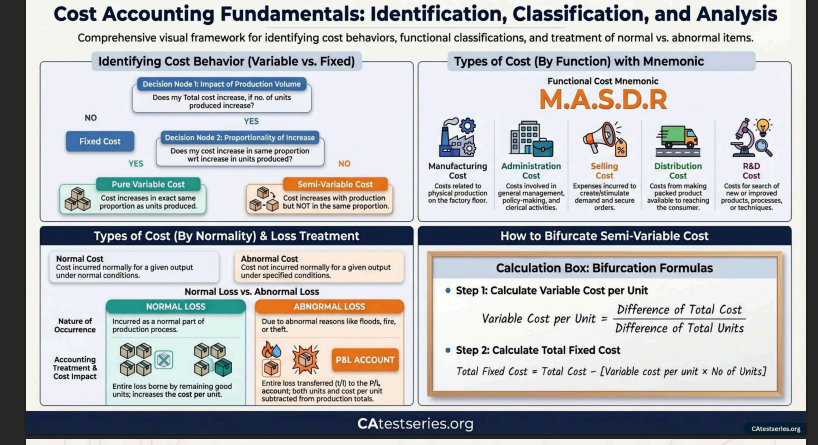
Students do not just learn the definitions of concepts but learn the reason behind their functioning.
Why are chart notes important?
Chart notes are very helpful for students for revision before the exam. These chart notes include brief points on topics covered in the lectures. These notes save students time for revision before the exam.
The following are the benefits of using chart notes:
To make a short concept
Make a quick revision
Easy learning and remembering.
It also includes flowcharts.
Learn through the diagram.
There is a 10-day revision chart for the students that helps in quick revision for the subject at the time of the exam.
CA Inter Cost & Management Accounting MCQ Question Bank
It is a test-based practice material which has been prepared especially for the CA Intermediate Cost and Management Accounting paper. It consists of a series of multiple-choice questions based on the important concepts and topics of the subject, along with detailed reasoning and explanation.
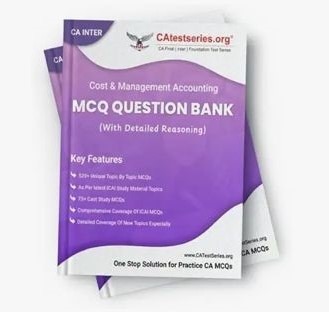
This book would be quite useful for those who need to prepare themselves using MCQ practice on a regular basis and revise the important concepts for the examination.
CA Inter Costing 10-Day Revision Plan (Day by Day)
A well-structured study planner can make CA Inter Cost and Management Accounting easier to manage, especially when you have to balance concept learning, practical question-solving, revision and tests. Instead of simply watching lectures one after another, divide each study session into Concept Understanding → Visualisation → Problem Solving → Homework → Revision → Testing.
Use the following 10-day planner to cover the syllabus systematically and identify weak areas before the examination.
Day | Chapters / Topics | What to Do |
Day 1 | Chapter 1: Introduction + Chapter 2: Material Cost | Revise basic concepts, formulas and important methods. Solve practical questions and prepare quick revision notes. |
Day 2 | Chapter 3: Employee Cost & Direct Expenses + Chapter 4: Overheads | Understand the concepts and methods. Practise important numerical questions and complete assigned homework. |
Day 3 | Chapter 5: Activity-Based Costing + Chapter 6: Cost Sheet | Focus on the logic behind calculations. Solve standard and exam-oriented questions and revise key formats. |
Day 4 | Chapter 7: Cost Accounting Systems + Revision of Module 1 | Complete Chapter 7 and revise Chapters 1–6. Solve selected questions without looking at the solution. |
Day 5 | Chapter 8: Unit & Batch Costing + Chapter 9: Job Costing | Understand the costing procedure and practise practical problems. Note down common mistakes and time-consuming questions. |
Day 6 | Chapter 10: Process & Operation Costing + Chapter 11: Joint Products & By-Products | Focus on problem-solving and application. Revise important concepts and practise exam-style questions. |
Day 7 | Chapter 12: Service Costing + Chapter 13: Standard Costing | Practise important numerical questions and revise formulas, variances and concepts. |
Day 8 | Chapter 14: Marginal Costing | Give special attention to break-even analysis, contribution, P/V ratio and decision-making applications. Practise multiple problems. |
Day 9 | Chapter 15: Budgets & Budgetary Control + Full Syllabus Revision | Revise budgeting concepts and solve practical questions. Quickly revise important formulas, formats and concepts from all chapters. |
Day 10 | Mock Test + Mistake Analysis + Final Revision | Attempt a full-syllabus test in exam conditions. Analyse every mistake, revise weak topics and review important formulas and concepts. |
How to Use This Planner Effectively
Do not treat the planner as a lecture-completion checklist. Each day's target should include learning as well as active practice.
Follow this routine for every chapter:
1. Understand the Concept → 2. Visualise the Concept → 3. Solve Questions → 4. Complete Homework → 5. Revise → 6. Take a Test → 7. Analyse Mistakes
While revising, use short chart notes and flowcharts to quickly recall important concepts. However, these should support your preparation rather than replace actual question-solving.
Best Faculty for CA Inter Costing: CA Himanshu Singla
A practising Chartered Accountant and one of the core academic mentors at CAtestseries.org, CA Himanshu Singla combines practical experience with teaching, bringing both hands-on costing knowledge and classroom expertise to every session. He has been mentoring CA aspirants with a practical, concept-driven, and examination-focused teaching methodology, helping thousands of students simplify Cost & Management Accounting through logical explanations, practical illustrations, and structured learning techniques.

Highlights:
Practising Chartered Accountant with an independent professional practice
Designs notes, question banks, and revision papers for the subject himself
Well-known for resolving doubts of students 24x7
Has guided thousands of students through structured performance tracking and mentoring since joining CATestSeries.org
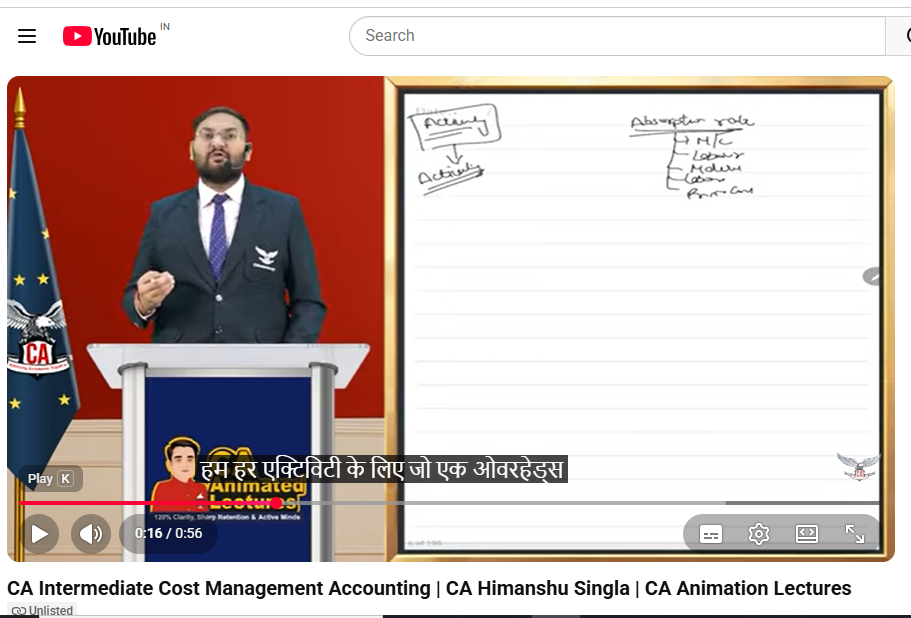
Watch CA Himanshu Singla Animated Lecture Session
CA Inter Test Series: Plans and Pricing
An effective test series enables you to progress beyond lectures and practice by assessing your preparation through chapter-wise and full-syllabus tests. This will help you find your errors, manage time effectively, and gain confidence for the exam. Selecting an appropriate test series will depend upon your level of preparation and other factors.
Test Series | Tests Included | Key Features | Starting Price |
Detailed Test Series | 5 Chapterwise + 1 Full Syllabus | Live Tests, Doubt Solving, Notes, Study Planner | ₹450 |
Individual Chapterwise (Recommended) | 1 Test/Chapter + 2 Full Tests | Live Tests, Doubt Solving, Notes, Study Planner | ₹825 |
Full Syllabus Test Series | 2 Full Tests/Subject | Live Tests, Doubt Solving, Notes, Study Planner | ₹300 |
Students can explore more CA Inter test series plans on CATestSeries.org.
Related CA Inter Papers
Cost and Management Accounting is one of six papers in the CA Intermediate curriculum. Students preparing for Paper 4 alongside the rest of Group II or Group I may also find these related papers useful:
Paper 1: Advanced Accounting (Group I)
Paper 2: Corporate and Other Laws (Group I)
Paper 3: Taxation (Group I)
Paper 5: Auditing and Ethics (Group II)
Paper 6: Financial Management and Strategic Management (Group II)
Dedicated syllabus and revision guides for each of these papers are available on CATestSeries.org.
Conclusion
Cost and Management Accounting CA Inter becomes a lot easier once you take the approach of solving a subject rather than formulae from it. The right process for preparation is never:
Lecture → Lecture → Next Chapte
It has to be concept clarity → Concept Visualisation → Problem Solving → Homework → Revision → Test → Mistake Correction.
While you can use faculty-created pictures, notes, QR charts, and strategy materials for interactive learning, these are supplementary tools, not substitutes for actual problem-solving. Above all, measure your preparation based on four criteria:
Understanding + Content and Books + Revision + Tests
Enrol now in the CA Inter Costing CAtestseries.org.