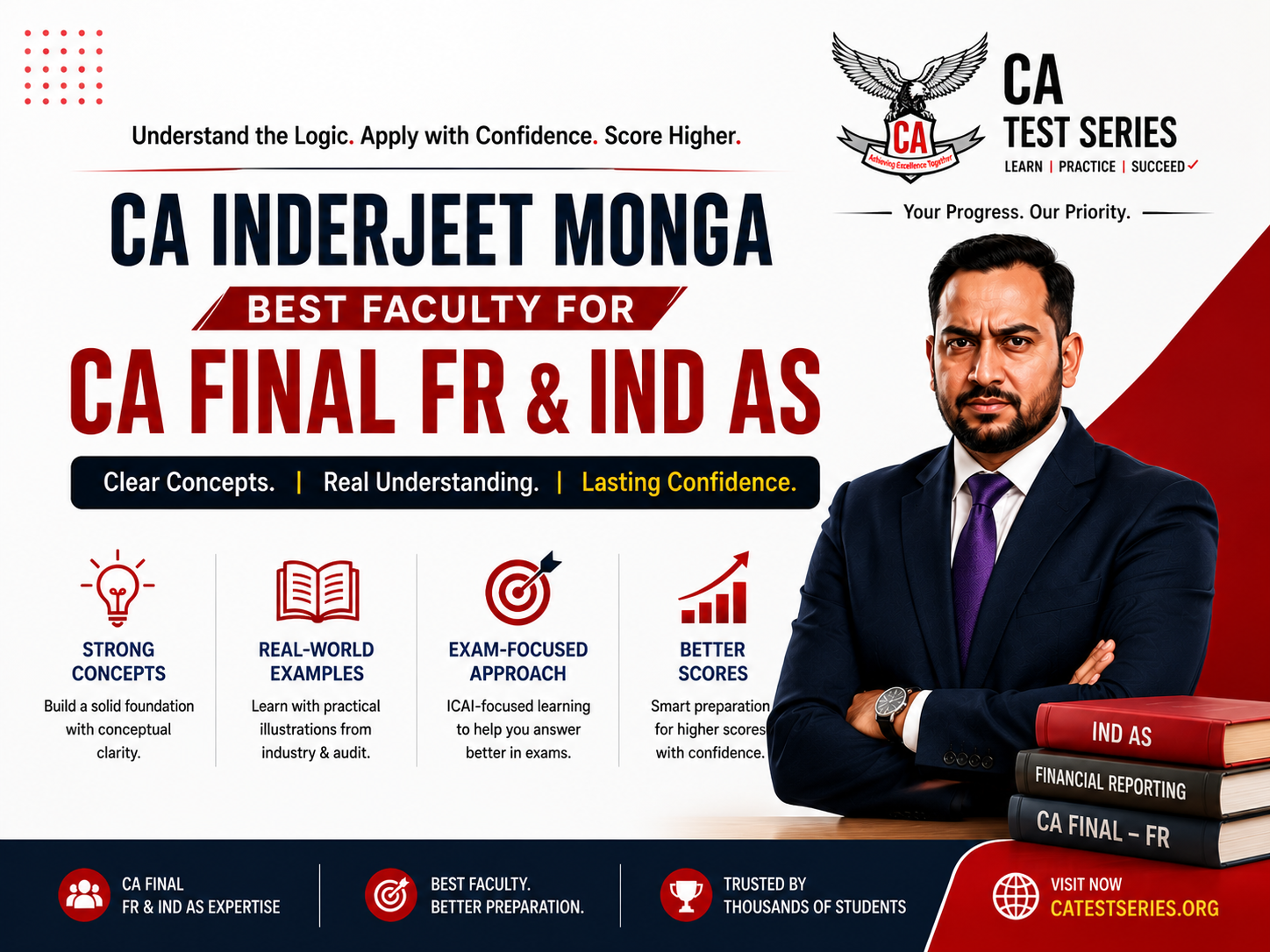
Choosing the right mentor for CA Final Financial Reporting (FR) and Ind AS can make the difference between a paper you dread and a paper you look forward to attempting. Among the names CA Final students discuss most often when searching for the best faculty for CA Final FR & Ind AS, CA Inderjeet Monga has built a reputation for turning one of the toughest papers in the CA Final curriculum into a subject students can actually understand, apply, and score well in.
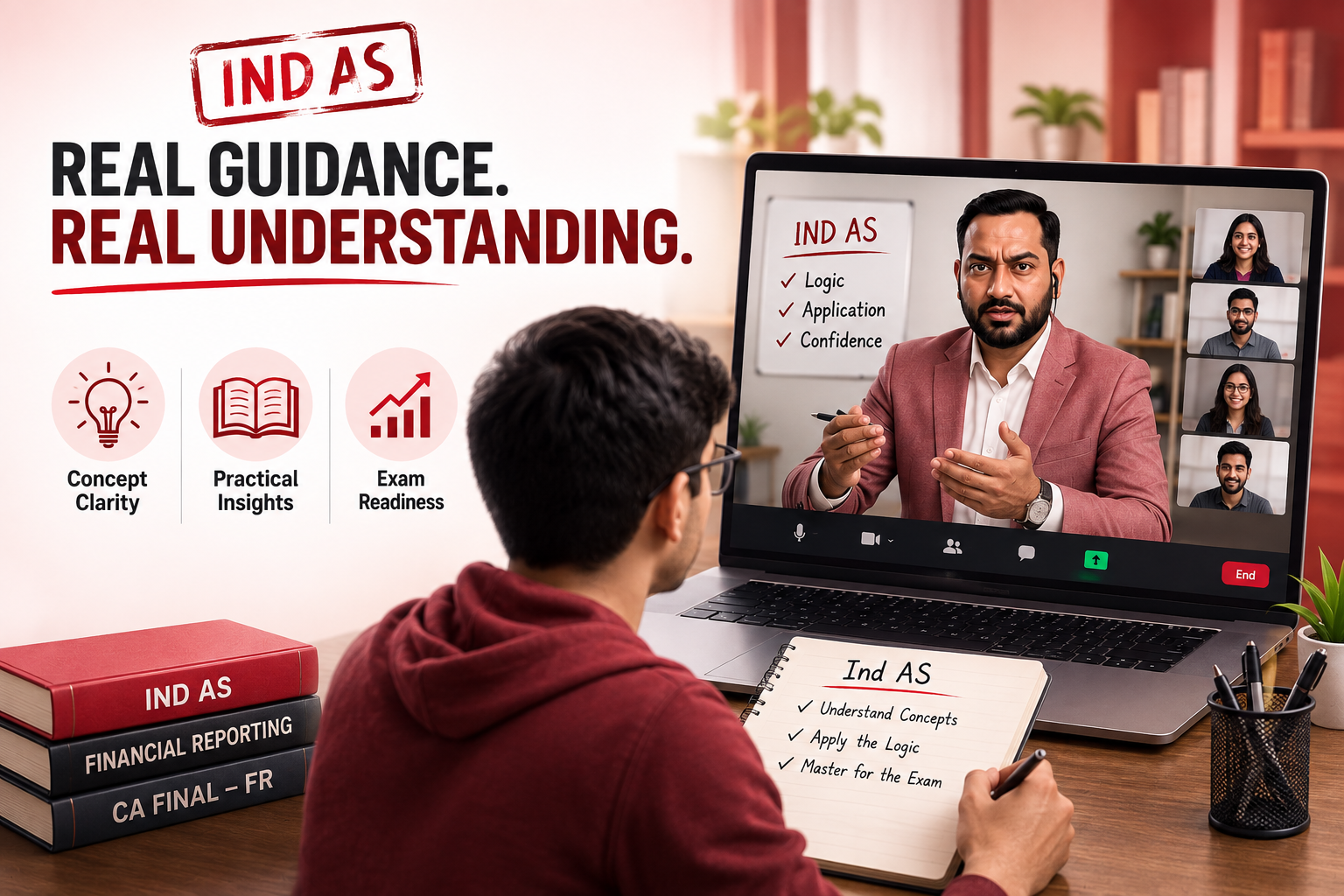
Why Ind AS Is a Game-Changer Paper in CA Final
Ask any CA Final student what keeps them up at night, and Ind AS will almost always come up in the conversation. It isn't just another chapter tucked inside Financial Reporting — it is, for most students, the single biggest reason FR feels overwhelming.
Here's why Ind AS carries so much weight:
It forms a substantial portion of the FR paper, and a weak grip on it can pull your overall score down significantly.
The standards are conceptually dense — consolidation, financial instruments, business combinations, and share-based payments are not topics you can memorise your way through.
ICAI's questions are increasingly practical and scenario-based, which means rote learning simply doesn't work anymore.
Many students carry forward gaps from their Intermediate-level accounting standards, which makes Ind AS at the Final level feel like starting from zero.
This is exactly where the right faculty changes the game. Ind AS preparation for CA Final isn't about reading the standard word for word — it's about understanding the logic behind each standard so that when ICAI twists a question, you can still reason your way to the answer. That is precisely the gap CA Inderjeet Monga's teaching fills.
Who Is CA Inderjeet Monga?
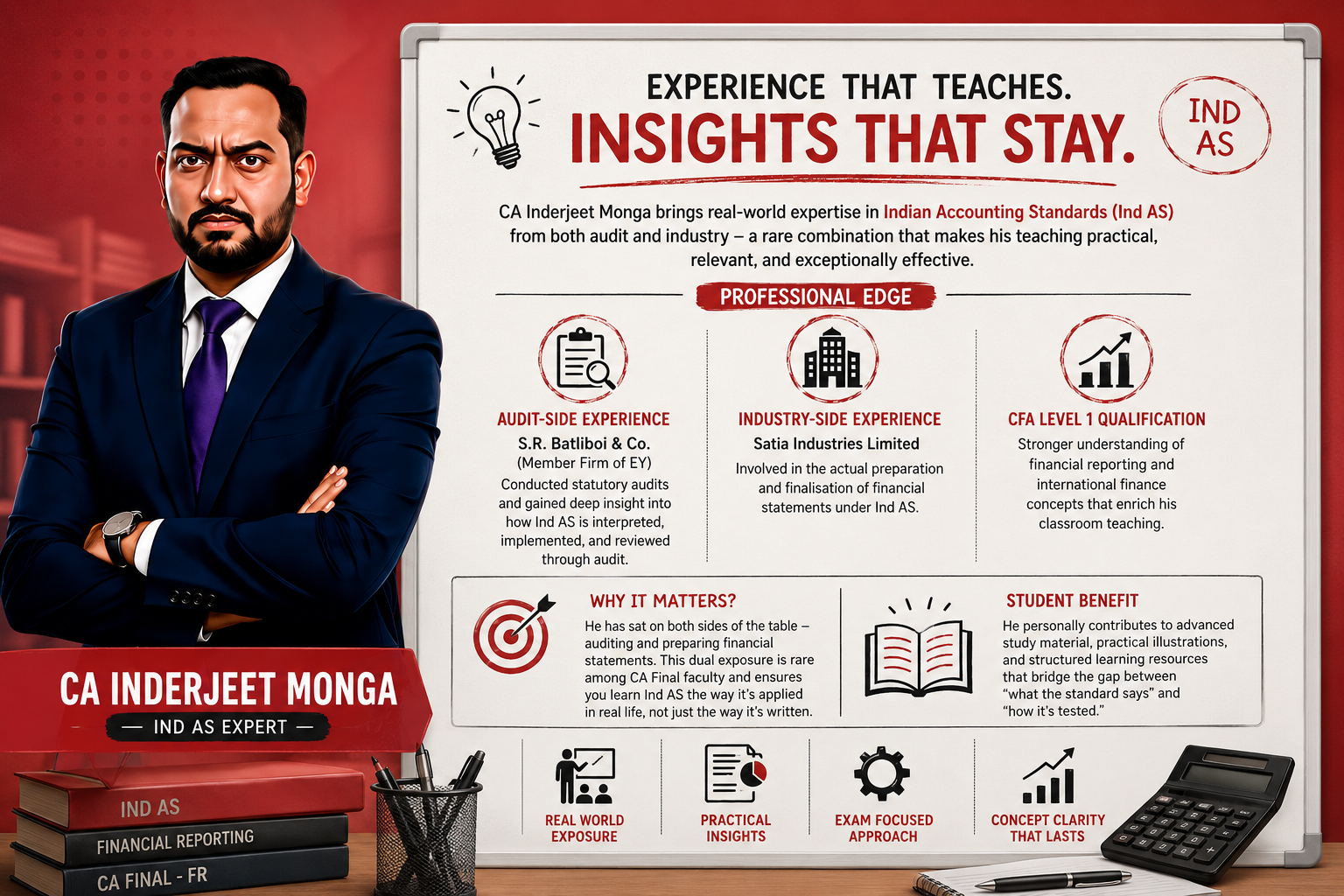
CA Inderjeet Monga is a faculty member specialising in Indian Accounting Standards (Ind AS), and what sets him apart from many other educators is the fact that his knowledge isn't purely academic — it comes from real, hands-on exposure to how Ind AS is applied inside actual companies.
His professional background includes:
Audit-side experience at S.R. Batliboi & Co. (which is a member firm of EY), where he carried out statutory audits and witnessed the way Ind AS is interpreted, implemented, and examined through audit review.
Industry-side experience at Satia Industries Limited, where he was involved in the actual preparation and finalisation of financial statements under Ind AS.
CFA Level 1 qualification, which has sharpened his understanding of financial reporting and international finance concepts — knowledge he brings directly into his classroom explanations.
This dual exposure — auditing financial statements on one side and preparing them on the other — is rare among CA Final faculty. Most educators teach Ind AS purely from a textbook or examination standpoint. CA Inderjeet Monga teaches it from the standpoint of someone who has actually sat across the table from auditors, defended accounting treatments, and prepared disclosures that go into real annual reports.
He personally contributes to the advanced study material, practical illustrations, and structured learning resources used by thousands of CA Final students preparing for the FR paper — resources built specifically to bridge the gap between "what the standard says" and "how it's tested."
His Teaching Approach to Ind AS
What consistently comes up in student feedback is that his classes don't feel like a reading of the bare act. Every standard is broken down, rebuilt with logic, and reinforced with examples until it sticks.
Standard-by-Standard Breakdown
Rather than treating Ind AS as one giant, intimidating block, CA Inderjeet Monga's method is to isolate each standard and build it up systematically:
Objective first — why does this standard exist, and what accounting problem is it solving?
Core recognition and measurement principles — explained in plain language before the technical terminology is introduced.
Exceptions and carve-outs — the areas ICAI loves to test, highlighted clearly rather than buried in a footnote.
Linkages between standards — for instance, how Ind AS 103 (Business Combinations) connects with Ind AS 110 (Consolidated Financial Statements) and Ind AS 28 (Investments in Associates and Joint Ventures).
This standard-by-standard structure means students aren't left trying to mentally stitch together fragmented notes closer to the exam — the connections are built in from day one.
Teaching Step | What It Covers | Why It Matters |
Objective | Why the standard exists and what problem it solves | Builds conceptual clarity before technical terms are introduced |
Recognition & Measurement | Core principles explained in plain language | Prevents rote memorisation of definitions |
Exceptions & Carve-Outs | Areas ICAI frequently tests | Reduces silly mistakes in exam scenarios |
Cross-Standard Linkages | How one Ind AS connects with related standards | Helps in combined, scenario-based questions |
Practical Illustrations & Real Company Examples
Because of his audit and industry background, he doesn't rely solely on textbook illustrations. He regularly brings in:
Real corporate scenarios that mirror how a standard actually plays out in a company's financial statements.
Practical adjustments and disclosures similar to what he encountered during his time at S.R. Batliboi & Co. and Satia Industries Limited.
Comparisons between how a concept "looks" on paper versus how it is actually applied when finalising accounts under audit pressure.
This is a crucial distinction for Ind AS preparation for CA Final. ICAI's exam pattern has moved firmly toward application-based and case-study questions, and students who've only memorised the standard often freeze when the facts are presented differently than expected. Students trained on real illustrations don't have that problem — they've already seen the standard "in action."
Which Students Benefit Most
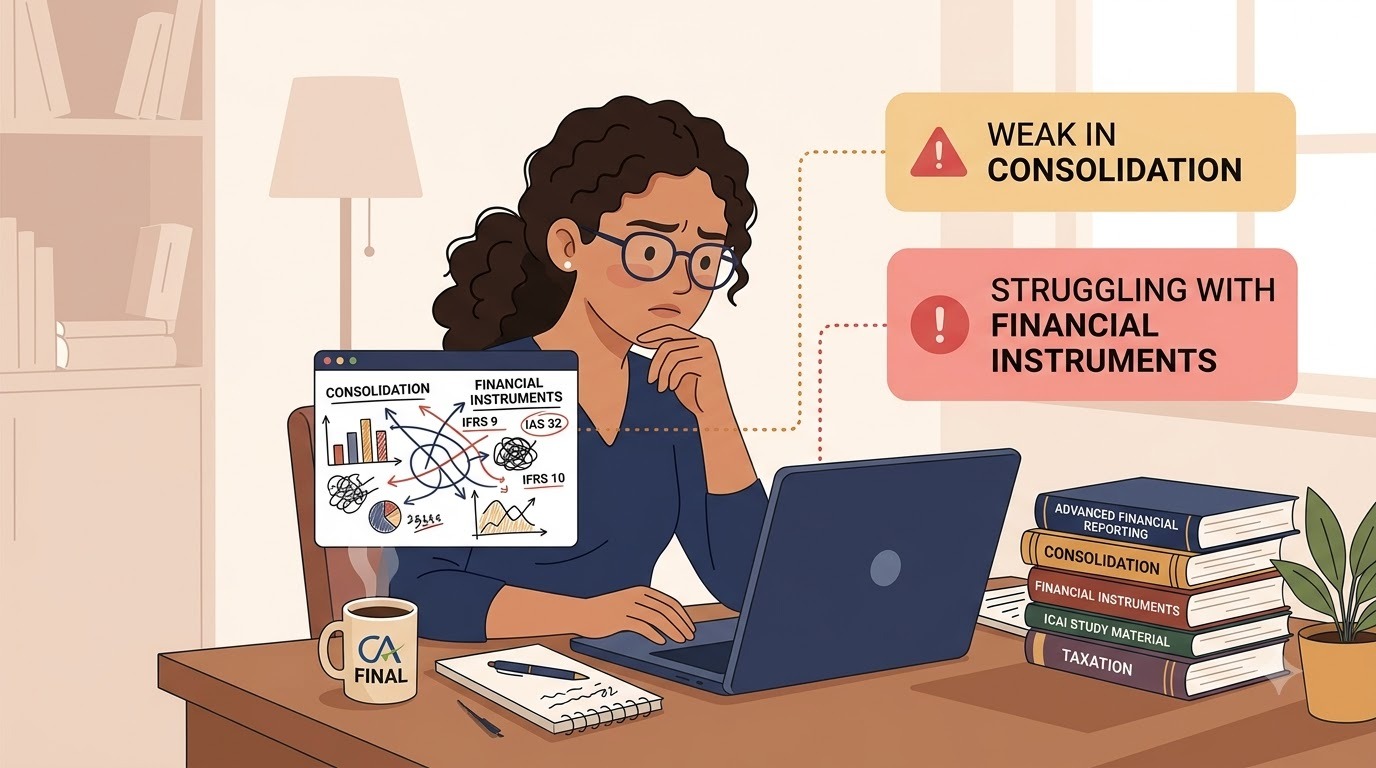
Not every student struggles with Ind AS for the same reason. Broadly, two categories of students see the most dramatic improvement from his classes.
Weak in Consolidation
Consolidation (Ind AS 110, Ind AS 103, Ind AS 28) is consistently ranked among the most feared topics in CA Final FR. Students in this category typically:
Get lost in the sheer number of adjustments — goodwill, non-controlling interest, elimination of intra-group transactions, fair value adjustments.
Face difficulty in remembering the sequence of each step required to arrive at consolidated figures.
Fall apart the moment a question introduces a step acquisition or a partial disposal.
His approach of breaking consolidation into a fixed, repeatable working format — rather than a set of loosely connected adjustments — is particularly effective for this group. Once the format is internalised, students find that even unfamiliar variations of consolidation questions become manageable.
Struggling with Financial Instruments
Financial Instruments (Ind AS 32, 109, 107) is the other major pain point. Students here usually:
Find the classification criteria (amortised cost, FVTOCI, FVTPL) confusing.
Struggle with effective interest rate calculations and impairment under the expected credit loss model.
Get overwhelmed by embedded derivatives and hedge accounting.
Because he has seen how financial instruments are actually classified and reported in real financial statements, he's able to simplify these classification rules into decision-tree style thinking rather than abstract definitions — making it far easier for students to apply the right treatment under exam pressure.
Student Profile | Common Struggles | How His Approach Helps |
Weak in Consolidation | Too many adjustments, unclear sequence, step acquisitions and partial disposals cause confusion | Fixed, repeatable working format for consolidation that adapts to unfamiliar variations |
Struggling with Financial Instruments | Confusing classification criteria, EIR calculations, impairment under ECL model | Decision-tree style classification based on real-world application |
New to Ind AS at Final level | No strong base from Intermediate accounting standards | Ground-up, standard-by-standard rebuilding of concepts |
Weak in application-based questions | Freezes when ICAI changes the fact pattern | Practical, real-company illustrations that train pattern recognition |
Beyond these two groups, students who are simply new to Ind AS at the Final level, or those who cleared Intermediate accounting standards without a strong conceptual base, also benefit significantly from his structured, ground-up teaching style.
Key Ind AS Topics He's Known For
While his teaching covers the full Ind AS syllabus for CA Final, certain topics stand out as areas where his industry-audit dual perspective adds the most value:
Ind AS | Topic | Why It's Critical |
Ind AS 115 | Revenue from Contracts with Customers | Frequently tested with scenario-based questions on performance obligations and timing of revenue recognition |
Ind AS 116 | Leases | Requires clear understanding of lessee accounting, right-of-use assets, and lease liability measurement |
Ind AS 103 | Business Combinations | Core to consolidation questions; often combined with Ind AS 110 in the exam |
Ind AS 110 | Consolidated Financial Statements | One of the highest-weightage and most calculation-intensive areas of FR |
Ind AS 109 | Financial Instruments | Classification, measurement, and impairment concepts that trip up most students |
Ind AS 102 | Share-Based Payment | Conceptually tricky, especially around vesting conditions and modifications |
Ind AS 12 | Income Taxes | Deferred tax computations that are easy to get theoretically wrong |
Each of these is taught with the same underlying philosophy: understand the "why" before attempting the "how," and always connect the standard back to how it would actually appear in a set of financial statements.
Why CA Inderjeet Monga Is the Best Faculty for CA Final FR & Ind AS
Many students recommend CA Inderjeet Monga for learning Ind AS because he makes difficult topics easier to understand :
"Ind AS finally makes sense." Students often say that topics they had only memorised before became much easier when they learned the basic logic behind them. His simple explanations help students understand why a rule works instead of just memorising it.
Confidence in scenario-based questions. Because of the practical, real-company
approach, students report feeling far more prepared when ICAI presents a question in an unfamiliar format.
Better retention closer to exams. Concepts that are understood — not memorised — are naturally easier to recall during revision, which matters enormously for a paper as vast as FR.
Improved performance in consolidation and financial instruments specifically — the two areas most students flag as their weakest going in.
A structured, revision-friendly approach. His teaching doesn't just help in first reading; it translates well into an Ind AS revision strategy that students can rely on in the final weeks before the exam.
Feedback | What Students Say |
Conceptual clarity | Concepts memorised for years without real understanding finally "click" |
Exam confidence | Better prepared for scenario-based and unfamiliar question formats |
Retention | Concepts understood (not memorised) are easier to recall during revision |
Weak-area improvement | Noticeable gains specifically in consolidation and financial instruments |
Revision-friendly structure | Teaching translates well into a practical Ind AS revision strategy |
This consistent feedback is exactly why his name comes up repeatedly whenever students discuss the best faculty for CA Final FR / Ind AS.
Explore Our Ind AS Study Notes & Test Series
If you're serious about mastering Ind AS for CA Final, don't stop at concept clarity — back it up with structured practice.
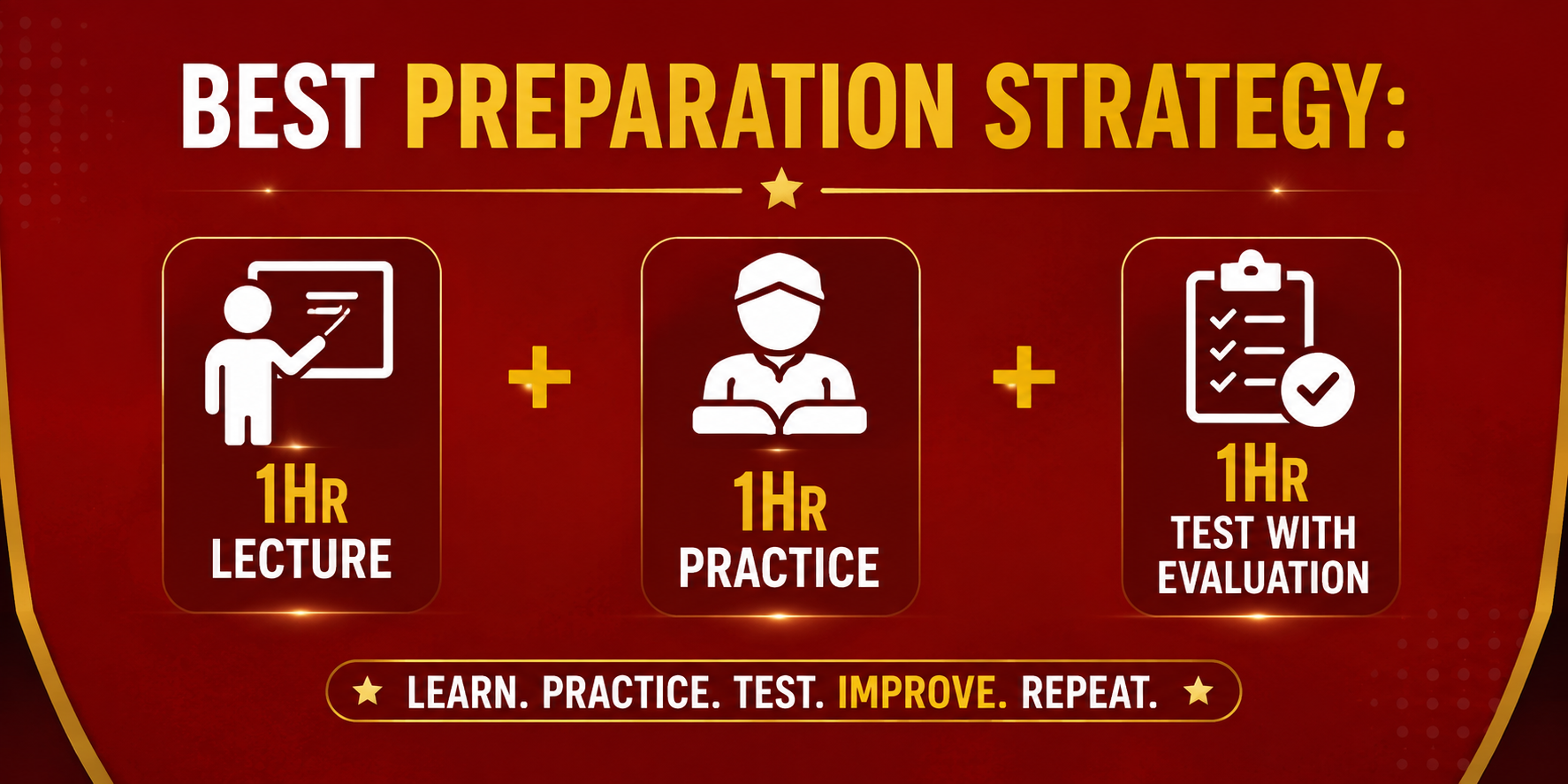
Explore our Ind AS classes for CA Final.
Premium Ind AS study notes and a CA Final Ind AS test series built to mirror ICAI's latest exam pattern, covering every standard with practical illustrations, past paper analysis, and revision-ready summaries. Visit CATestSeries.org today to strengthen your Ind AS preparation for CA Final and get exam-ready with confidence.
Free Demo Lectures by CA Inderjeet Monga (Coming Soon)
Want to experience his teaching style before you commit? Free demo lectures covering key Ind AS topics will be available soon — giving you a first-hand look at his standard-by-standard, example-driven approach before you enroll.
Stay tuned — demo lecture access will be updated here shortly.
Conclusion — Next Steps for Ind AS Preparation
Ind AS doesn't have to be the paper that decides whether you clear CA Final or not — and choosing the best faculty for CA Final FR & Ind AS is the first step. With the right guidance — one that combines conceptual clarity, real-world application, and a structured revision approach — it can actually become one of your strongest scoring areas.
The unique combination of the audit and industry perspective of CA Inderjeet Monga, along with his CFA Level 1 certification, provides an opportunity for students to learn Ind AS through an application-based perspective that is not easily found elsewhere. Whether it be consolidation, financial instruments, or any other Ind AS topic, his approach to teaching Ind AS by standard ensures that you'll be exam-ready.
The next step is simple: pair this conceptual clarity with consistent practice. Concepts alone don't win marks — application under exam conditions does.