
"Quantitative Aptitude does not depend on memorising formulas but rather on comprehending and practising them."
Quantitative Aptitude may be a scary thought for some students preparing for their CA Foundation exam. Quantitative Aptitude is not all about remembering the formulas and solving lots of sums. It is rather an amalgamation of comprehension, visualisation, practice, revision, and testing.
CA Foundation Quantitative Aptitude: Free Lectures, Notes & Useful Tips
The third paper of CA Foundation is Quantitative Aptitude, having three main heads, namely: Business Mathematics, Logical Reasoning & Statistics. The syllabus from the May 2026 examination onwards comprises a total of 17 chapters falling into these three heads.
Therefore, the proper strategy here would not be just reading all the chapters. Instead, what should be done is a learning process incorporating all five elements simultaneously.
CA Quantitative Aptitude Structure and Syllabus
The right approach is not necessarily doing one chapter after another. The important thing is the process of active learning, wherein all five components – comprehension, visualisation, practice, revision, and test – come together, rather than as distinct activities to be done individually.
Exam Pattern & Marks Distribution
Section | No. of Chapters | Marks | Approx. Weightage |
Business Mathematics | 8 | 40 | 40% |
Logical Reasoning | 4 | 20 | 20% |
Statistics | 5 | 40 | 40% |
Total | 17 | 100 | 100% |
Guessing can lead to poor scores due to the negative marking scheme. Therefore, candidates should concentrate on comprehending the questions and answering them wisely.
The Four-Stage Cycle for Quantitative Aptitude Preparation
Rather than evaluating their preparation by how many chapters they have completed, students should evaluate themselves using a four-stage cycle. Understanding → Practice → Revision → Testing. The exact number of repetitions in each stage will depend on the chapter difficulty and the type of questions involved.
Stage | What You Should Do | Completion Target |
Understanding | Watch lecture + make notes | 100% |
Practice | Solve examples + questions | 80–100 questions per chapter |
Revision | Revise formulas and concepts | 2–3 rounds |
Testing | Chapter and sectional tests | 2–3 tests |
Consistently following the cycle will help ensure that students do not fall into the frequent trap of saying, “I have finished the chapter,” after watching the video lecture.
What Are the Sections in Quantitative Aptitude
This paper not only tests the ability to calculate; it also requires the student to comprehend the concept behind the calculations.
Section | Major Topics |
Ratio & Proportion, Indices, Logarithms, Equations, Linear Inequalities, Mathematics of Finance, Permutations & Combinations, Sequence & Series. | |
Number Series, Coding-Decoding, Odd Man Out, Direction Sense, Seating Arrangements, Blood Relations | |
Statistical Description of Data, Sampling, Central Tendency, Dispersion, Probability, Theoretical Distributions, Correlation & Regression |
There are eight chapters in Business Mathematics, four in Logical Reasoning and five in Statistics in the current ICAI study material.
Why Do Students Find CA Foundation Quantitative Aptitude Difficult?
It is not that students do not know how to do mathematics. It is how they study it that creates problems for students. Even after attending a two-hour lecture, a student might think they have understood the chapter. But when faced with a new question on the test, the students do not have a clue about the formula and concept. This happens because of passive learning.
Attending lectures alone will not help. The entire process of learning must be an active one where the students have to ask themselves which are given below:
What is the concept behind this question?
Why am I using this formula?
Can I visualise this problem?
Can I solve another such problem without checking the solution?
Can I describe this concept in my own words?
How Much Time Should You Spend on CA Foundation Quantitative Aptitude?
It is a common error among students to allocate many hours just to watch lectures. However, a better way is to allocate your study time to studying, practising, revising, and testing yourself.
Activity | Recommended Time | Main Objective |
Faculty Lecture | 1–2 hours | Understand concepts |
Concept Revision | 30–45 minutes | Recall formulas and methods |
Practice Questions | 60–90 minutes | Develop problem-solving ability |
Homework | 30–60 minutes | Independent practice |
Mistake Analysis | 15–30 minutes | Identify weak areas |
Test Practice | 30–60 minutes | Improve speed and accuracy |
For example, if you dedicate 2 hours to watching a lecture, try to solve questions on the same topic for 1–2 more hours.
Best Way to Prepare for Foundation Quantitative Aptitude
An effective strategy for preparation is discussed in the following manner:
1. Attend Lectures and Concentrate on Understanding the Concepts
The process of attending lectures should not be perceived as something to be ticked off the list. Make sure you pay attention to the faculty's explanations, ways of solving the problem, formulas, shortcuts, errors, and other useful information.
2. Use Faculty Notes and Strategy Charts to Help Yourself
It is possible to use notes, QR charts, and other strategic information to structure the information provided in the chapter, but not to substitute it.

Faculty explanations, notes, QR charts and strategy charts can be helpful for students to understand different components of the chapter. But these resources must not replace real problem-solving.
3. Use Concept Visualisation in Learning Mathematics
This is one of the best methods: instead of rewriting a concept again, visualise it. Turning a concept into something visible helps in remembering.
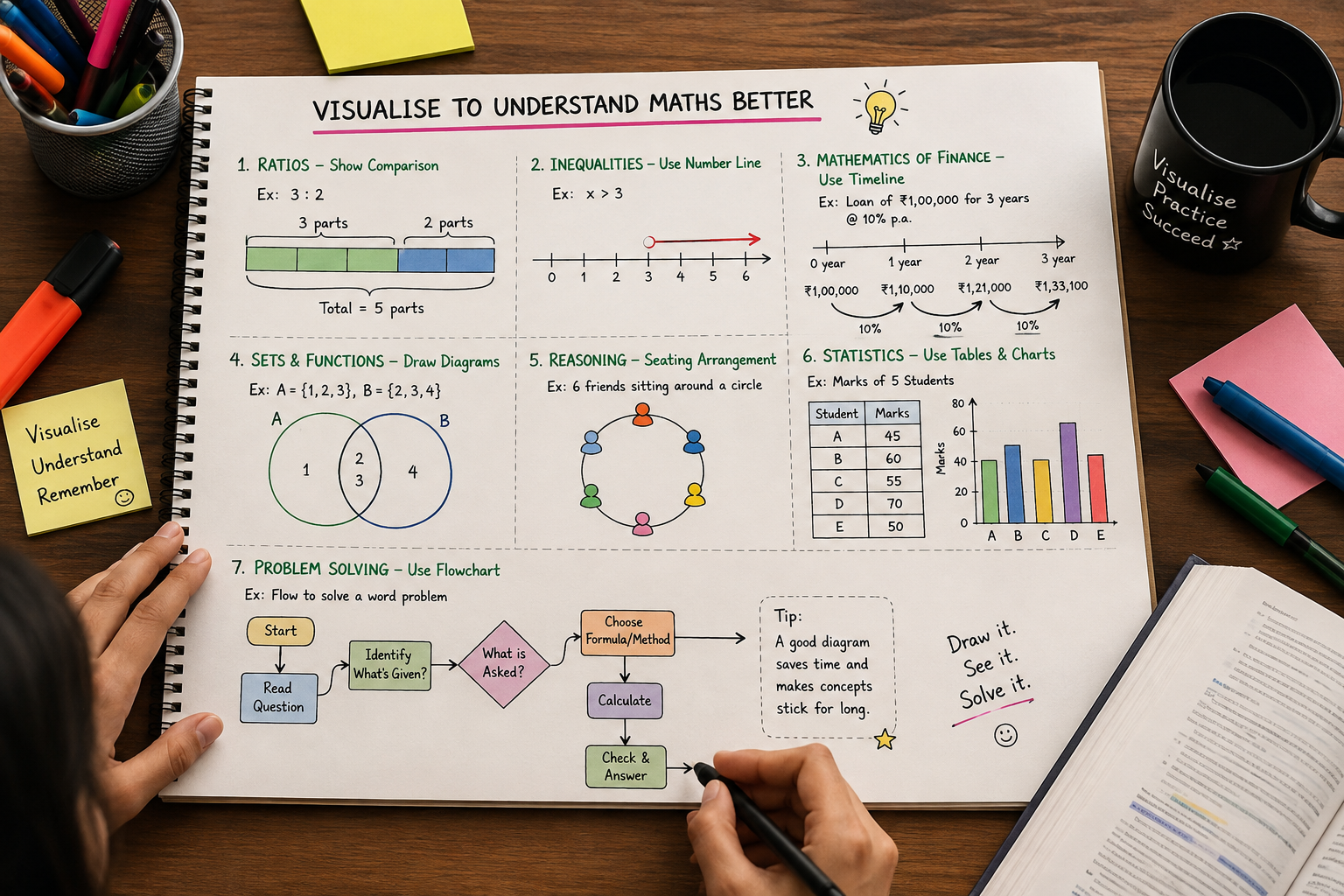
Some examples would be:
Representing ratios by means of comparisons
Representing inequalities through number lines
Using timelines when learning Mathematics of Finance
Using diagrams for sets and functions
Drawing seating plans for reasoning
Using tables and charts when learning statistics
Creating flowcharts for step-by-step procedures
4. Practice Often to Improve Your Concepts
Once you learn a concept, practice will reinforce that knowledge. Do not move on to answer keys directly — remember this order:
Concept → Worked Example → Practice Questions → Assignment → Test
Before looking into solutions, make sure to ask yourself:
What information do we have?
What does the question want from us?
Which concept can be applied in this question?
Which formula should we use?
Where am I going wrong?
The preparation advice provided by ICAI focuses on reading a question thoroughly and planning it according to the official ICAI material before answering it.
How Many Questions Should You Solve Daily?
This cannot be determined with certainty because different students have their own capabilities and requirements. But then, one may structure the question attempts in a particular format.
Preparation Level | Daily Questions | Focus |
Beginner | 20–30 | Concept clarity |
Intermediate | 30–50 | Accuracy + variety |
Advanced | 50–70 | Speed + exam-level practice |
Revision Phase | 40–60 | Mixed questions + weak areas |
Instead of attempting 100 easy questions, it would be better to attempt 40–50 questions on varying concepts.
Why Should You Not Skip Homework?
Homework is not simply another piece of work assigned by the faculty. Homework becomes the link between learning and problem-solving. While in class, the faculty is leading you. While doing homework, you are expected to solve the problem on your own.
This distinction is very critical. If you manage to solve a problem only when the faculty is discussing it, then it seems like the idea has not been mastered yet.
So, do homework at the end of each class or each chapter.
How Mentoring Can Help You Identify Your Weaknesses
The next important point could be mentoring. There may be cases when students know some weaknesses but do not know what specifically to improve. For example, the list of such cases could include:
Making mistakes in calculations
Not remembering the formulas
Choosing the incorrect formulas
Interpreting the questions incorrectly
Taking too long to perform tasks
Mistakes in one particular chapter
Keep a notebook of your errors and check the mistakes during revision.
Common Mistakes to Avoid in Quantative Aptitude
One of the most common mistakes students make is concentrating only on remembering formulae and not comprehending what they really mean. Other problems include not practising regularly, not managing time, and not learning from mistakes made in exams.
Just Listening to Lectures: Watching lectures does not necessarily mean completing preparation.
Learning Without Comprehension: Learning without understanding makes unfamiliar problems hard to solve.
Neglecting Homework: Learning is not easy without homework.
Refraining from Taking Tests: Some students wait until they have completed the whole syllabus before taking a test.
Lack of Mistake Analysis: Tests without mistake analysis are meaningless.
Reading Too Many Resources: Different resources can be confusing and may lead to incomplete revision.
No Revision: What you learn today may be forgotten within a few weeks.
Solving Only Easy Problems: Preparing for exams should involve solving different types of questions.
How to Track Your Progress in Quantative Aptitude
Instead of marking "Chapter Completed", keep a progress tracker. For each chapter, maintain a tracker.
Chapters | Understanding | Practice | Revision | Test |
Ratio & Proportion | ✓ | ✓ | ✓ | ✓ |
Equations | ✓ | ✓ | — | — |
Mathematics of Finance | ✓ | ✓ | ✓ | — |
Probability | ✓ | ✓ | — | — |
Conclusion
Quantitative aptitude for the CA Foundation is not a topic to be prepared with just formulas and by randomly attempting questions. What really matters is to develop an entire learning process.
The initial step would be faculty lectures and taking proper notes, then understanding the concept and visualising the topic to make things simple. Next come practising questions, solving assignments, mentorship, and taking test series to evaluate yourself.
Above all, assess your preparation on four factors such as Understanding, Practice, Revision and Test Performance.