The Chartered Accountancy Foundation examination is the first step toward becoming a Chartered Accountant in India. Conducted by the Institute of Chartered Accountants of India, the CA Foundation exam attracts lakhs of students every year from commerce and non-commerce backgrounds. Because of its competitive structure and strict evaluation standards, the pass percentage remains one of the most discussed topics among CA aspirants.
Understanding the CA Foundation Exam and Its Competitive Nature
The CA Foundation exam is designed to test conceptual clarity, analytical ability, and discipline. Many students enter the course believing it is similar to regular school-level commerce studies, but they quickly realize that the exam demands a much deeper understanding of accounting principles, law concepts, mathematics, and logical reasoning.
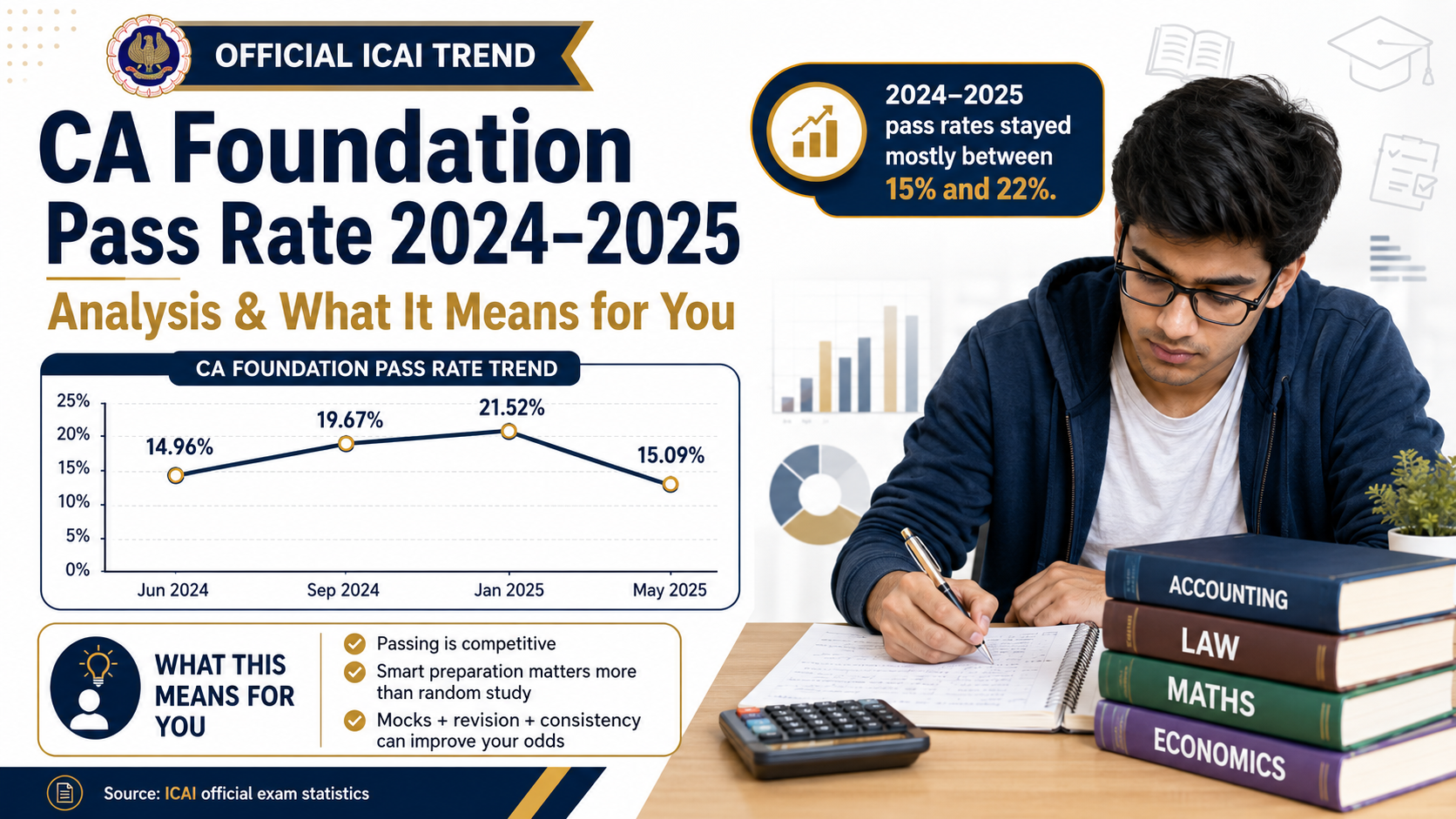
The 2024–2025 pass rate trends have created major discussions among students, coaching institutes, and education experts. Some attempts recorded lower success percentages, while others showed moderate improvement. These changing results reveal important insights about preparation strategies, student behavior, exam difficulty, and future expectations.
Understanding these pass rate trends is important because they help students estimate the level of competition and prepare more strategically instead of emotionally.
CA Foundation Pass Rate Trends in 2024–2025
The CA Foundation examination is conducted multiple times a year, and each session shows different performance statistics. In the 2024–2025 period, the overall pass rate fluctuated between moderate and low ranges compared to earlier years.
Several attempts recorded pass percentages below expectations, proving that ICAI continues to maintain strict standards. Although many students considered certain papers easier, the evaluation pattern and conceptual testing reduced the number of successful candidates.
A noticeable trend during this period was the difference between prepared candidates and casual aspirants. Students who relied only on coaching notes or last-minute revisions struggled more compared to those who practiced mock tests and conceptual learning consistently.
The overall pass trend also indicates that:
- Competition is increasing rapidly
- Students are registering in larger numbers
- Conceptual papers are becoming tougher
- Time management is playing a bigger role
- Negative marking in objective papers affects scores significantly
For serious aspirants, these trends are not meant to create fear. Instead, they highlight the importance of smart preparation and exam discipline.
Why CA Foundation Pass Rates Remain Low
Many students wonder why the CA Foundation pass percentage remains relatively low despite the availability of coaching institutes, online classes, YouTube lectures, and test series. The answer lies in the examination itself.
The CA Foundation course tests more than theoretical knowledge. It evaluates whether students can apply concepts under pressure within a limited time.
One major reason behind lower pass rates is lack of consistency. Students often begin preparation with enthusiasm but lose momentum after a few weeks. Since the syllabus is vast, irregular study routines create major gaps before the examination.
Another important factor is poor practice. Subjects like Mathematics, Statistics, and Accounts require daily problem-solving. Reading theory alone cannot help students score well.
Common reasons students fail include:
- Ignoring mock tests
- Weak revision planning
- Overdependence on coaching material
- Fear of Mathematics
- Poor writing presentation in Law papers
- Lack of conceptual clarity
- Last-minute preparation
- Exam stress and time pressure
ICAI papers are also known for indirect questioning patterns. Even when students know the topic, they may struggle if they cannot interpret the question properly.
This is why disciplined students usually perform better than naturally intelligent but inconsistent candidates.
Subject-Wise Impact on Pass Percentage
Every CA Foundation subject contributes differently to the overall pass percentage. Some subjects are considered scoring, while others become major hurdles for students.
Principles and Practice of Accounting
Accounting is one of the highest-weight subjects and plays a decisive role in the result. Students with strong conceptual clarity in journal entries, rectification, final accounts, and partnership concepts usually score well.
However, students who practice fewer problems often lose marks due to calculation mistakes and presentation errors.
Business Laws
Law is a theory-heavy subject that requires precise writing and understanding of provisions. Many students read chapters repeatedly but fail because they cannot frame proper legal answers.
Presentation, keywords, and answer structure matter heavily in this paper.
Quantitative Aptitude
This paper combines Mathematics, Logical Reasoning, and Statistics. It creates fear among many students, especially non-commerce candidates.
Negative marking becomes a major issue here. Students attempting questions without confidence often lose marks unnecessarily.
Business Economics
Economics is generally considered manageable, but conceptual MCQs can still reduce scores if preparation is weak.
Students who understand practical applications and economic logic perform better than those relying only on memorization.
The combined performance across these subjects directly influences the overall pass percentage in every attempt.
How ICAI’s Exam Pattern Influences Results
The examination pattern itself has a strong impact on pass rates. ICAI continuously focuses on analytical and application-based learning rather than rote memorization.
The CA Foundation exam includes both subjective and objective papers. This structure creates a balanced but challenging assessment environment.
Students must manage:
- Conceptual understanding
- Speed and accuracy
- Writing quality
- MCQ precision
- Negative marking risks
- Time management
The objective papers especially influence the final result because even minor mistakes reduce total marks rapidly.
Another important factor is the minimum passing criteria. Students must:
- Score at least 40% in each subject
- Achieve 50% aggregate overall
This means even if a student performs exceptionally in three subjects, failing one paper can result in an unsuccessful attempt.
Many students lose confidence because of this strict structure, but it actually encourages balanced preparation across all subjects.
ICAI’s approach ensures that only disciplined and conceptually strong candidates move forward toward Intermediate-level studies.
What the 2024–2025 Pass Rate Means for Future Aspirants
The recent pass percentages send a clear message to future CA aspirants: preparation standards must improve.
The days when students could pass by studying only before exams are largely gone. The current CA Foundation pattern rewards consistency, conceptual learning, and practical application.
For future aspirants, the 2024–2025 trends indicate several important realities:
Competition Will Continue Increasing
Every year, more students register for the CA course due to strong career opportunities and professional respect associated with becoming a Chartered Accountant.
As registration numbers rise, competition naturally becomes tougher.
Smart Study Matters More Than Long Study Hours
Students now need efficient preparation strategies rather than simply studying for long hours without direction.
Focused revision, chapter-wise testing, and error analysis have become essential.
Test Series Are Becoming Extremely Important
Mock exams help students:
- Improve speed
- Understand ICAI patterns
- Reduce exam anxiety
- Identify weak areas
- Build writing discipline
Students who regularly attempt test series generally perform better than those studying passively.
Self-Discipline Is the Biggest Advantage
Many successful candidates in 2024–2025 followed strict daily schedules instead of depending entirely on coaching institutes.
Consistency remains the biggest success factor.
Effective Strategies to Beat the Low Pass Percentage
Although pass rates may appear intimidating, thousands of students still clear the examination every year. The difference usually lies in strategy and execution.
Students preparing for upcoming attempts should focus on practical preparation methods.
Build a Realistic Study Plan
A balanced study schedule should include:
- Daily concept revision
- Practice questions
- Mock tests
- Weekly analysis
- Short revision cycles
Unrealistic schedules often lead to burnout and inconsistency.
Focus on ICAI Study Material
ICAI questions are heavily aligned with official material. Students who ignore ICAI resources and depend only on shortcuts often struggle in actual exams.
Practice Writing Answers
Law and theory subjects require structured presentation. Writing practice improves clarity, confidence, and speed.
Avoid Selective Studying
Selective preparation is one of the biggest reasons students fail. ICAI frequently asks practical and unexpected questions from less-discussed topics.
Complete syllabus coverage is essential.
Strengthen Weak Subjects Early
Students afraid of Mathematics or Law should start those subjects first instead of postponing them until the final months.
Early improvement reduces exam pressure later.
Common Mistakes Students Make During Preparation
The low pass rate is not only about exam difficulty. Many students unknowingly repeat preparation mistakes that reduce their chances of success.
One major mistake is watching lectures continuously without solving practical questions. Passive learning creates false confidence.
Another common issue is excessive dependence on coaching institutes. Coaching can guide students, but personal revision and self-practice determine actual performance.
Students also make the mistake of comparing their preparation with others. This creates anxiety and reduces productivity.
Some additional mistakes include:
- Ignoring revision
- Studying without short notes
- Skipping mock tests
- Attempting too many books
- Focusing only on favorite subjects
- Poor sleep routine before exams
- Panic during difficult papers
Students who avoid these mistakes significantly improve their chances of clearing the exam.
The CA Foundation journey is less about perfection and more about consistency and adaptability.
Final Thoughts on CA Foundation Pass Rate 2024–2025
The CA Foundation pass rate for 2024–2025 reflects the evolving nature of professional education in India. The examination is becoming more analytical, disciplined, and application-oriented with every attempt.
While lower pass percentages may appear discouraging initially, they also create opportunities for serious and focused students. The exam does not demand extraordinary intelligence. Instead, it rewards consistency, planning, conceptual understanding, and disciplined execution.
Students who understand the exam pattern early, practice regularly, and stay emotionally balanced during preparation usually outperform others.
The most important thing to remember is that pass percentages do not decide an individual student’s future. They only represent overall statistics. Every attempt sees thousands of successful candidates who began with the same fears and uncertainties.
If you prepare strategically, revise consistently, and stay committed to the process, clearing the CA Foundation examination is absolutely achievable.