The CA Foundation exam is the first step toward becoming a Chartered Accountant. Every year, thousands of students appear for this examination, but only those who clearly understand the exam pattern can prepare effectively. Knowing the paper structure, marks distribution, exam duration, and passing criteria helps students build a smarter study strategy.
The CA Foundation Exam Pattern 2026, designed by the Institute of Chartered Accountants of India, tests students on accounting, law, mathematics, logical reasoning, economics, and business knowledge fundamentals. The examination contains both subjective and objective papers, making it important for students to focus on conceptual clarity, presentation, and accuracy.
This guide explains the complete CA Foundation 2026 exam pattern in detail, including subject-wise paper structure, marking scheme, duration, passing rules, and preparation tips.
Overview of CA Foundation Exam Pattern 2026
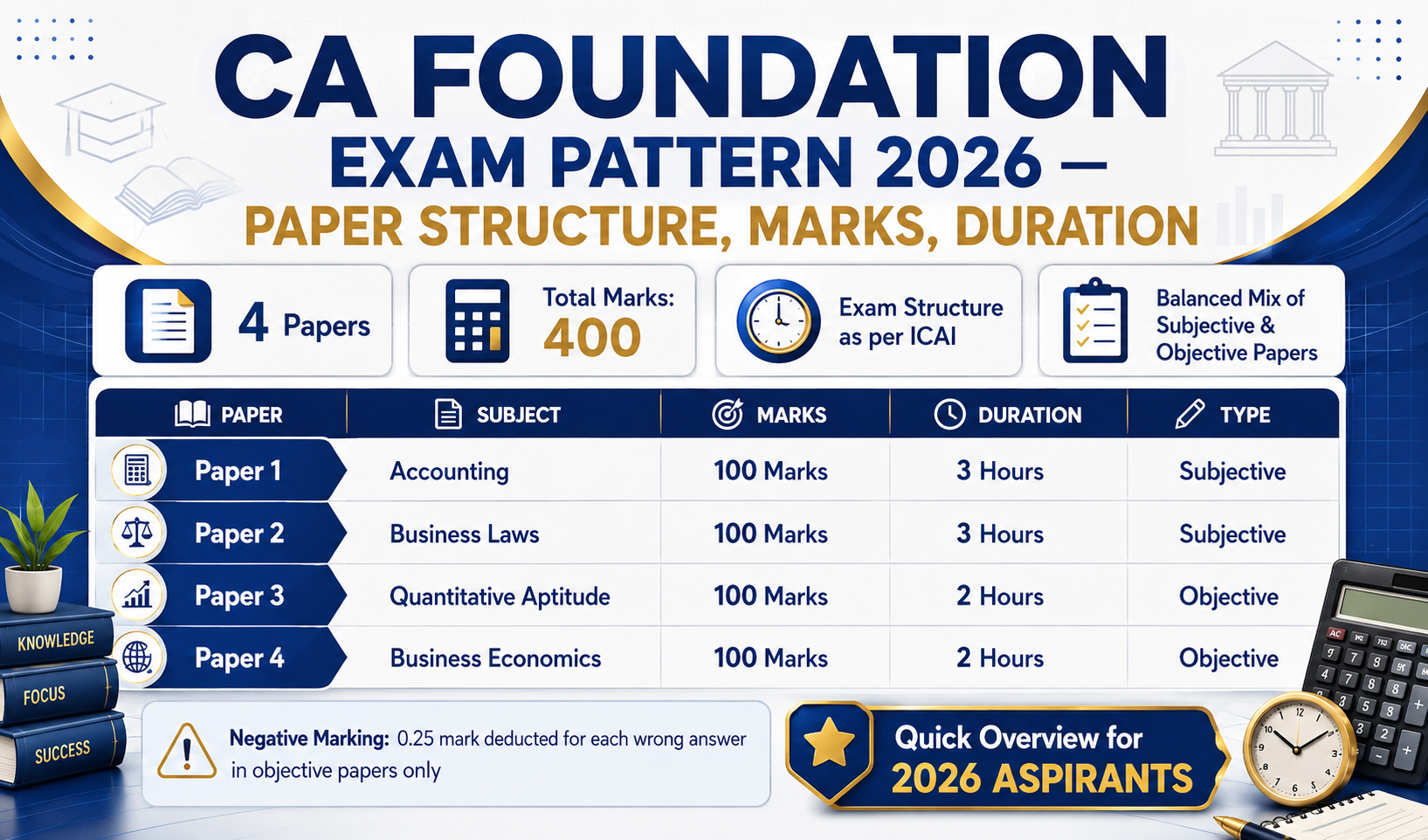
The CA Foundation examination consists of four papers carrying a total of 400 marks. Each paper is equally important because students must score minimum passing marks in every subject along with the required aggregate percentage.
The exam is conducted in offline mode, and every paper is scheduled for three hours. The examination pattern combines descriptive and multiple-choice formats to test both theoretical understanding and practical problem-solving skills.
Papers 1 and 2 are subjective, while Papers 3 and 4 are objective papers with negative marking. Students should understand the format carefully before beginning their preparation because the approach for subjective and objective papers is completely different.
CA Foundation 2026 Subject-Wise Paper Structure
The CA Foundation course includes four major subjects designed to build strong commerce and business fundamentals.
Paper 1: Principles and Practice of Accounting
Paper 1 focuses entirely on accounting concepts and numerical problem-solving. This paper is descriptive in nature and carries 100 marks.
Students are expected to solve practical accounting questions related to journal entries, ledger accounts, trial balance, rectification of errors, depreciation, partnership accounts, and final accounts.
Strong conceptual clarity and regular practice are extremely important in this paper. Students who practice accounting questions daily usually score well because accuracy and presentation play a major role in evaluation.
There is no negative marking in this paper since it follows a subjective format.
Paper 2: Business Laws and Business Correspondence & Reporting
Paper 2 is also descriptive and carries 100 marks. It is divided into two sections.
The Business Laws section focuses mainly on legal concepts, including the Indian Contract Act and other important business laws. Students must understand legal provisions properly and present answers using appropriate legal language.
The Business Correspondence and Reporting section tests communication skills, grammar, comprehension, report writing, and business communication abilities.
Many students underestimate this paper, but strong writing skills and proper presentation can help achieve excellent marks.
Like Paper 1, there is no negative marking in this subject.
Paper 3: Business Mathematics, Logical Reasoning, and Statistics
Paper 3 is an objective paper containing multiple-choice questions. It combines mathematics, reasoning, and statistics into one subject.
The Business Mathematics portion includes topics such as equations, ratios, interest calculations, permutations, combinations, and probability. Logical Reasoning tests analytical thinking and puzzle-solving abilities, while Statistics focuses on data interpretation and statistical calculations.
Since this paper is objective in nature, students need both speed and accuracy. Regular MCQ practice is extremely important for scoring well.
Negative marking is applicable in this paper, so students should avoid random guessing.
Paper 4: Business Economics and Business & Commercial Knowledge
Paper 4 is also objective and carries 100 marks.
The Business Economics section covers topics like demand and supply, market structures, national income, and economic theories. The Business & Commercial Knowledge portion tests awareness about industries, business terminology, companies, and commercial environments.
Students who regularly revise concepts and stay updated with business-related information generally perform very well in this paper.
Negative marking applies here as well, making careful question selection very important.
Detailed Marking Scheme for CA Foundation 2026
Understanding the marking scheme is one of the most important parts of exam preparation because it directly impacts the strategy students should follow during the exam.
Marking Pattern for Subjective Papers
Papers 1 and 2 follow a descriptive format. Marks are awarded based on conceptual clarity, step-wise presentation, proper working notes, and answer structure.
Students should always attempt maximum questions because there is no negative marking in subjective papers. Even partial answers can help secure some marks if the presentation is correct.
In law papers, proper legal language and keywords can improve scores significantly. In accounting papers, neat presentation and accurate calculations matter a lot.
Marking Pattern for Objective Papers
Papers 3 and 4 follow the multiple-choice format.
Students receive one mark for every correct answer, while one-fourth mark is deducted for every incorrect answer. No marks are deducted for unattempted questions.
This negative marking system means students should avoid blind guessing. Intelligent attempts and strong conceptual preparation are necessary to maintain accuracy.
Practicing mock tests regularly helps students improve speed and reduce mistakes in objective papers.
CA Foundation 2026 Exam Duration and Time Management
Each paper in the CA Foundation examination is conducted for three hours. Students also receive additional reading time before the exam begins.
Although three hours may appear sufficient, many students struggle to complete the paper on time because of poor time management. Therefore, developing speed through regular practice is extremely important.
Students should divide their time wisely during the examination. Easy questions should be attempted first to build confidence and save time for lengthy or difficult problems later.
Keeping the final few minutes for revision is also important because small calculation mistakes or writing errors can reduce marks unnecessarily.
Timed mock tests are one of the best ways to improve exam performance and time management skills.
Passing Criteria for CA Foundation 2026
The passing criteria for the CA Foundation examination are very important because students must satisfy both individual paper requirements and overall aggregate requirements.
Students need at least 40 percent marks in every paper individually. In addition, they must score a minimum aggregate of 50 percent across all four papers combined.
This means scoring high marks in only a few subjects is not enough. Even if a student performs exceptionally well in three papers, failing to secure minimum marks in one paper will fail.
Balanced preparation across all subjects is therefore essential for success in the CA Foundation exam.
Important Updates Expected in CA Foundation 2026
The Institute of Chartered Accountants of India occasionally updates the syllabus and exam structure to align with modern industry requirements and educational standards.
Although the overall structure of the CA Foundation exam is expected to remain similar in 2026, students should still stay updated regarding any official announcements.
Possible updates may include changes in topic weightage, introduction of case-study-based questions, revised law amendments, or syllabus modifications.
Students should regularly check official ICAI notifications and revision test papers to stay informed about the latest examination trends.
Best Preparation Strategy According to the Exam Pattern
Preparing according to the exam pattern can significantly improve performance and confidence.
Build Strong Conceptual Understanding
Students should focus on understanding concepts deeply instead of simply memorizing answers. Modern CA Foundation papers increasingly test application-based learning.
Conceptual clarity helps students solve both theoretical and practical questions more effectively.
Practice Writing Answers Regularly
For subjective papers like Accounting and Law, answer-writing practice is extremely important.
Students should regularly practice full-length answers, maintain neat presentation, and learn proper formats for legal and accounting solutions.
Good handwriting, proper structure, and organized presentation often create a positive impression during evaluation.
Solve MCQs Every Day
Objective papers require consistent MCQ practice.
Students should solve multiple-choice questions daily to improve accuracy, calculation speed, and confidence. Mock tests also help students identify weak areas and reduce negative marking risks.
Maintain a Balanced Study Routine
Many students spend excessive time on favorite subjects while ignoring weaker areas. This can become dangerous because every paper carries equal importance.
A balanced study routine should include daily accounting practice, law revision, mathematics problem-solving, economics revision, and mock test analysis.
Consistency matters much more than studying for very long hours occasionally.
Common Mistakes Students Make in CA Foundation Exams
Many students fail the CA Foundation examination because of avoidable mistakes rather than lack of intelligence.
Ignoring Official ICAI Material
The official study material provided by the Institute of Chartered Accountants of India is extremely important because many exam questions are directly or indirectly based on it.
Students who depend only on coaching notes often miss important concepts and question patterns.
Lack of Mock Test Practice
Without mock tests, students struggle with speed, confidence, and time management during the real examination.
Regular mock exams help simulate actual exam conditions and improve performance under pressure.
Poor Revision Planning
Some students keep studying new topics continuously but spend very little time revising previously learned chapters.
Revision is essential for retaining concepts, formulas, and legal provisions. Short notes, formula sheets, and weekly revision schedules can improve memory retention significantly.
Excessive Guessing in MCQ Papers
Because of negative marking, random guessing in objective papers can reduce overall scores badly.
Students should attempt questions carefully and focus more on accuracy than attempting every question blindly.
Final Thoughts on CA Foundation Exam Pattern 2026
The CA Foundation Exam Pattern 2026 is designed to evaluate both conceptual understanding and practical application skills. With four well-balanced papers covering accounting, law, mathematics, reasoning, economics, and business knowledge, students need disciplined preparation and smart strategy to succeed.
Understanding the paper structure, exam duration, marking scheme, and passing criteria gives students a clear roadmap for preparation. Subjective papers require strong presentation and conceptual clarity, while objective papers demand speed, precision, and accuracy.
Students who consistently practice mock tests, revise regularly, and follow the official ICAI study material usually perform much better in the examination.
Success in the CA Foundation exam does not depend only on hard work. It also depends on smart preparation according to the exam pattern. With proper planning, regular revision, and continuous practice, students can confidently clear the CA Foundation Exam 2026 in their first attempt.