CA Foundation Economics: Complete Preparation Strategy & Chapter-Wise Guide
“For a CA student, economics is the art of understanding choices, scarcity, and business behaviour.”
Before starting to prepare for the CA Foundation Economics, many students have certain questions in their minds, such as:
1. Is Economics a tough subject to learn?
2. Does it seem like there are numerous concepts, theories, and graphs which need to be memorised?
3. Do you go through lectures but fail to grasp the concepts while studying from books?
4. What is the secret to scoring high in the CA Foundation Exam with the help of Economic Studies?
CA Foundation Economics: Complete Preparation Strategy & Chapter-Wise Guide
If these thoughts have been going through your head, you are not the only one. Business Economics may indeed come across as a theoretical subject, but by adopting the right strategy, this paper becomes the easiest and highest-scoring one in CA Foundation.
Understanding the CA Foundation Economics Syllabus
Business Economics enables candidates to understand how economic theory can be used in making business decisions. This subject links economic theories with real-world scenarios relating to consumption, production, markets, prices, and government policies.
However, the aim of the subject is not just to learn definitions. Students are expected to understand economic theories and their application in various situations.
Some points to remember:
Economics involves scarcity, choices and allocation of resources.
Concepts such as demand, supply, cost, markets and national income form the base of the subject.
It becomes easier to revise and practice MCQs with an understanding of concepts.
According to ICAI, Business Economics is “the application of economic analysis to business decision-making through optimal use of scarce resources.”
The syllabus for ICAI Paper 4 consists of ten chapters, which take the student from the basics of economics to topics like national income, public finance, monetary policy, international trade and the Indian economy.
Particular | Information |
Paper | Paper 4 – Business Economics |
Total Chapters | 10 |
Chapter 1–10 | Business Economics syllabus |
Current syllabus | Applicable from May 2026 onwards |
Major units | Multiple units across Chapters 1–9 |
Exam preparation focus | Concept + Revision + Practice + Tests |
Thus, the subject matter of this paper is wider than just demand and supply. The student will thus require an effective preparation strategy rather than going through individual chapters at random.
CA Foundation Economics Section-Wise Weightage
These are the statistics that all prep books fail to mention. Following the section-wise weightage document issued by ICAI’s Board of Studies, below is the approximate weightage distribution in CA Foundation Paper 4 (100 marks in total). These figures are ICAI’s officially issued guidance – use these to understand the marking pattern of the paper – ICAI allows deviations from these.
Chapter | Topic Area | Approx. Weightage |
1 | Introduction to Business Economics | ~5% |
2 | Theory of Demand and Supply | ~10% |
3 | Theory of Production and Cost | ~10% |
4 | Price Determination in Different Markets | ~15% |
5 | Determination of National Income | ~15% |
6 | Business Cycles | ~5% |
7 | Public Finance | ~10% |
8 | Money Market | ~10% |
9 | International Trade | ~10% |
10 | Indian Economy | ~10% |
Summary: Price Determination and National Income include about 30% weightage together in the paper – give them priority. The rest of the syllabus has relatively uniform weightage at around 10% each – “skipping the low weightage sections” strategy is not advisable in this case.
CA Foundation Economics Chapters: Complete Overview
While preparing for the CA Foundation exam, students must be clear about what each chapter deals with. It helps to formulate your study plan accordingly.
Below are the economics chapters as per the ICAI syllabus for Paper 4.
Chapters | Major Areas | What Students Should Focus On |
Chapter 1 | Nature & Scope | Basic economic problems, scarcity, choice and price mechanism |
Chapter 2 | Demand & Supply | Demand, elasticity, consumer behaviour, supply and equilibrium |
Chapter 3 | Production & Cost | Production, factors, variable proportions, returns and cost |
Chapter 4 | Market Structure | Different markets, price determination and firm behaviour |
Chapter 5 | Business Cycles | Phases, causes and characteristics of business cycles |
Chapter 6 | National Income | National income concepts, accounting and Keynesian theory |
Chapter 7 | Public Finance | Government revenue, expenditure, budget and fiscal policy |
Chapter 8 | Money Market | Money demand, money supply and monetary policy |
Chapter 9 | International Trade | Trade theories, trade policy, exchange rates and capital movements |
Chapter 10 | Indian Economy | Evolution and major features of the Indian economy |
The thing to remember is that each chapter demands a different approach in its preparation process. Some topics demand more conceptual knowledge, while some topics require you to revise the concepts again and again.
Why Is Economics Difficult for Students?
Students think that Economics is difficult because there are many definitions and theories. But the main problem is not definitions but passive learning.
A student attends a lecture, understands everything at once, and thinks that he has mastered the entire chapter. Some days later, he opens his book and realises that he does not remember anything.
Typical mistakes are as follows:
Attending lectures without taking any useful notes.
Memorising definitions without understanding their meaning.
Disregarding graphs and diagrams.
Learning without constant revising.
Solving very few MCQ questions after finishing a chapter.
Failing to analyse errors made in tests.
The only thing you have to do is start actively learning from the very beginning.
Meet Our Expert Faculty
Our faculty comprises experienced Chartered Accountants, industry professionals, and subject experts who are committed to delivering quality education with a perfect blend of conceptual clarity, practical exposure, and exam-oriented preparation. Every mentor contributes extensively to lectures, notes, question banks, answer-writing guidance, test evaluation, revision planning, and personalised student mentoring.
CA Mehak Soni: Faculty, Business Economics

CA Mehak Soni, who is a Chartered Accountant with a post-graduation in Commerce (B.Com, M.Com), brings both theoretical and practical knowledge due to her self-owned proprietary practice. Having her own practice while teaching gives her the advantage of giving practical examples for a subject that otherwise lacks practicality in nature.
She believes Economics becomes genuinely easy once concepts are connected to real business situations. Her lectures simplify theoretical frameworks using practical examples, graphical explanations, and structured revision techniques — an approach that has helped thousands of CA Foundation students turn Business Economics from a scoring weak point into a scoring strength. She personally contributes to academic content development, practice material, and one-on-one student mentoring throughout their preparation journey.
Highlights:
B.Com, M.Com, Chartered Accountant
Self-employed in a proprietorship firm in addition to teaching
Expert in Business Economics for CA Foundation course
Famous for making theoretical subjects easy with practical examples and revisions
Study Economics Using Concept Visualisation
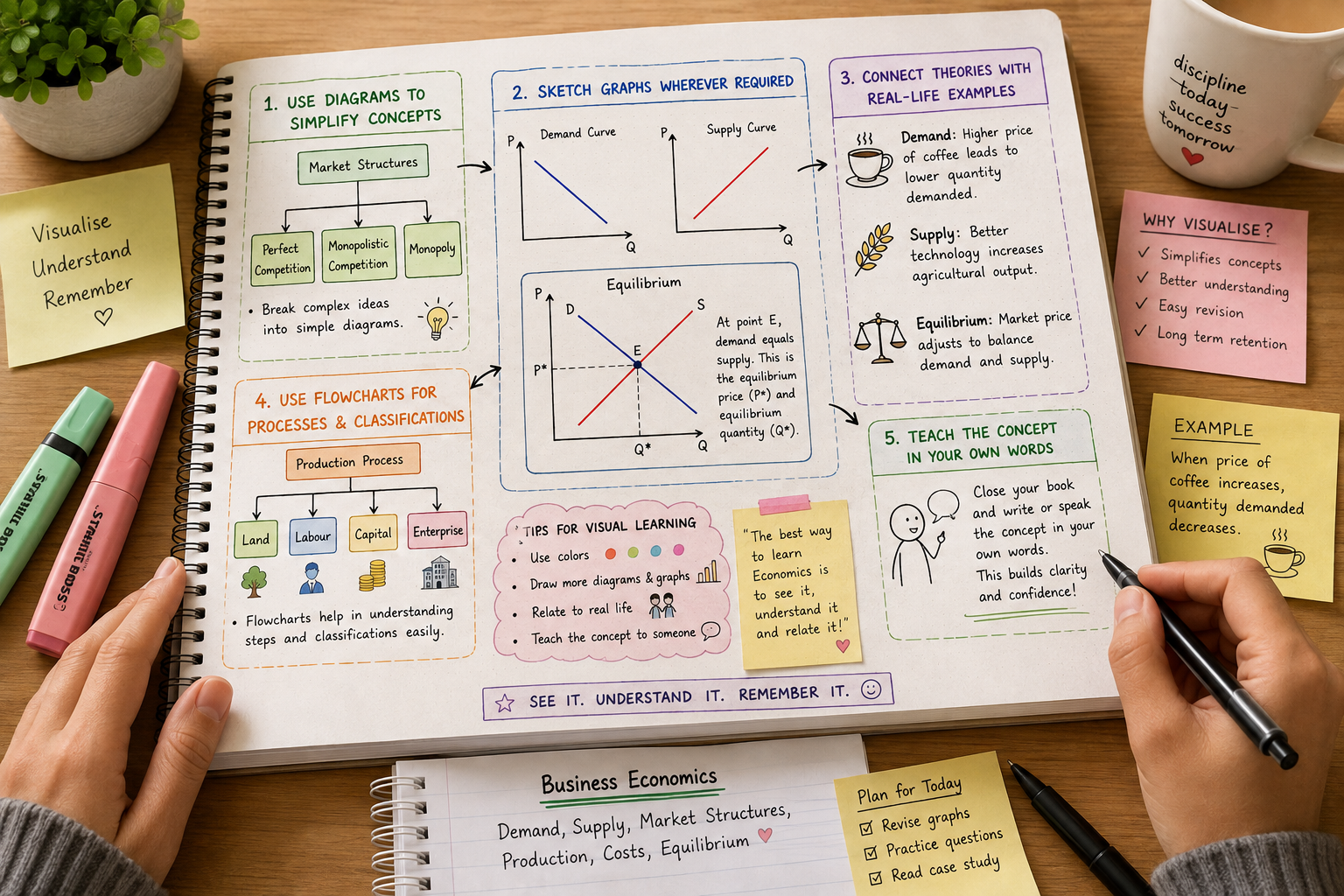
The most beneficial approach to studying Economics is concept visualisation. Do not keep reading one paragraph again and again; rather, try to visualise what the concept actually tries to explain. Concepts such as demand, supply, equilibrium, production, costs, and market structures would become easy to understand by visualising them through graphs and examples.
Represent the difficult concepts in simpler diagrams.
Sketch graphs wherever required.
Link up theories with practical business examples.
Represent processes and classifications using flowcharts.
Try to explain the concept on your own without seeing the text in the book.
ICAI itself, in its learning materials, shows the benefits of using graphs and charts to understand and revise concepts of Business Economics.
Faculty, Notes, and Study Resources
A good lecture may provide the guidance that is needed to comprehend a complex chapter. Lectures must be viewed as an initial step towards understanding a topic.
Faculty guidance, your notes, and ICAI study material should go hand in hand. Do not continue to accumulate multiple study materials until you complete the existing ones.
Some study resources may include:
Lectures by your faculty members.
Notes taken in classes.
ICAI study material.
Visual aids.
Revision notes.
MCQs and practice questions.
Mock test papers and past examination questions.
Keep Yourself Active in the Lecture
Just sitting and listening to the lecture for 2 hours does not ensure learning. You must keep your brain engaged while attending lectures.
Always ask yourself: why is this concept important, and what happens if a variable in it changes?
In lectures, you can do the following things:
Take notes.
Highlight important concepts.
Draw graphs when the faculty is doing it.
Ask your doubts right away.
Guess the answer before the faculty explains it.
Revise the last concept before learning the next one.
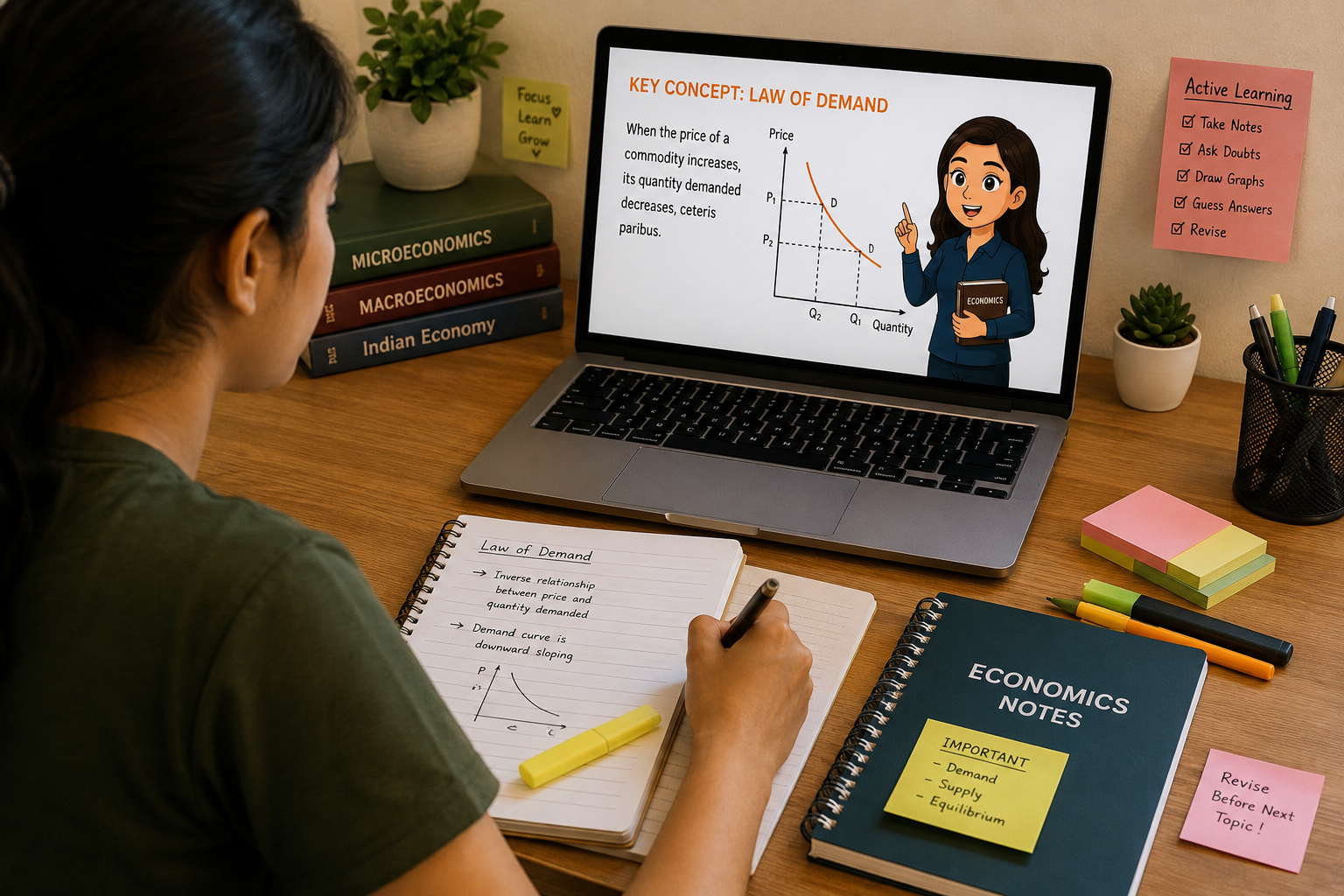
This kind of learning approach can help to overcome the most common issue: you understand everything in the lecture but forget it later.
Practice: Assignment, Mentoring, and Testing
Economic preparation should not end upon completion of a lecture. It is practice that decides whether you have truly understood the subject matter.

A complete cycle of preparation must consist of:
Lectures
Understanding
Assignment
Revising
Test
Analysis
Upon the completion of each topic:
Complete your assigned assignment.
Solve the problems without checking the answers first.
Get mentoring or doubt-solving support for difficult topics
Do testing on each topic separately.
Analyse every wrong answer.
Revise the topic that caused the error.
The Significance of Revision in Economics
In economics, revision is necessary since the subject has numerous concepts that could easily be forgotten.
The first revision should take place shortly after finishing the chapter. Future revisions could be brief since you will only need to recall, but not necessarily learn, the whole content again.
A possible revision process:
Revision 1: Soon after completing the chapter.
Revision 2: After about one week.
Revision 3: After finishing the chapters.
Revision 4: Before your examinations.
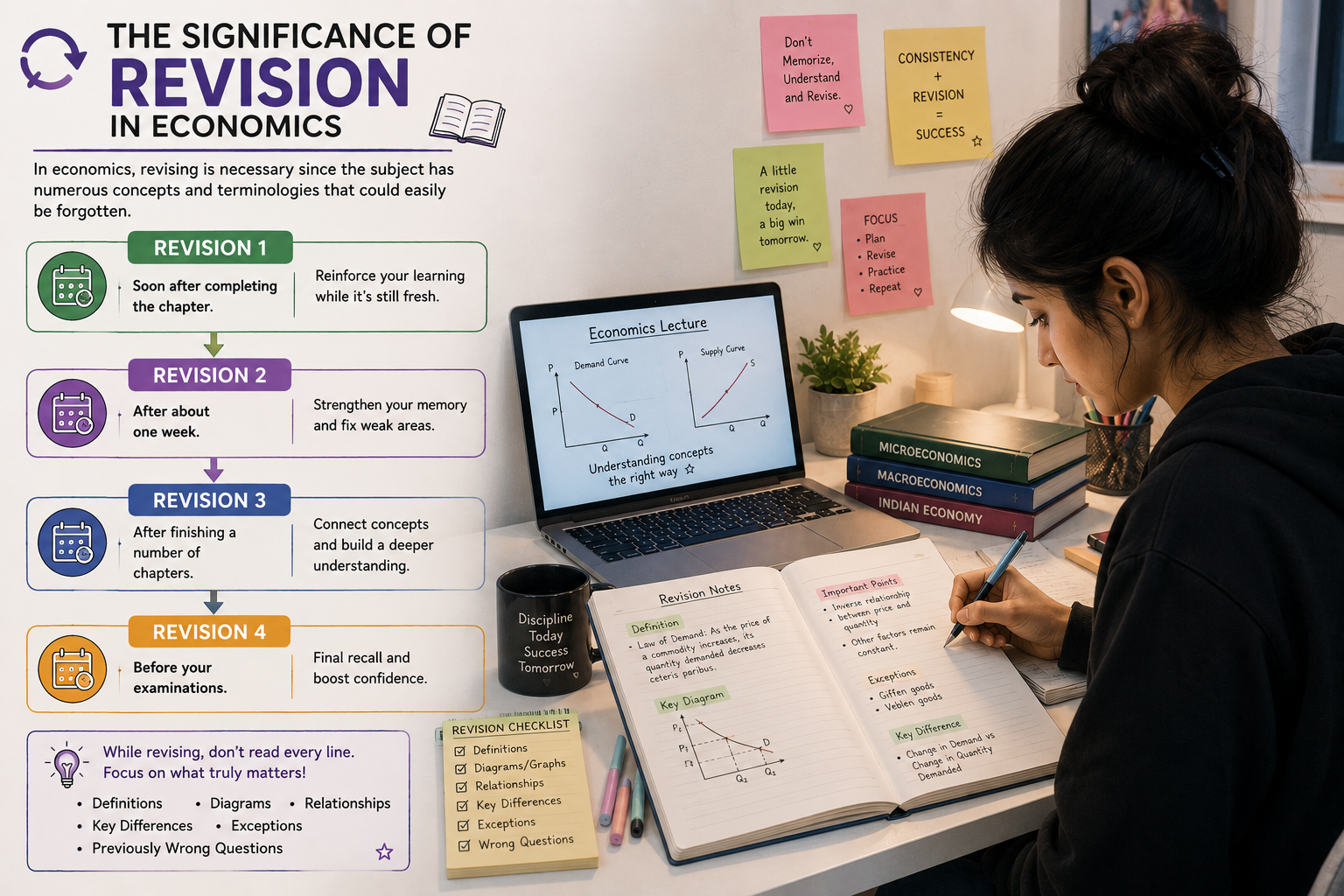
While revising, do not go through every sentence. Concentrate on the definitions, diagrams, relationships, key differences, exceptions, and questions that were wrong previously.
New Strategy: Weightage + Understanding + Visualization + Tests
The most effective Economics study method is not merely “learn the weightage chapters.” Students must do these four things together:
Weightage → Understanding → Visualization → Testing
Apply weightage to areas that need extra attention, get understanding by attending lectures and reading notes, improve visualisation with the help of tables and graphs, and test yourself to see whether you have studied well or not.
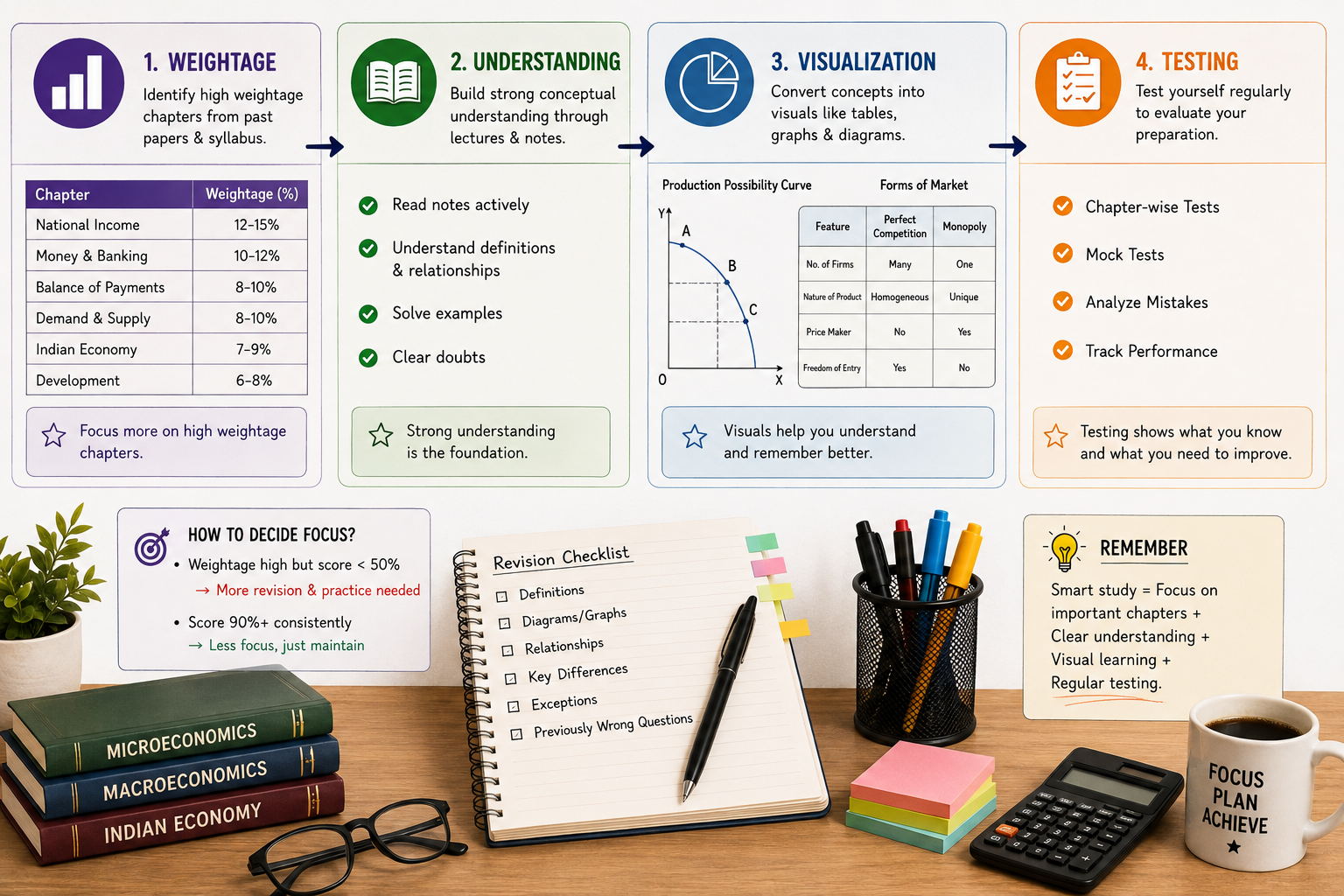
If a particular chapter has weightage but your performance is below 50%, then that chapter needs more revision. But if you keep getting 90%+ marks in any particular chapter, then that area needs less focus.
Common Mistakes to Avoid in Economics Subject
Economics may become complicated for students if they follow the wrong preparation technique. One of the most common mistakes is treating it like a subject that can be solved by reading once. Another mistake is attempting to solve problems without analysing the reasons behind an incorrect answer. The following are some mistakes you should avoid:
Studying from too many teachers and materials.
Neglecting ICAI material.
Solving problems by rote learning.
Skipping graphs.
Neglecting the revision of completed chapters.
Skipping practice tests.
Neglecting incorrect answers.
Delaying tough chapters.
Adopting a strict preparation technique may help make the subject easier.
Conclusion
CA Foundation Business Economics is not just a subject of concepts and theories. It is a subject that will teach you how consumers, firms, markets and governments take economic decisions.
The way to success in Economics lies in understanding of concepts, visualisation, quality note-making, practice through homework, mentoring, revision and tests. The points stated in the above framework—faculty support, note-making, charts, strategy, visualisation of concepts, practice, homework, mentoring and tests—are more effective when integrated in a continuous preparation process.
Do not measure your progress with the number of lectures watched and the number of chapters read. Measure your progress with your ability to understand a concept, retain it, apply it to a problem and analyse why an answer is right or wrong.