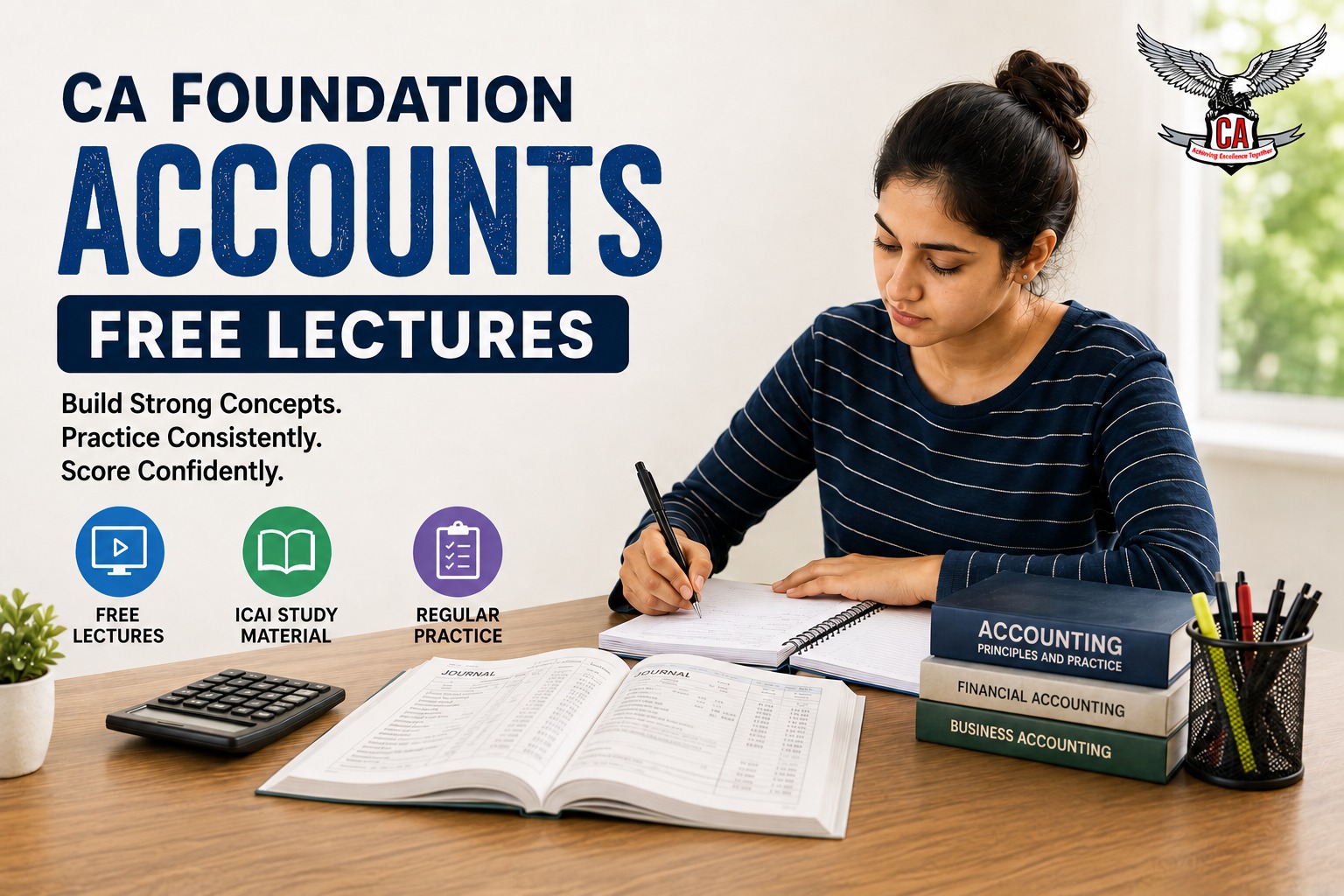
CA Foundation Accounting Free Lectures: Complete Study Guide & Notes
CA Foundation Accounting at lower-cost lectures can be very effective for students who want to develop their accounting concepts without paying much for coaching classes. If they are provided with the right lectures, ICAI study material, regular practice and mock tests, a student will be able to devise an efficient study schedule even while self-studying.
The trick is to understand that attending lectures is just the beginning stage of studying. Question solving and testing have to continue. Thus, a student should go through a full circle of lecture → comprehension → practice → revision → test → analysis.
For students studying for the CA exam, ICAI offers access to lectures, study material, revision test papers, and mock test papers from its Board of Studies.
What Are CA Foundation Accounting Free Lectures?
CA Foundation Accounting free lectures are provided to students through the Internet; i.e., there will be no additional fee to attend classes apart from their coaching fee. Such free lectures may prove beneficial for those students who like to study on their own or wish to gain concept clarity to decide if they require coaching.
A proper lecture must focus on concept clarity rather than mere completion of the syllabus. It should be easy for students to learn the concept and later solve practical questions by themselves.
Such free lectures may include concepts related to accounting principles, journal entries and more chapters like inventories, bank reconciliation, etc.
Concept-oriented teaching
Practical examples
Lectures chapter-wise
Question-solving classes
Notes and revision support
Practice questions and homework
Preparation of tests
Doubt-clearing classes
Why Choose CA Foundation Accounting Free Lectures?
Free accounting lectures could decrease the expenses of preparing for examinations and could give more options to students. Free lectures prove helpful for those students who study well independently and have a fixed routine.
Develop fundamental accounting concepts.
Learn from experienced faculty.
Review difficult chapters
Understand practical questions
Decrease reliance on expensive coaching classes
Study according to your schedule
The other benefit is that students can repeat difficult concepts instead of understanding them. However, this facility should not be used as an excuse to watch the same lecture without answering questions.
Where to Find CA Foundation Accounting Free Lectures
Students must first try the official ICAI learning sources. It currently provides access to video lectures, study material, live sessions, and doubt-clearing sessions.
Apart from these sources, students can make use of other educational websites, YouTube and Test Series, but must always ensure that the syllabus and study material used are relevant to their attempt.
Before opting for any lecture series, the students must confirm the following:
Is the syllabus relevant to your attempt?
Are all chapters covered?
Are there discussions on practice questions?
Does the faculty clearly explain the concepts?
How to Build Concept Clarity in CA Foundation Accounting
Accounting is one such subject where rote learning of answers is not at all useful. The reason why one particular method is adopted in an accounting entry needs to be understood by students.
Key Points:
Concept clarity in accounting
Learning from examples
Connecting different concepts
Solving problems on your own
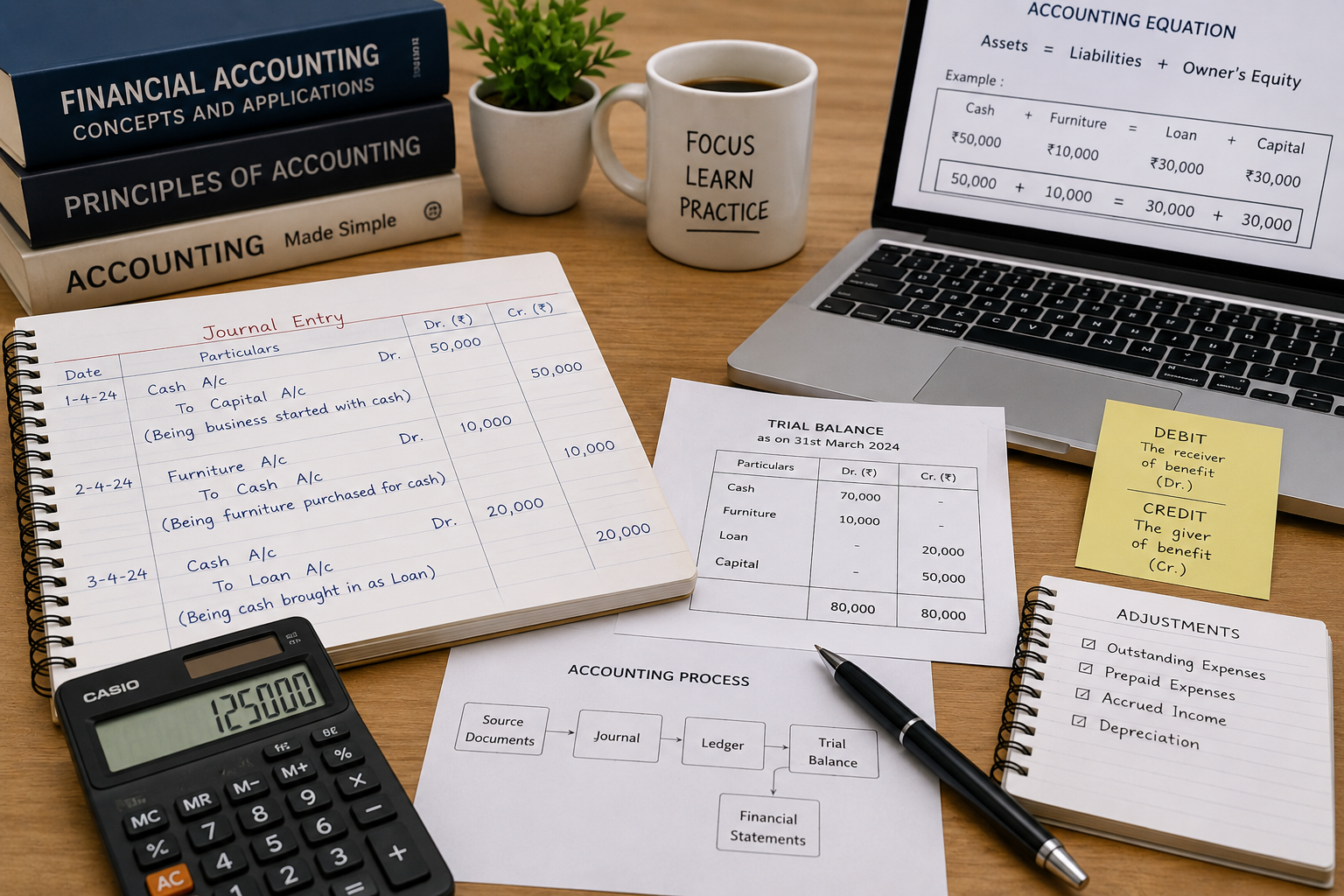
For instance, instead of remembering the journal entries, one should focus on understanding which accounts have been affected, whether they are credit or debit accounts, and why.
CA Chesta Chawla (Accounting)
CA Chesta Chawla focuses on developing conceptual understanding and practical applications of Accounting. She helps prepare notes systematically and covers accounting concepts.

Area of Specialisation: CA Foundation Accounting
Provides structured revision schedules to students
Aware of the latest developments in accounting standards
Provides individual attention to students having difficulty in numerical and case problems
Learn CA Foundation Accounting Through Visualisation and Examples
Sometimes certain aspects of accounting tend to be confusing at first glance, especially when one studies theory alone. Practical examples and visual aids make them easy to understand.
One example is depreciation of business assets like machines, furniture, and vehicles. Also, accounting processes become easy to grasp when one understands how an entry is made from the journal to the ledger to the financial statements.
Understanding accounting processes
Retention of the concepts
Linking theory to practice
Adjustment concepts
Reducing cramming
How to Take Notes During CA Foundation Accounting Free Lectures
Good notes will make revision easier. It is not necessary to jot down everything that the faculty says during the lecture. It is better to note down all the important accounting aspects, adjustments, difficult questions and common mistakes that one makes.
Important concepts
Journal entries format
Accounting treatments
Important adjustments
Difficult questions
Common mistakes
Practice: The Key to Cracking CA Foundation Accounting
The most common mistake students make is that they attend several lectures but solve very few questions. Seeing how the teacher does it may seem very easy to solve, but the true test of understanding lies in doing the problem on one’s own.
Once one has gone through a topic, stop watching the video and solve the problems. Follow the steps listed below.
Practice
↓
Check
↓
Correct & Analysis
↓
Repeat
How Many Questions Should You Practice After Each Lecture?
As the lecture complexity increases, the number of questions to be practised must also grow. These are just suggestions on how many to do, not hard requirements.
Topic Difficulty | Questions After Lecture | Reattempt Target |
Easy | 10–15 | 3–5 |
Moderate | 15–25 | 5–8 |
Difficult | 25–35 | 8–10 |
Weak Topic | 30+ | 10+ |
Your goal should not be to do many questions. Correctness and comprehension matter much more than quantity alone. Questions which have been answered wrongly must be highlighted for future improvement.
Daily Study Schedule for CA Foundation Accounting
Students are advised not to spend the entire time listening to lectures in one session. Students should combine studying, revising, solving questions, and analysing their mistakes.
The following is the study schedule for students that helps in completing the daily target.
Activity | Suggested Time | Daily Target |
Free Lecture | 90 minutes | 1 lecture per session |
Concept Revision | 30 minutes | 1 topic |
Question Practice | 45 minutes | 15–25 questions |
Mistake Analysis | 15 minutes | 5–10 mistakes |
The lecture part is important for understanding new things. The practice part is important for applying the knowledge in solving problems. The last 15 minutes are important for noting down errors and revising them later.
Weekly Study Schedule for CA Foundation Accounting
A weekly target will help students assess their preparation level based on facts rather than on how many videos they have watched. The following is a suggested target for four weeks:
Week | Lecture Target | Questions | Tests | Revision |
Week 1 | 5–7 | 75–100 | 1 | 1 session |
Week 2 | 5–7 | 100–125 | 1–2 | 2 sessions |
Week 3 | 4–6 | 125–150 | 2 | 2–3 sessions |
Week 4 | 2–4 | 150+ | 3 | 3–4 sessions |
Weak students in Accounting can keep their question targets low and focus more on understanding concepts. Strong conceptual students can raise their practice target. The main point is consistency through the week.
30-Day Study Plan for CA Foundation Accounting
Students who like a step-by-step procedure can divide their preparation into four stages: building concepts, practising questions, revising and testing. Here is a 30-day plan for you which help to complete the syllabus and study hours.
Preparation Phase | Days | Main Focus | Daily Study |
Concept Building | 1–15 | Lectures + Material | 2.5–3 hrs |
Question Practice | 16–23 | Practical Questions | 3 hrs |
Revision | 24–27 | Weak Topics + Notes | 2–3 hrs |
Mock Tests | 28–30 | Tests + Analysis | 3 hrs |
For the first 15 days, focus on concept building rather than running through lectures. The next stage must involve solving more questions independently. The last stage must concentrate on revising, testing and error correction.
Homework and Regular Tests in CA Foundation Accounting
Homework is used to enable students to apply what they have just learned from a class. It will also make clear whether they understood the concept or not, based on their performance.
Good practice will consist of:
Daily question practice
Chapter tests
Mixed topic tests
Revision
Mock exams
Test analysis
Tests should start chapter by chapter and slowly progress into mixed and full test papers. This will allow them to build confidence and accuracy before the actual exam.
CA Foundation Accounting: Free Lectures vs. Paid Coaching
Free and paid courses can both be equally effective depending upon their proper application. The choice of course mainly depends on the budget and learning capacity of the student.
Some students might be able to study through free video lectures and study themselves, whereas some students might benefit from a paid course.
Factors | Free Lectures | Paid Classes |
Cost | Usually free | Course fee required |
Flexibility | Generally high | Depends on provider |
Study Material | May vary | Usually structured |
Doubt Support | May be limited | Often structured |
Self-Discipline | High requirement | Usually more structured |
Tests | Depends on resource | May be included |
Common Mistakes to Avoid in CA Foundation Accounting
Students usually make the mistake of assuming their level of preparation depends on the number of lectures taken. This creates an illusion of preparation while students may not have solved many questions.
Another problem is that students frequently change teachers once the difficulty level rises in any chapter. The solution here should be revising the concepts and then gradually moving towards the difficult questions.
The list of mistakes to avoid includes:
Watching lectures without making notes
Not solving questions after class
Ignoring the ICAI material
Not revising
Avoiding difficult chapters
Not analysing test errors
Frequently changing teachers
Taking lectures without taking tests
Conclusion
Free lectures on CA Foundation Accounting can prove to be an effective and economical way of making good concepts and preparing for the examination. But just attending lectures is not sufficient. It is important to combine lectures with study materials from ICAI, consistent practice questions, revisions, and chapter as well as complete test papers.
Consistency and active preparation is the secret to success. Maintain a systematic schedule, work on accounting concepts, analyze your errors, and slowly start improving your speed and accuracy. With the right lectures, consistent preparation, and regular testing, students can prepare for CA Foundation Accounting in self-preparation mode.