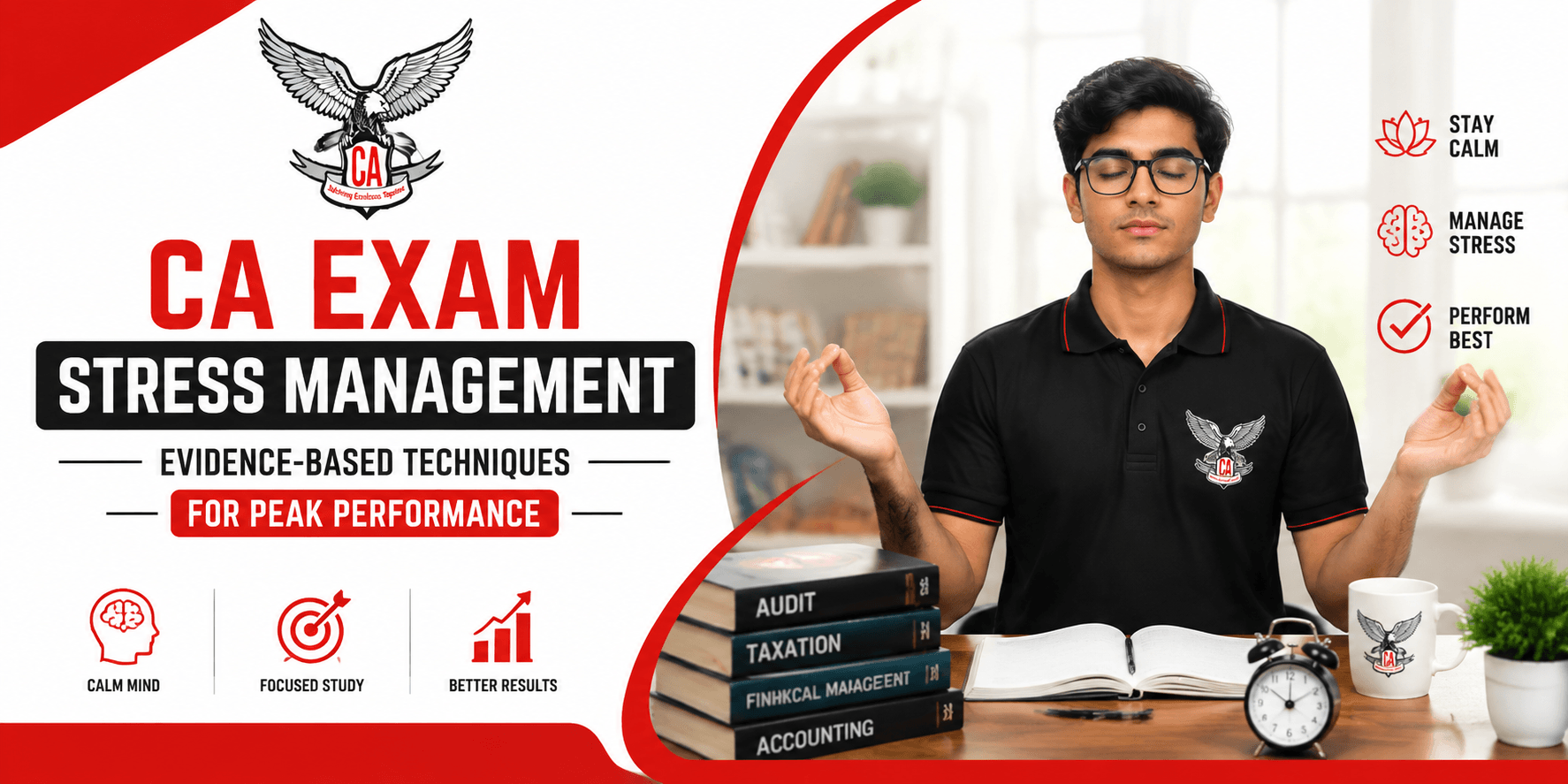
The journey of becoming a Chartered Accountant (CA) requires discipline, consistency, strategic preparation, and strong mental resilience. Students preparing for CA Foundation, CA Intermediate, and CA Final examinations often experience significant academic pressure due to extensive syllabuses, multiple subjects, continuous revisions, mock tests, and uncertainty about examination results. A certain level of stress can improve focus and encourage students to work harder. However, excessive exam stress can negatively impact concentration, memory retention, confidence, and overall performance. Many CA aspirants spend long hours studying but struggle to perform effectively because anxiety prevents them from applying their knowledge properly during examinations. Effective CA Exam Stress Management helps students maintain emotional balance, improve productivity, and develop confidence throughout their preparation journey. By following structured study plans, practicing regularly, maintaining healthy routines, and using anxiety-control techniques, students can handle exam pressure more effectively.
Why Do CA Students Experience High Exam Stress?
CA examinations are considered among the most challenging professional examinations because students must manage conceptual understanding, practical application, revision planning, and exam-writing skills simultaneously.
Stress usually increases when students feel uncertain about their preparation, struggle with time management, or compare their progress with others. Identifying the causes of stress is the first step toward developing effective solutions.
1. Extensive CA Syllabus and Multiple Subjects
One of the biggest reasons behind CA exam stress is the large syllabus that students must complete within a limited preparation period.
CA students usually prepare:
Practical subjects requiring continuous problem-solving practice
Theory subjects requiring repeated revision
Concept-based topics requiring detailed understanding
Exam-oriented questions requiring regular practice
When preparation is delayed or revision is not planned properly, pending chapters and incomplete topics create additional pressure.
A structured study approach helps students divide their workload into manageable targets.
Common Challenge | Effective Solution |
Large syllabus | Divide chapters into daily and weekly targets |
Multiple subjects | Create a balanced subject-wise timetable |
Revision pressure | Follow planned revision cycles |
Lack of progress tracking | Review preparation regularly |
Instead of worrying about completing the entire syllabus at once, students should focus on consistent daily improvement.
How Does CA Exam Stress Affect Students?
While controlled stress can improve motivation, excessive stress can negatively affect learning ability, physical health, and examination performance.
Impact on Learning and Memory
High stress levels can reduce concentration and make it difficult to understand and retain important concepts.
Students experiencing exam anxiety may face:
Difficulty focusing during study sessions
Poor memory retention
Reduced problem-solving ability
Lower confidence during revision
Using active learning techniques such as self-testing, writing practice, and regular revision improves knowledge retention and builds confidence.
Impact on Physical Health
During CA preparation, many students ignore their health by reducing sleep, avoiding exercise, and following unhealthy routines.
Common problems include:
Irregular sleep schedules
Low energy levels
Mental fatigue
Reduced concentration
Maintaining proper sleep, nutrition, hydration, and physical activity helps students stay mentally alert during long preparation periods.
Impact on Exam Performance
Even well-prepared students may struggle if stress becomes overwhelming during examinations.
Exam anxiety can cause:
Difficulty understanding questions
Poor time management
Panic during difficult sections
Mistakes in answer presentation
Regular mock tests help students become comfortable with exam conditions and improve confidence.
Effective CA Exam Stress Management Techniques
Managing CA exam stress requires more than increasing study hours. Success depends on smart preparation, consistent practice, and maintaining mental balance.
1. Create a Realistic CA Study Plan
A realistic study plan is one of the most effective ways to reduce exam stress.
Many students create unrealistic schedules with extremely long study hours. When they fail to complete these targets, they experience disappointment and anxiety.
A practical CA study plan should include:
Daily achievable targets
Subject-wise time allocation
Revision schedules
Mock test practice
Short recovery breaks
Study Planning Mistake | Better Approach |
Setting unrealistic targets | Create achievable daily goals |
Studying only preferred subjects | Maintain balance across subjects |
Ignoring revision | Include revision from the beginning |
No progress tracking | Review performance regularly |
A structured plan reduces uncertainty and gives students better control over their preparation.
2. Use Active Learning Methods
Simply reading textbooks repeatedly is not always effective. CA students need active learning methods that improve understanding and application.
Useful techniques include:
Active recall
Self-testing
Writing answers without notes
Solving practical questions regularly
Spaced revision
These methods help students identify weak areas and measure their actual preparation level.
3. Practice ICAI Pattern Mock Tests
Mock tests are one of the most effective tools for reducing CA exam anxiety.
Many students feel stressed because they are unsure about:
Their preparation level
Writing speed
Time management ability
Answer presentation skills
Regular mock tests create familiarity with the actual examination environment.
Mock Test Benefit | How It Helps |
Exam simulation | Reduces fear of the final examination |
Time management practice | Improves paper completion ability |
Performance analysis | Identifies weak areas |
Answer evaluation | Improves writing quality |
A structured CA test series allows students to practice exam-level questions, analyze mistakes, and improve their preparation strategy.
Daily Habits That Reduce CA Exam Stress
Academic preparation alone is not enough. Lifestyle habits play an important role in maintaining focus and emotional stability.
Maintain Proper Sleep Schedule
Sleep supports memory formation, concentration, and learning efficiency.
Students should:
Maintain consistent sleeping hours
Avoid unnecessary late-night studying
Take proper rest before examinations
A refreshed mind performs better than an exhausted one.
Exercise and Physical Activity
Physical movement helps reduce stress and improve mental performance.
Simple activities such as:
Walking
Stretching
Light exercise
can reduce fatigue and improve concentration during study sessions.
Follow a Balanced Diet
Proper nutrition supports energy levels and brain function.
Students should focus on:
Balanced meals
Adequate water intake
Healthy snacks
Excessive caffeine and unhealthy food habits may reduce energy stability and concentration.
Take Planned Breaks
Continuous studying without breaks can lead to burnout.
Short breaks help the brain recover and maintain productivity.
Students can use:
Focused study sessions
Regular rest intervals
Changes in learning activities
How to Handle CA Exam Anxiety Before Exam Day
The final days before CA examinations can be extremely stressful. Students often try to revise everything at once, which increases anxiety.
Avoid Last-Minute Panic
The final preparation phase should focus on:
Revising important concepts
Reviewing mistakes
Practicing important questions
Building confidence
Starting completely new topics at the last moment may create confusion.
Prepare an Exam-Day Strategy
A clear examination strategy reduces uncertainty.
Students should decide:
How much time to spend on each question
Which questions to attempt first
How to handle difficult questions
Proper planning allows students to focus on answering rather than worrying.
CA Stress Management Strategies by Exam Level
Foundation students should focus on developing strong concepts and disciplined study habits.
Key strategies:
Maintain a consistent routine
Understand basic concepts clearly
Practice questions regularly
Build revision habits
CA Intermediate Students
Intermediate-level preparation requires stronger conceptual application.
Students should focus on:
Subject planning
Regular revision
Practical question practice
Identifying weak areas early
CA Final Students
CA Final students often balance advanced concepts with professional responsibilities.
Important strategies include:
Strategic revision planning
Mock examination practice
Answer-writing improvement
Maintaining mental balance
30-Day CA Exam Stress Management Plan
Period | Focus Area |
Days 1–10 | Organize preparation, identify weak areas, create revision schedules |
Days 11–20 | Attempt mock tests, improve answer writing, analyze mistakes |
Days 21–30 | Final revision, confidence building, exam simulation |
A structured final-month strategy helps students remain calm and prepared.
Conclusion
CA exam stress is a common challenge faced by students throughout their Chartered Accountancy journey. However, stress can be managed effectively through proper planning, smart learning techniques, healthy lifestyle habits, and consistent practice. Successful CA Exam Stress Management is not about studying for unlimited hours. It is about studying efficiently, maintaining mental balance, improving continuously, and developing confidence through preparation. With the right strategy and mindset, CA students can manage exam pressure effectively and perform at their best.