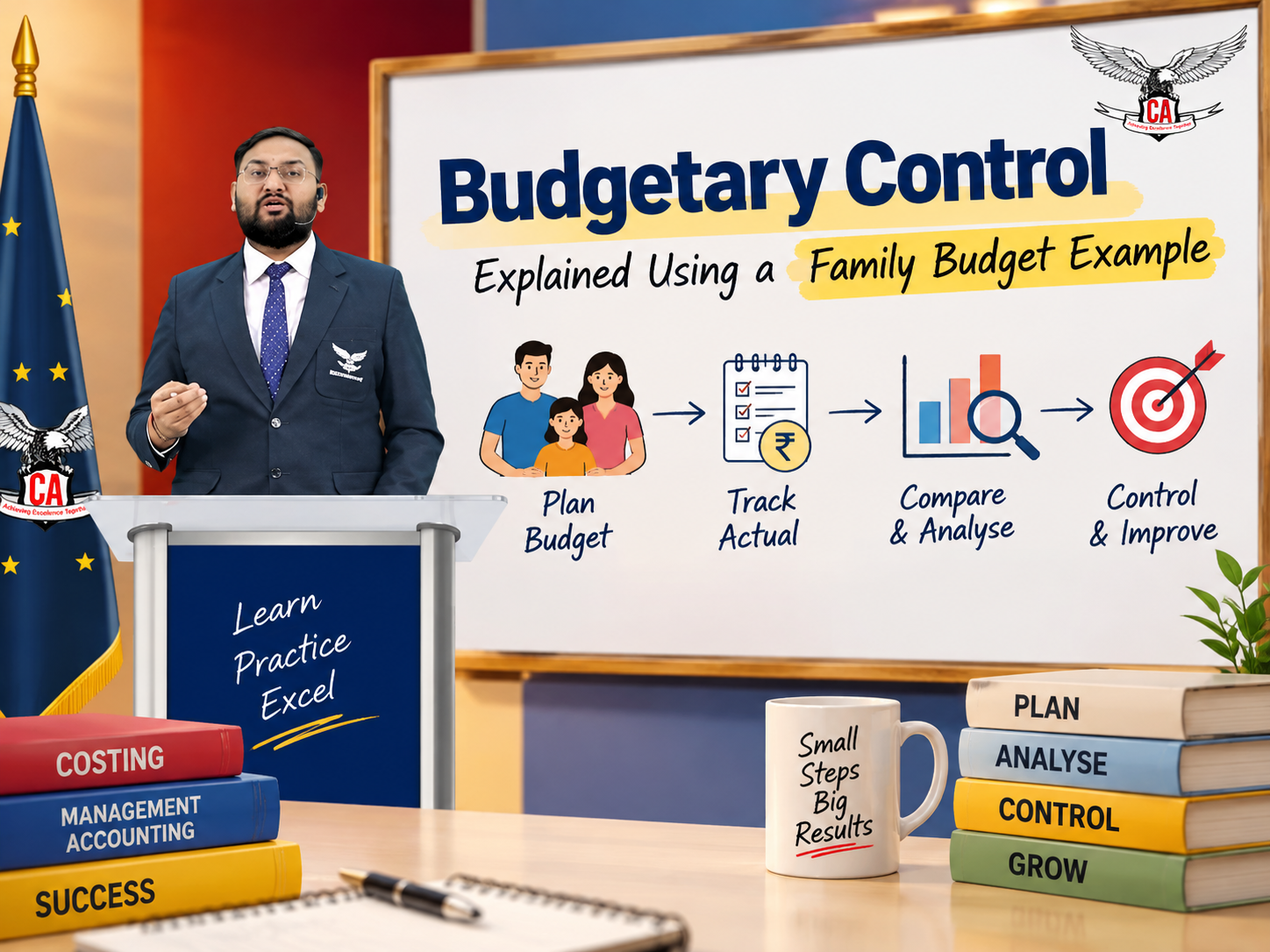
Budgetary Control Explained with a Family Budget Example
It is a topic of Cost and Management Accounting which is quite tricky in the textbooks. But it can be understood easily as compared to an activity that you perform every month in your home. This blog post gives an idea about this topic through a monthly family budget.
In this blog post, you will come to know about this topic as it is explained by CA Himanshu Singla, Faculty of CAtestseries.org.
What Is Budgetary Control?
Budgetary Control is a method of management in which:
A budget is made in advance for the future.
Actual performance is recorded after the passage of this period.
Figures in the budget are compared with actual figures.
Differences are discovered and analysed.
Action is taken to control costs and improve future performance.
In other words, Budgetary Control = Planning + Comparing + Controlling.
It is more than just making a budget – making the budget is just the first step. The real "control" lies in constant comparison of actual performance with the plan.
Monthly Budget of the Family: Example
This can be linked to an activity which each and every family undertakes every month: making a family budget. Consider a family that gets together every month to make a budget for the following items:
Expense Category | Amount (₹) |
Groceries | 8,000 |
Electricity and Water Bills | 3,000 |
School and College Fees | 6,000 |
Fuel and Transport | 2,500 |
Entertainment | 2,000 |
Savings and Investments | 3,000 |
Total | 24,500 |
At the end of the month, they look at their bank statements and bill payments as follows:
Grocery Purchased: ₹9,200
Expenses on electricity and water: ₹2,700
School fees for the children: ₹6,000
Cost for fuel and transport: ₹3,100
Entertainment costs and restaurant: ₹3,500
Savings and investments: ₹4,000
Total Actual Expenses: ₹28,500
Expense Category | Actual Amount (₹) |
Groceries | 9,200 |
Electricity and Water Bills | 2,700 |
School Fees for Children | 6,000 |
Fuel and Transport | 3,100 |
Entertainment and Restaurants | 3,500 |
Savings and Investments | 4,000 |
Total Actual Expenses | 28,500 |
The "Control" stage comes now, where there will be a comparison between budget and actual costs, finding the variance and the reasons behind it, and taking corrective measures for next month (maybe reducing the spending in restaurants or negotiating about the electricity consumption or increasing the budget for groceries).
This whole process, "Plan, Record Actual, Compare, Analyse Variance, and Take Corrective Action," is nothing but exactly what Budgetary Control means in a firm.
Family Budget vs. Corporate Budgetary Control: Comparison
Family Monthly Budget | Corporate Budgetary Control |
The head of the family plans monthly expenses | Budget Committee / Management prepares functional budgets |
Categories: groceries, bills, fees, fuel, savings | Categories: material, labour, overheads, sales, cash |
Budget period = 1 month | Budget period = usually 1 year, broken into months/quarters |
Actual expenses tracked via bills, UPI statements | Actual costs tracked via cost accounting records/ERP |
Comparison done manually by parents | Comparison done via Variance Analysis Reports |
Variance reason: unexpected guest, price rise, festival | Variance reason: price variance, efficiency variance, volume variance |
Corrective action: cut unnecessary spending, renegotiate bills | Corrective action: cost control measures, process improvement, revised targets |
Responsibility: whole family, but mainly the budget-maker | Responsibility: fixed on Cost Centres / Responsibility Centres |
Goal: financial discipline & savings target | Goal: profitability, cost efficiency, and goal congruence |
Tools used: notebook, spreadsheet, budgeting app | Tools used: flexible budgets, standard costing, ERP/MIS reports |
Objectives of Budgetary Control
Planning: Planning on what should be done (just as when one plans expenditure for the month ahead).
Coordination: Coordinating various departments (such as coordinating the grocery, education, and savings requirements in one income).
Control: Comparing the actual with the budgeted and controlling variances.
Communication: Budgets communicate the goals to various levels of management (as in a family, communicating the "expenditure ceiling" to all members).
Motivation: Achievable budgets act as motivation for employees and family members to meet the goals.
Performance Evaluation: Assists in the evaluation of whether the department/family member is efficient or not.
Budget Types (With Examples)
Fixed Budget: Preparing a budget for a single level of activity. (Family Example: Fixed budget for a month considering no guests or no emergencies — but not possible if things change.)
Flexible Budget: Changing the budget based on the actual level of activity. (Family Example: "If any guest comes home, the daily grocery budget will increase by ₹500 automatically.")
Master Budget: Consolidated version of all functional budgets. (Family Example: The budget sheet that consolidates all aspects of groceries, bills, fees, and savings into one single document.)
Cash Budget: Estimating the cash inflow and cash outflow. (Family Example: Budgeting salary dates versus EMI or bill payment dates so that there is no shortage of cash in hand for the family.)
Zero-Base Budgeting (ZBB): Every cost is justified starting from zero rather than last year's budget amount. (Family Example: Rather than saying "last year we spent ₹2000 on eating out," they question, "Is this really necessary for this month?")
Budgetary Control Advantages
Introduces financial discipline (family budgeting will seldom face a money shortage problem).
Makes it possible to recognise any wastage of money.
Aids in improving coordination between different departments/individuals in a family.
Serves as a tool for measuring performance.
Enables decisions based on facts rather than guesses.
Promotes a sense of frugality across all levels.
Budgetary Control Disadvantages
Relies on assumptions which may not always hold (family may understate a situation relating to medical care).
Becomes inflexible without revision of changes in circumstances.
May lead to inter-departmental conflicts (or family conflicts over allocation of funds).
Difficult to prepare and maintain.
May become too number-oriented and ignore non-numerical considerations.
Variance Analysis – The importance of Budgetary Control
After comparison of the actual with the budget, it results in a variance.
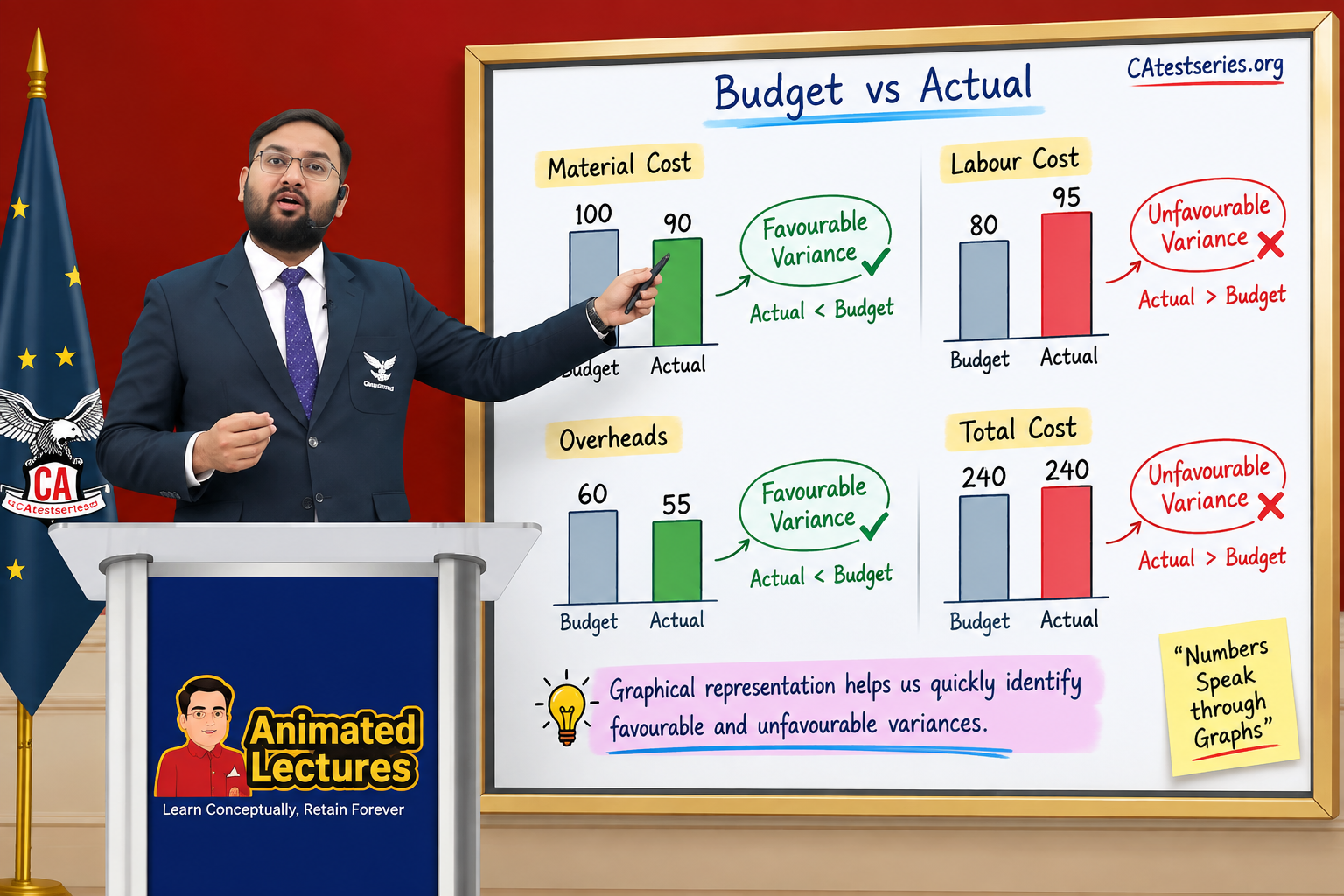
Favourable Variance: Where actual is better than budget (for example, less spending on electricity by the family).
Adverse or Unfavourable Variance: Where actual is worse than budget (for example, overspending on outings by the family).
Continuing with the family example above:
Item | Budget | Actual | Variance | Type |
Groceries | ₹8,000 | ₹9,200 | ₹1,200 | Adverse |
Electricity & water | ₹3,000 | ₹2,700 | ₹300 | Favourable |
School fees | ₹6,000 | ₹6,000 | Nil | — |
Fuel/transport | ₹2,500 | ₹3,100 | ₹600 | Adverse |
Entertainment & dining out | ₹2,000 | ₹3,500 | ₹1,500 | Adverse |
Savings/investments | ₹3,000 | ₹4,000 | ₹1,000 | Favourable |
Total | ₹24,500 | ₹28,500 | ₹4,000 | Net Adverse |
Similarly, companies apply the same principle by subdividing it into various components like Material Cost Variance, Labour Cost Variance, Overhead Variance, Sales Variance, etc., all based on the same "actuals vs budget" principle, starting right from your dinner table.
How Does CA Himanshu Singla (Faculty at CAtestseries) Teach This Topic?
Students appearing for CA usually have the opinion that this topic is very "wordy" in nature and contains definitions and concepts which are difficult to remember. It is here that CA Himanshu Singla, a faculty member at CAtestseries.org , has developed his unique way of teaching this topic.
Graphical Representation: He draws graphs for budgeted vs actual figures in the lecture using different colored bars (green for favourable variance and red for unfavourable variance) and explains the variance graphically.
Real Life Examples: Before discussing the application of these concepts to business cases, he always begins each lesson by giving an example of family budgets, which is something that students can relate to, just like the one we have discussed in this blog post.
Organised Handwritten & Digital Notes: After each animation, he prepares concise, examination-focused notes complete with tables (like the table in this article), keywords and formatting that examiners require – enabling students to write quickly and score better in theoretical questions.
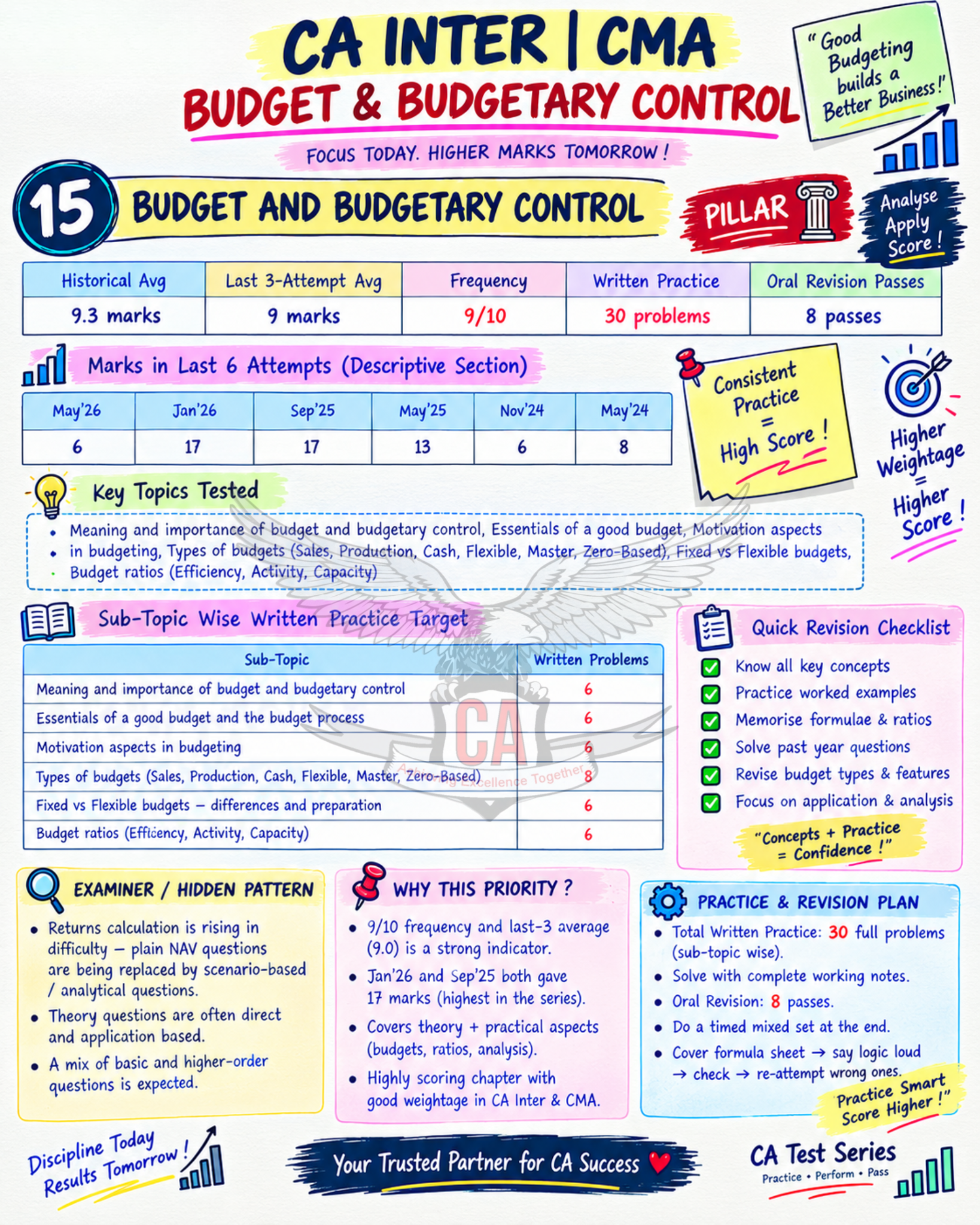
Flow Diagrams for Concepts: The 10-step process of Budgetary Control (Objectives → Corrective Action) is explained via diagrams, making sure that the whole process can be drawn in the exam when required to "explain the steps."
Revision focused on Practice: At the end of the topic, he carries out quick-fire questions and mock test analysis through CAtestseries.
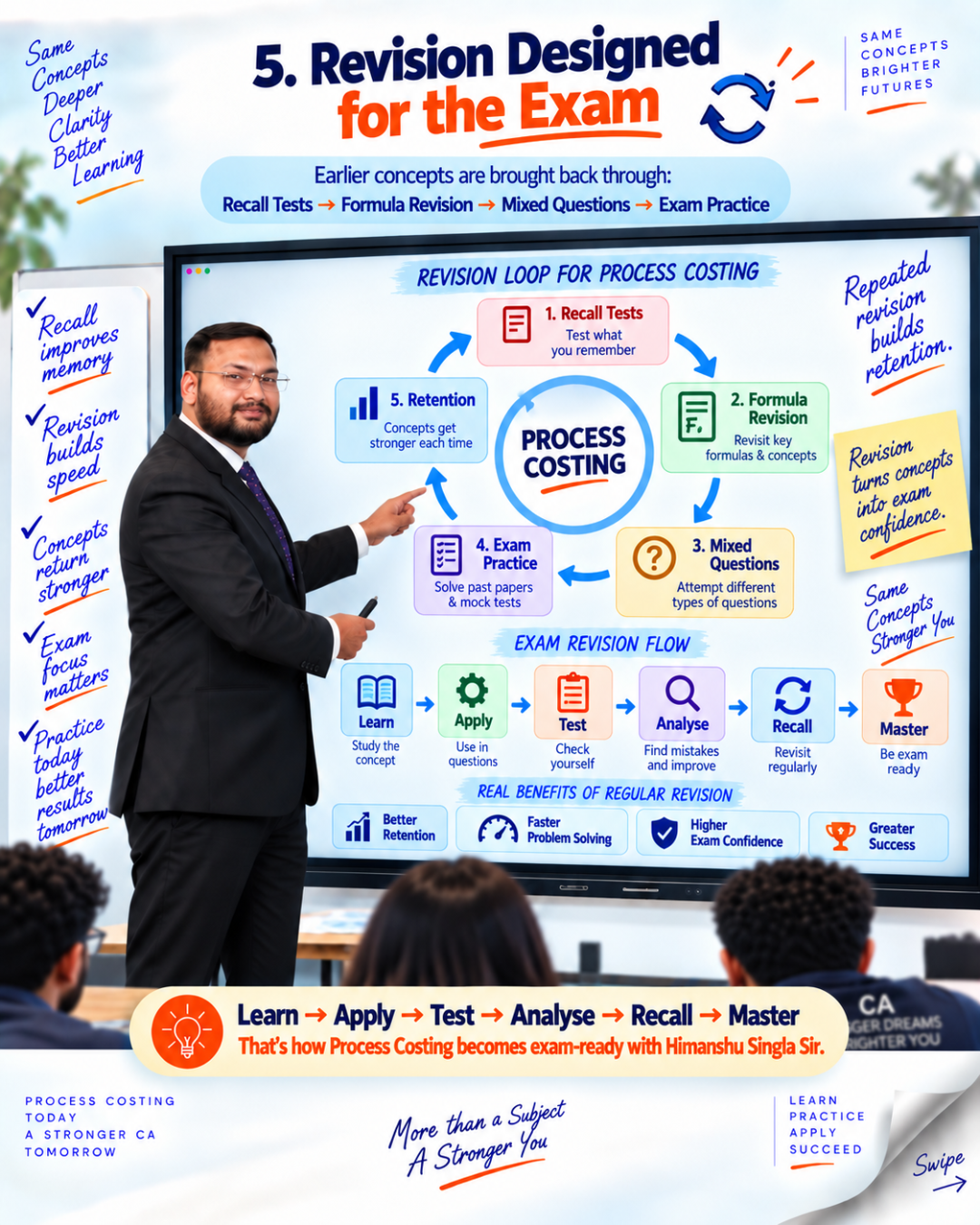
This is the power of animation, graphs, well-organised notes and real-life examples that have made the classes of CA Himanshu Singla popular with CAtestseries because students feel that this is the way to make theory topics such as Budgetary Control into scoring ones rather than just “once-read-and-forgotten” ones.
Conclusion
Budgetary Control is the same process that a good household follows each month – make a plan for your expenditure, monitor the actual expenditure, measure the difference between the two, learn why there was a difference, and then change your conduct for the future. Once you analyse the budgeting process from the point of view of a family, everything discussed in the chapter - objectives, steps, types of budgets, benefits, drawbacks, and variance analysis - turns out to be simple and logical.
And since Budgetary Control is taught at CAtestseries.org by CA Himanshu Singla using animated video lectures and illustrated graphs and neat note structure, it becomes one of the highest-scoring chapters of the whole syllabus. Next time you plan the monthly budget of your family, don’t forget that you are actually practising the process of Budgetary Control in real life.