Best Faculty for CA Inter SM: Conceptual Learning Without Rote Learning
Finding the best faculty for CA Inter SM is the first real decision that shapes how this subject feels — confusing or logical. Do you know a student who is good at every CA Inter subject but gets stuck in SM? This happens a lot. Many students try to memorise SM rather than understand it. They learn lines by heart. Then the exam gives a new case. Now they don't know what to write. Their mind goes blank, even if they "knew" the chapter the night before.
SM (Strategic Management), part of the CA Inter syllabus, tests logic more than memory. A good teacher does not just hand you notes to remember. A good teacher helps you understand each topic, step by step, so you can use that idea in any question — even a new one. This is what people mean by the conceptual learning CA Inter students actually need for this paper.
It will help you whether you are planning for your attempt in November 2026 or any other coming year's attempt. This will provide you with information about the failure of rote learning in SM, the level of knowledge that is required, developing a study plan, test day preparation, and why CA Chesta Chawla is an effective choice for SM and FM.
CA Inter SM Syllabus and Chapter-Wise Weightage
Before picking a teacher or a study planner, it helps to see the shape of the subject itself. Strategic Management is a shorter paper compared to some other CA Inter subjects, which is exactly why students underestimate it — and why understanding, not just reading once, matters so much per chapter.
Chapter / Topic | Key Focus Areas |
Introduction to Strategic Management | Why businesses need strategy |
Strategic Analysis: External Environment | Porter’s Five Forces, PESTLE |
Strategic Analysis: Internal Environment | Resource & capability analysis, SWOT |
Strategic Choices | Corporate-level and business-level strategies |
Strategy Implementation and Evaluation | Turning strategy into action and measuring results |
Digital Transformation | Technology’s role in changing business strategy |
Emerging Strategic Issues in Business | New and current strategic topics |
Weightage can shift slightly with every attempt, since ICAI updates its study material and exam pattern from time to time. Treat the list above as a guide to what's covered, not fixed marks — always cross-check the latest chapter-wise weightage on icai.org before finalising your study plan.
Why Rote Learning Does Not Work in SM
Let's look at a simple example. Suppose you learn this line by heart: "Porter's Five Forces looks at new entrants, suppliers, buyers, substitutes, and rivals."
Now, in the exam, ICAI gives you a short story. A company sells mobile phones. A new foreign brand enters the market at a low price. The question asks: "Which force is hurting this company the most? What should it do?"
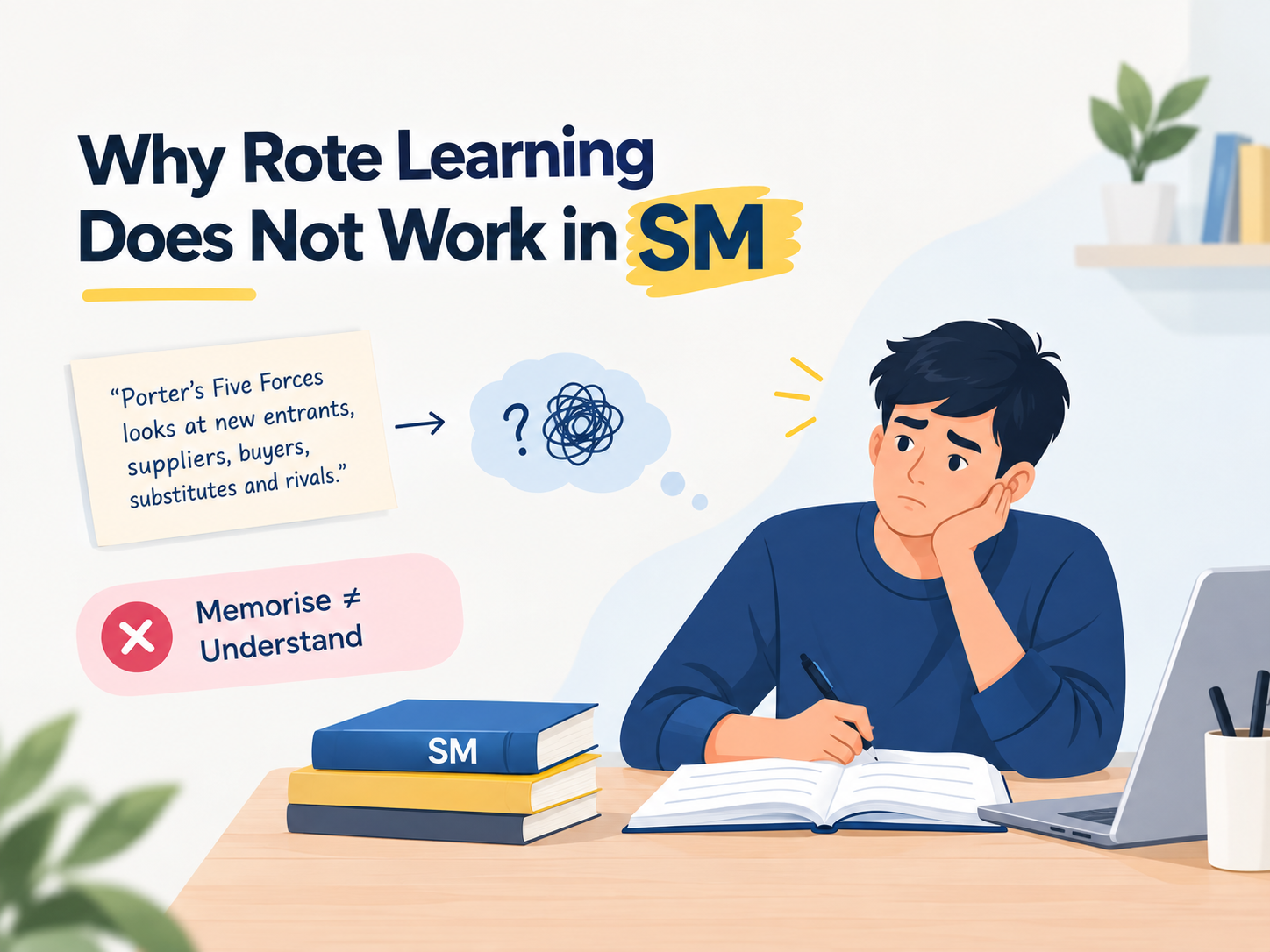
If you only remember the five names, you may not connect "new foreign brand with low prices" to "threat of new entrants." You know the words. But you don't know how to use them. This is the real problem with learning by heart instead of understanding.
The SM exam today is not just about writing definitions. ICAI now gives short business stories often — a merger, a new competitor, a pricing problem. You must read the story, pick the right tool, and explain your answer using facts from the story.
Problems in rote learning include:
You confuse similar concepts due to stress
You cannot apply the concept to a new story
You forget the wording in a few weeks
You avoid story questions since they appear difficult
You lose marks, even after many hours of study
This is why students often say, "I studied SM so much, but I still couldn't write a good answer." The real issue is not effort — it's the method of study. This is exactly why choosing the right SM mentor is such an important first step. Without the right faculty, even hard-working students stay stuck in the memorise-and-forget cycle.
What Does "Understanding the Concept" Mean?
Understanding means your teacher explains why an idea exists — before the name or the definition. You learn the reason behind a tool, not just its shape or its five bullet points.
Let's return to our example. The teacher who teaches from understanding starts by asking an easy question: "Why should a company analyse its competitors?" After giving the explanation of the actual logic, they introduce the concept. There might be new entrants. Suppliers might raise prices. Consumers could shift to another brand. Another product could replace this product. The competing companies will fight each other for the same consumers. Then and only then do they name the theory: "Porter's Five Forces."
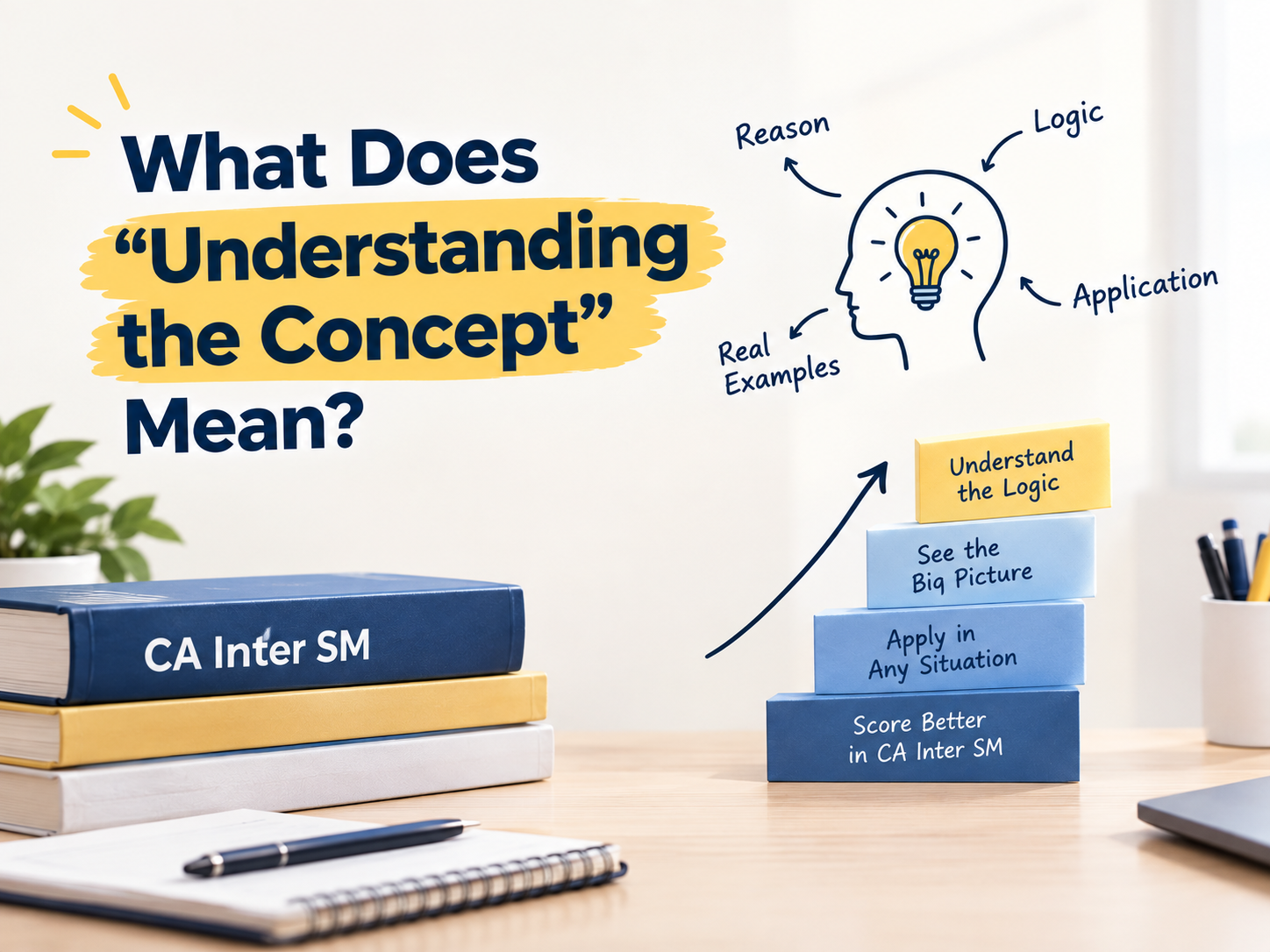
Once you understand the logic, you can spot these five pressures in any story — even one from an industry you have never studied before.
A good teacher, the kind you want as the right mentor for CA Inter SM, will usually:
Provide simple, realistic examples for every major concept.
Show you when one concept applies and when another should be used.
Teach you concepts through logical reasoning and storytelling, not through repetition.
Provide practice questions similar to exam scenarios.
Show you how one chapter connects to the next chapter
Ask you to explain the answer in your own words
Checklist: How to Pick the Best Faculty for CA Inter SM
Use this when you watch a demo class, read reviews, or ask seniors about a teacher.
Evaluation Factor | Good Sign | Warning Sign |
Teaching style | Explains “why” before “what” | Jumps straight to definitions |
Practice questions | Gives story-based questions frequently | Only gives theory to repeat |
CA Inter SM notes | Short, simple, and easy to connect | Long paragraphs meant to be memorised word-for-word |
Doubt solving | Explains the logic behind the answer | Says, “Just remember this” |
Exam focus | Discusses new exam patterns and changing question styles | Ignores how the exam has changed |
Results | Students say, “I understood it.” | Students only say, “It was fast.” |
Speed of teaching | Matches your pace and allows time for questions | Rushes through the syllabus |
If a teacher checks most of these boxes, they are likely a strong candidate for the best faculty for CA Inter SM.
Rote Learning vs Understanding
Point | Rote Learning | Understanding |
How you study | You learn words by heart | You learn the reason behind the idea |
New questions | You get confused | You can still answer |
Memory | You forget it fast | You remember it for longer |
Marks | Good only in easy, direct questions | Good at both easy and hard questions |
Exam stress | High, since you fear forgetting | Low, since you understand it |
Revision time | More, since you must repeat often | Less, since logic is easy to recall |
Confidence | Drops if a question is phrased differently | Stays steady, even for new cases |
How Teaching Approaches Compare
Teaching Approach | How Classes Feel | Common Outcome |
Definition-first coaching | Fast-paced, focused on covering the syllabus quickly | Good for direct/theory questions, but weaker for case-based questions |
Notes-heavy coaching | Long printed notes, expected to be learned as-is | Feels thorough, but retention often fades before the exam |
Concept-first coaching | Logic and real examples before definitions, with regular case practice | Slower to start, but stronger recall and better performance in case-based questions |
CA Chesta Chawla's classes are a good example of this third, concept-first approach in practice. It's usually the style that actually moves scores, not just how quickly a syllabus gets "completed."
Meet CA Chesta Chawla — Faculty for SM and FM
CA Chesta Chawla is a member of ICAI. She teaches two subjects: Strategic Management (SM) and Financial Management (FM). Both subjects need more than memory — they need students to think and connect ideas to real business situations. This is exactly where rote learning fails, and understanding wins.
She is known for making hard topics feel easy, using simple, real business examples so students actually understand a topic instead of just memorising it. In her classes, every big idea starts with a story; the technical name comes later. This order — logic first, name second — is a big reason her students report that ideas "stick" in memory.
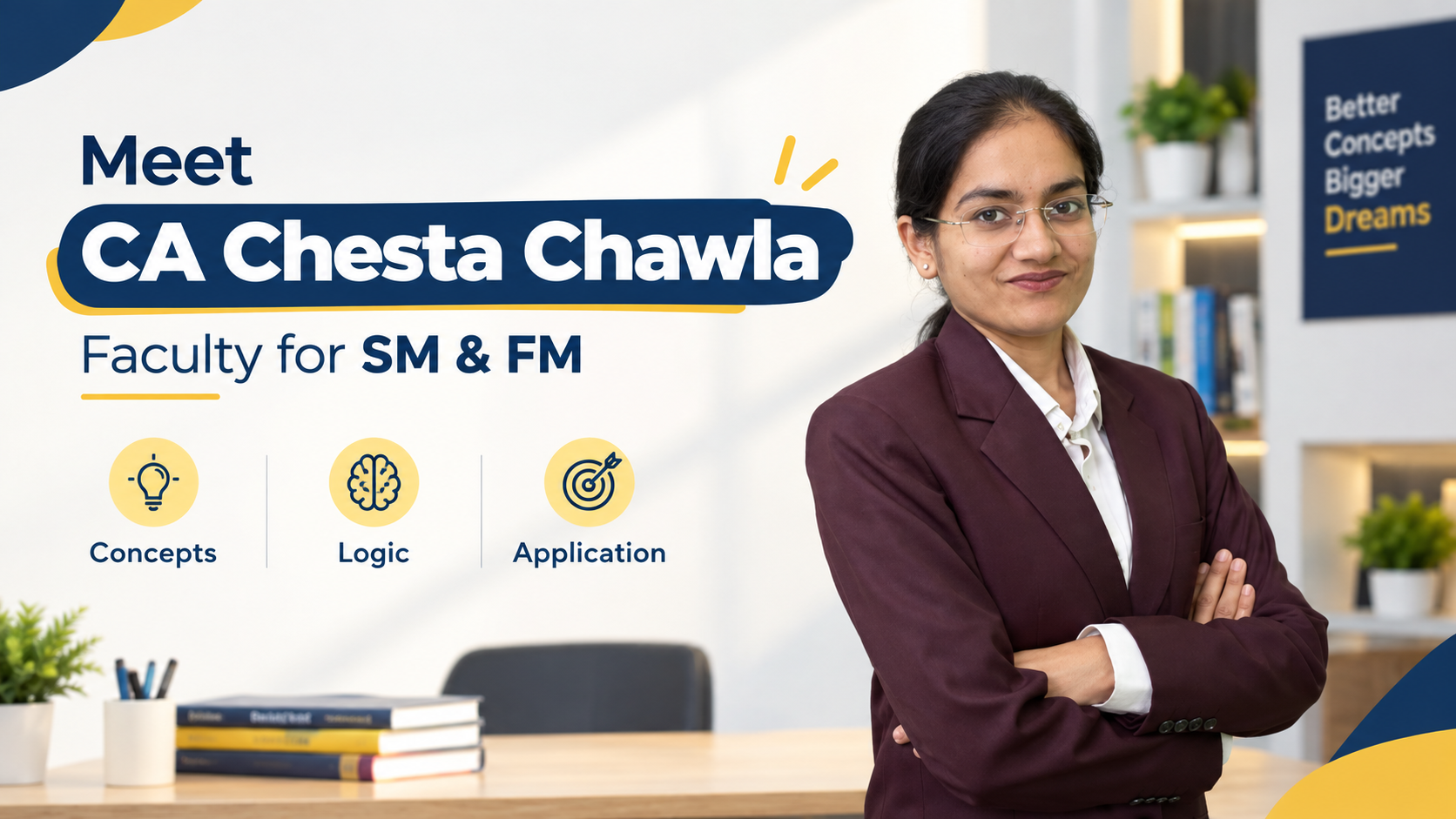
Her classes also connect classroom learning to what ICAI expects in the exam, which helps students feel less scared of tricky or story-based questions — usually the ones students fear most.
Her teaching philosophy is simple: understand the concept, don't just remember it. This is exactly what SM and FM students need, since both subjects test how well you can apply logic, not how well you can copy the textbook.
Facts about her:
Subjects: SM and FM
About her: According to the faculty bio available on her profile, she used to work at Acuity Knowledge Partners prior to becoming a teacher.
Unique strength: Advanced Financial Management for CA Final
Methodology: Teaches concepts through logical explanation and examples, rather than memorisation
Perfect for: Students who find numbers/case questions tough
What she offers: Study materials, questions, and study strategy
If you want a teacher who explains SM and FM in a simple way, CA Chesta Chawla is a strong choice — she helps you understand a topic instead of just repeating it.
Study Material You Should Use
A good teacher is only one part of your study plan. Even the SM faculty who fits your learning style cannot help you without the right material. Good CA Inter SM notes and practice material turn understanding into exam-ready answers.
ICAI Study Material — the full syllabus, in ICAI's own words
ICAI RTPs (Revision Test Papers) — try the last 6 sets to see the newest question style, available on icai.org
ICAI MTPs (Mock Test Papers) — good for timed, exam-like practice, also on icai.org
Short, simple CA Inter SM notes — notes that connect ideas, not long paragraphs to memorise
Old question papers — show how SM questions have changed over the years
Full mock tests — show your weak spots early, while there is still time to fix them
catestseries.org CA Inter SM mock test series — full tests, chapter tests, and revision papers built for the newer, story-based SM style
Group study or discussion — talking about a case with friends builds understanding faster
How to Make a CA Inter SM Study Planner
A CA Inter SM study planner is simple: it tells you what to study and when. Without a planner, students often repeat their favourite chapters and skip the harder ones. A planner stops this.
Step 1: Break the Syllabus into Small Parts. Do not think of SM as one big subject. Break it into small chapters. This feels less overwhelming and makes progress easier to track.
Step 2: Use a First Round and a Second Round. The first round is for understanding. The second round is for practice and case questions. Do not mix both rounds — first understand, then practice.
Step 3: Add Weekly Mock Tests. Finish two or three chapters, then take a small chapter test. This checks if you really understood the topic or only felt like you did.
8-Week CA Inter SM Study Planner
Week | Topic | Focus / Study Approach |
Weeks 1–2 | Introduction to Strategic Management | Understand concepts through examples and take brief notes |
Week 3 | Strategic Analysis (SWOT, Porter’s Five Forces) | Understand the rationale first, then solve 5–6 case questions |
Week 4 | Strategic Choices | Compare similar ideas using a table and take a chapter test |
Week 5 | Strategy Implementation | Connect this chapter with earlier chapters |
Week 6 | Digital Transformation & Emerging Tech | Focus on real-life, current examples |
Week 7 | Full Revision of All Chapters | Redo short notes instead of reading the full textbook |
Week 8 | Full-Length Mock Tests | Take timed tests, check answers, and fix weak areas |
This is just a sample plan — change the number of weeks based on how much time you have before your exam. What matters is having rounds, practice, and regular testing built in.
Tips for studying daily:
SM should be studied in small doses of 45-60 minutes, with small intervals
After every session, try to teach the topic orally, without referring to any notes
Maintain a small notebook with confusing topics and keep revising it
Never start a new chapter on the eve of a mock test, but rather revise it
CA Inter SM Exam Strategy for Exam Day
Understanding the subject is only half the work. The other half is a clear CA Inter SM exam strategy for how you attempt the paper.
Before you start writing:
Read the whole question paper first
Mark which questions feel easiest to you
Decide roughly how many minutes each question needs, based on its marks
Start with the question you understand best — this builds confidence early
While answering case-based or story questions:
Read the story twice before you write your answer
Underline the key facts in the story — these facts are your clues
Pick the correct concept and explain why it fits the story, using the facts you found
Do not write everything you know — write only what the question asks
While answering theory questions:
Start with a short, clear definition, in simple words
Add one small example or real-life case to support your answer
Use short points or short paragraphs — avoid one long block of text
Time management tips:
Give slightly more time to higher-mark questions
Do not spend too long on any single question
Keep the last 10-15 minutes to check your answers, not to start a new one
If you get stuck, move on and come back to that question later
Common Mistakes Students Make in SM
Even hard-working students fall into these traps. Try to avoid them.
Reading the theory once and assuming it is "done" — SM needs revision, not just one reading
Skipping case-based practice — many students only practice definitions and leave case questions for the last week.
Copying notes without understanding them — this feels productive, but it is close to rote learning in disguise
Taking mock tests too late — waiting until the last month leaves no time to fix mistakes
Studying only "important" chapters — SM papers can ask from any chapter, so skipping topics is risky
Not reviewing past mistakes — if you skip checking why you lost marks, you may repeat the same mistakes.
Why a CA Inter SM Mock Test Series Helps
Your understanding may be strong, but you still need practice in real exam-like conditions. Here's why a mock test series matters so much.
Timed practice shows if you can write fast enough, not just if you know the answer.
Feedback on your answers shows if your thinking is correct, not just your final answer
Chapter-wise tests let you fix one weak topic at a time
Scores over time show if you are really understanding the subject, or only remembering it briefly
Practice under pressure makes the real exam feel less scary, since you've faced this pressure before
Many CA Inter and CA Final students use the catestseries.org CA Inter SM mock test series for this kind of practice — full tests, chapter-wise tests, and revision papers built for the current story-based SM pattern. Pairing steady faculty guidance with regular self-testing tends to work far better than doing just one of these alone.
Glossary: Key CA Inter SM Terms Explained Simply
A big part of conceptual learning is knowing what these words actually mean, not just where they appear in the textbook.
Term | What It Really Means |
Strategy | A plan a business uses to reach a long-term goal, given its resources and competition |
SWOT Analysis | A simple check of a company's Strengths, Weaknesses, Opportunities, and Threats |
Porter's Five Forces | A way to study the five pressures a business faces from its market and competitors |
Core Competency | Something a company does better than most others, and builds its strategy around |
Corporate-Level Strategy | Big-picture decisions about which businesses or markets a company should be in |
Business-Level Strategy | Decisions about how to compete well within one specific business or market |
Strategy Implementation | Turning a strategy on paper into real action inside the company |
Digital Transformation | By using technology to change how a business creates value or serves customers |
Keep this glossary next to your notes. When a case study uses one of these words, come back here first — understanding the word properly is often the fastest way to unlock the whole answer.
Conclusion
SM doesn't always need to be like a test of your memory skills. Once you move from rote learning to understanding, it gets easier. It requires the right mentor; it takes a study plan to guide you along; it takes an exam strategy to use your understanding in the exams; and lastly, it requires consistent mock tests to convert your understanding into scores.
If you are still looking out for the right faculty for CA Inter SM, then you can go ahead with the following tips and comparison of approaches. Take up the demo class and check whether the teacher teaches you logic or not. One of the faculty members that you should look at is CA Chesta Chawla, and this is if you are looking out for an expert in FM too.