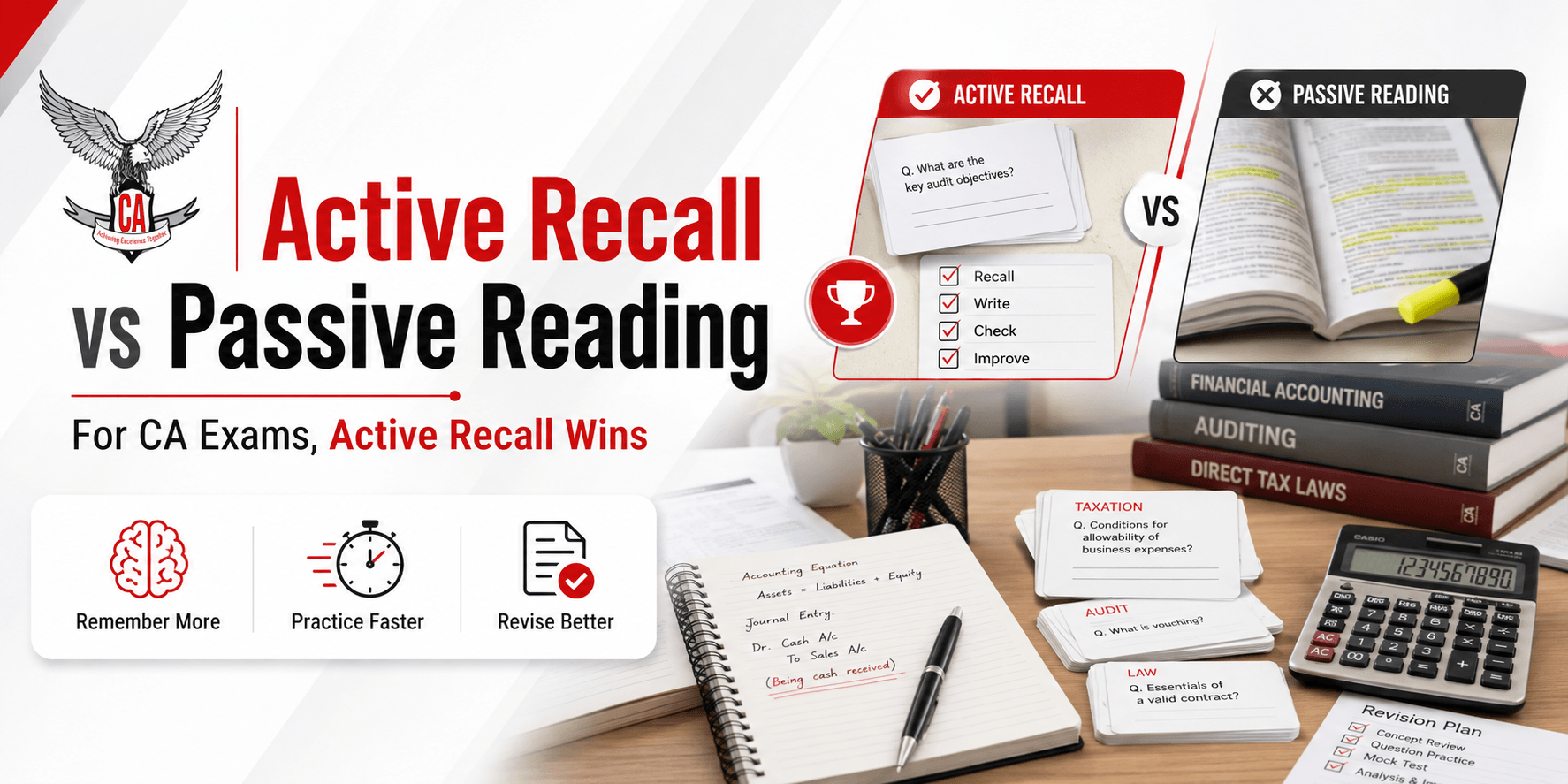
CA students often spend hours reading ICAI study material, revision notes, amendments, formulas, and solved questions but still struggle to reproduce the same information in an exam. The issue is not always how long you study; it is often how you study. In the debate over Active Recall vs Passive Reading, passive reading helps you understand and become familiar with a topic, while active recall requires you to retrieve and apply that information without looking at your notes. For CA Foundation, CA Intermediate, and CA Final students, the best strategy is not to eliminate reading completely but to know when to move from understanding a topic to actively testing it.
Active Recall vs Passive Reading: Quick Answer for CA Students
Active recall is generally more effective for revision, long-term retention, question practice, weak-area identification, and exam preparation because it forces you to produce information independently. Passive reading is more useful when learning a new chapter, understanding a complex provision, reviewing amendments, or studying unfamiliar material for the first time. A practical CA study strategy is therefore Read to understand → Recall without notes → Apply through questions → Test yourself → Review mistakes.
Active Recall vs Passive Reading at a Glance
The main difference between active recall and passive reading is whether you are simply looking at information or trying to reproduce it independently. This distinction matters in CA exams because you must recall formulas, provisions, concepts, working methods, and answer structures without having your books or notes available.
Comparison Factor | Active Recall | Passive Reading |
Main purpose | Retrieve and apply knowledge | Understand or review information |
Mental effort | High | Relatively low |
Memory retention | Stronger retrieval practice | Mainly creates familiarity |
Weak-area detection | Quickly reveals gaps | Gaps may remain unnoticed |
Question-solving practice | High | Limited |
Best use | Revision and exam practice | Initial learning |
Mock-test preparation | Highly useful | Limited |
Final exam revision | Strongly recommended | Use selectively |
What Is Active Recall?
Active recall is a study method in which you deliberately retrieve information from memory instead of repeatedly looking at the answer. For a CA student, this could mean closing the book and recalling an audit point, writing a legal provision from memory, reproducing an accounting treatment, remembering a formula, solving a taxation adjustment, or attempting an ICAI-style question before checking the solution. The goal is to determine whether you can actually produce and apply the information rather than simply recognise it on the page.
How Can CA Students Practise Active Recall?
CA students can practise active recall by answering questions without notes, using blank-page recall, solving past ICAI questions, writing theory answers from memory, recalling formulas before starting numerical problems, explaining concepts aloud, attempting chapter-wise tests, and taking full-syllabus mock exams. Flashcards can also help with short information such as definitions, provisions, conditions, formulas, and exceptions, but they should support rather than replace written practice and problem solving.
What Is Passive Reading?
Passive reading means reviewing information without actively checking whether you can recall or apply it independently. Common examples include repeatedly reading ICAI modules, highlighting paragraphs, going through revision notes several times, watching lectures without practising questions, or reading suggested answers without attempting the question first. Passive reading can be useful during initial learning, but relying on it throughout revision may create familiarity with a chapter without proving that you can reproduce the answer under examination conditions.
Why Passive Reading Can Feel More Effective Than It Is
Repeated reading makes words, headings, formulas, and solutions increasingly familiar, which may create the feeling that a chapter has been mastered. However, recognising an answer while looking at it is different from retrieving it when the book is closed. This difference often becomes obvious during a mock test when a student remembers seeing a provision or formula but cannot reproduce or apply it independently.
When Should CA Students Use Active Recall and Passive Reading?
The two methods are most useful at different stages of preparation. Passive reading is suitable for learning a topic for the first time, understanding difficult concepts, reviewing unfamiliar provisions, reading amendments, and analysing ICAI study material. Active recall should gradually take over during revision, question practice, retention testing, mock preparation, and final exam preparation because these stages require evidence that you can recall and apply what you have studied.
Preparation Stage | Recommended Approach | Useful Activities |
Initial learning | More passive reading | ICAI material, lectures, examples |
First revision | Balanced approach | Recall headings, solve basic questions |
Second revision | More active recall | Written practice, chapter tests |
Pre-mock stage | Strong active recall | Timed questions, error review |
Final preparation | Mostly recall and testing | Mocks, formulas, provisions, weak areas |
Active Recall for Different CA Subjects
Active recall should be adapted according to the subject rather than applied in exactly the same way everywhere. Theory-heavy subjects benefit from recalling headings, provisions, conditions, exceptions, and answer structures; practical subjects require students to solve problems without looking at solutions and recall formulas or working methods independently; while tax, law, and case-based topics benefit from scenario questions that require students to identify the relevant rule and apply it correctly.
For CA Foundation, Intermediate and Final
CA Foundation students can use active recall to strengthen basic concepts, formulas, theory, and numerical methods. CA Intermediate students can combine recall with more detailed accounting, costing, taxation, legal, and theory-based question practice. At CA Final, active recall becomes especially valuable for advanced application, integrated questions, standards, audit, taxation, law, and provision-heavy subjects because students must retrieve information from a much larger syllabus and apply it quickly to complex examination questions.
How to Use Mock Tests as an Active Recall Technique
Mock tests are one of the strongest forms of active recall because they require you to retrieve knowledge across several chapters without using notes while also managing time, calculations, answer presentation, and question selection. Attempt each mock honestly before checking solutions, follow realistic time limits, analyse every incorrect or incomplete answer, and retest weak chapters after revision. This turns a mock test from a simple score-checking exercise into a complete cycle of retrieve → apply → analyse → improve → retest.
Categorise Your Mock-Test Mistakes
Instead of simply marking answers right or wrong, identify why you lost marks. Conceptual mistakes mean the underlying principle needs to be relearned; recall mistakes mean you understood the topic but could not retrieve the required information; calculation mistakes require better working and checking; presentation mistakes indicate problems with structure, headings, working notes, or conclusions; and time-management mistakes show that you need more timed practice. Categorising errors makes revision much more targeted.
Common Active Recall Mistakes CA Students Should Avoid
Active recall becomes less effective when students check solutions too quickly, attempt to memorise concepts they do not understand, rely only on flashcards, avoid difficult questions, ignore wrong answers, practise only without time limits, or begin self-testing only a few days before the examination. Another common mistake is treating repeated rereading as complete revision. Effective revision should regularly test whether you can recall, solve, write, and apply what you studied without immediate support.
Active Recall Study Routine for Busy CA Students
Busy CA students can integrate active recall into normal study instead of creating a separate schedule for it. On a regular day, learn a topic, close the material, recall the main ideas, attempt one or two relevant questions, and review your mistakes. During revision, begin with self-testing rather than immediately opening the notes. In the final month, increase timed question practice and mock exams, while the final week should focus on formulas, provisions, amendments, error logs, important questions, and previously identified weak areas.
How CA Test Series Can Support Active Recall Practice
CA Test Series can support active recall by giving CA Foundation, CA Intermediate, and CA Final students structured opportunities to practise retrieval and application instead of depending only on reading. Chapter-wise practice tests help identify weak topics early, ICAI-pattern test papers provide exam-oriented question practice, and full-syllabus mock exams test knowledge across multiple chapters under realistic conditions. Expert answer evaluation and performance feedback can further highlight conceptual, calculation, presentation, and recall-related weaknesses so students know exactly what to revise and retest.
Active Recall vs Passive Reading: Which Should CA Students Choose?
CA students should not treat Active Recall vs Passive Reading as a choice where one method must completely replace the other. Passive reading is better for understanding new or unfamiliar material, whereas active recall is more effective once that knowledge must be retained, applied, and reproduced in an examination. As the exam gets closer, the balance should progressively shift from reading towards question practice, written recall, timed testing, mock exams, and analysis of mistakes.
Conclusion
When comparing Active Recall vs Passive Reading for CA exams, both techniques have a place, but their roles are different. Passive reading helps CA students build understanding, while active recall tests whether that knowledge can be retrieved and applied when required. For more effective CA preparation, follow a simple cycle: Understand → Recall → Apply → Test → Review. Combine focused reading with chapter-wise question practice, ICAI-pattern papers, mock exams, error analysis, and targeted retesting so that your revision is based not on how familiar the syllabus feels, but on what you can actually reproduce under exam conditions.