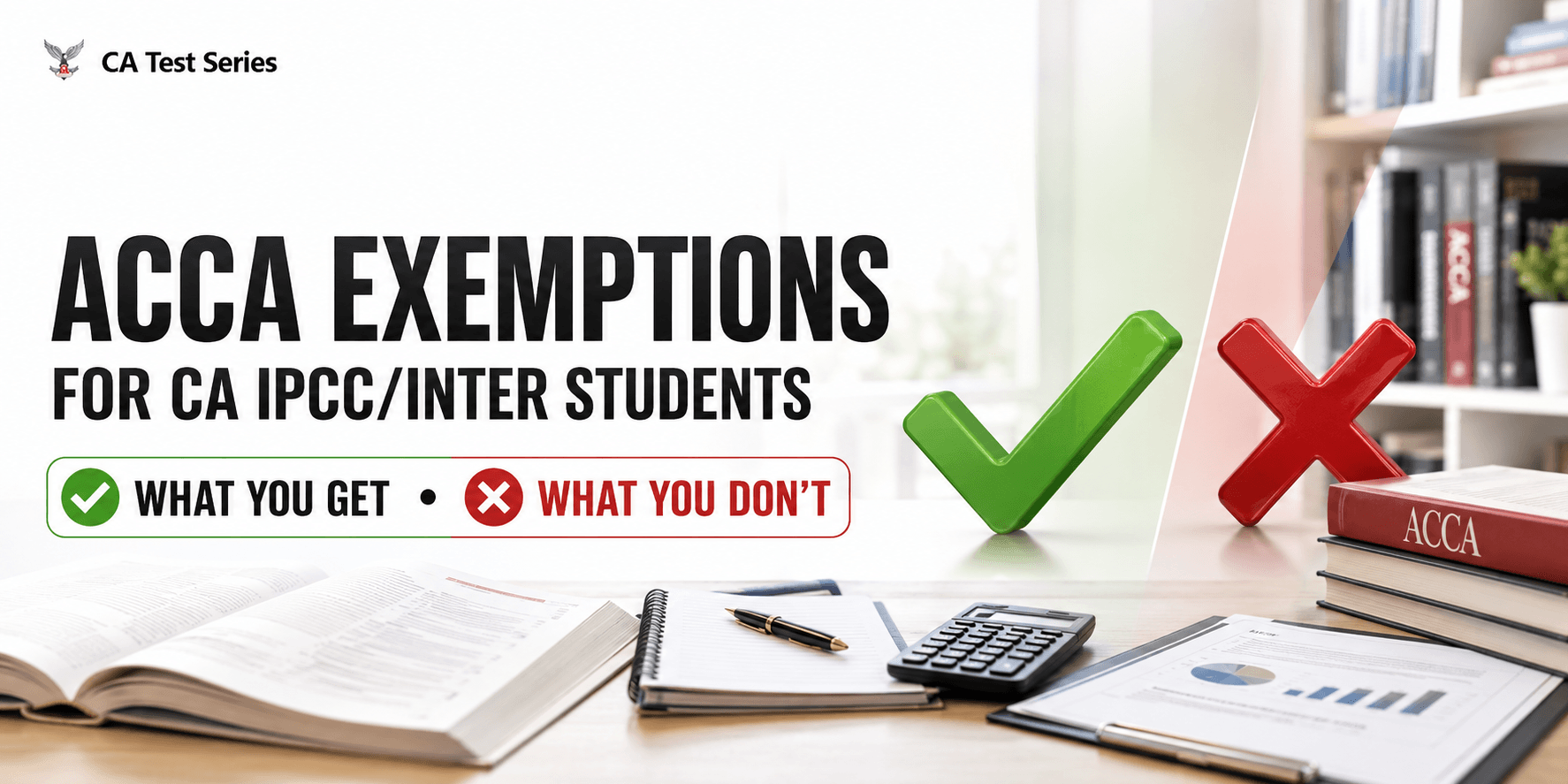
If you have completed CA IPCC or CA Intermediate and are considering ACCA, exemptions can significantly reduce the number of exams you need to take. ACCA exemptions for CA IPCC/Inter students recognise relevant subjects already studied under the ICAI curriculum, helping eligible candidates avoid repeating similar accounting, taxation, audit, and management topics. However, exemption eligibility is not identical for every student, as it can depend on your ICAI scheme, completion status, qualification year, and additional academic qualifications. For this reason, students should always verify their exact eligibility through ACCA’s official Exemptions Calculator before planning their ACCA journey.
ACCA Exemptions for CA IPCC/Inter Students – Quick Answer
Students who have completed both groups of CA IPCC or CA Intermediate are commonly associated with up to five ACCA exemptions, typically covering Business and Technology (BT), Management Accounting (MA), Financial Accounting (FA), Taxation (TX), and Audit and Assurance (AA). Students with an additional eligible qualification, such as certain recognised commerce degrees, may potentially receive more exemptions. These figures should be treated as general guidance rather than a guaranteed entitlement because ACCA assesses every qualification individually.
Quick ACCA Exemption Summary
CA Qualification/Status | Possible Exemptions | Commonly Exempted Papers | Approx. Papers Remaining |
CA IPCC/Inter – Both Groups Cleared | Up to 5 | BT, MA, FA, TX, AA | Around 8 |
CA Inter + Eligible Graduation | Up to 6 | BT, MA, FA, LW, TX, AA | Around 7 |
Partially Completed CA Inter | Varies | Depends on ACCA assessment | Varies |
Qualified ICAI CA | Up to 9 | Applied Knowledge + eligible Applied Skills | Minimum 4 |
Old CA IPCC Scheme | Varies | Depends on scheme and year | Varies |
What Are ACCA Exemptions?
ACCA exemptions are credits awarded for recognised prior learning. If your earlier academic or professional qualification covers subjects that substantially overlap with ACCA papers, ACCA may allow you to skip those examinations. Exemptions can apply to papers at the Applied Knowledge and Applied Skills levels, but Strategic Professional examinations cannot be exempted. This allows eligible CA students to begin ACCA at a more appropriate stage instead of starting the qualification from the first paper.
Who Is Eligible for ACCA Exemptions After CA Intermediate?
Eligibility depends on the qualification you have actually completed rather than simply being registered as a CA Intermediate student. Candidates who have completed both CA Inter/IPCC groups generally have a stronger exemption position than students who have completed only one group. Old IPCC candidates should also select the exact historical qualification and study year when checking eligibility because ACCA assessments may vary between ICAI schemes.
CA Inter Exemption Eligibility at a Glance
Candidate Status | Exemption Position |
Both CA Inter groups completed | Commonly eligible for multiple exemptions |
Only one group completed | Eligibility may vary |
Old CA IPCC completed | Depends on scheme and completion year |
CA Inter + eligible degree | Additional exemptions may be possible |
Qualified ICAI CA | May receive up to nine exemptions |
ACCA Papers Exempted for CA IPCC/Inter Students
The commonly referenced exemption route for eligible CA IPCC/Inter students includes all three Applied Knowledge papers—BT, MA, and FA—along with selected Applied Skills papers such as TX and AA. Corporate and Business Law (LW) may also become available where an additional recognised qualification is considered. Students should nevertheless check the exact papers shown in their personal ACCA assessment before assuming that any specific subject is exempted.
ACCA Paper-Wise Exemption Overview
ACCA Paper | Level | Typical Position for CA Inter/IPCC |
BT – Business and Technology | Applied Knowledge | Commonly exempted |
MA – Management Accounting | Applied Knowledge | Commonly exempted |
FA – Financial Accounting | Applied Knowledge | Commonly exempted |
LW – Corporate and Business Law | Applied Skills | May depend on additional qualification |
PM – Performance Management | Applied Skills | Usually remains |
TX – Taxation | Applied Skills | Commonly exempted |
FR – Financial Reporting | Applied Skills | Usually remains |
AA – Audit and Assurance | Applied Skills | Commonly exempted |
FM – Financial Management | Applied Skills | Usually remains |
What CA Inter Students Do Not Get Exemptions From
CA Intermediate exemptions do not normally remove the entire Applied Skills stage, and they do not provide exemptions from Strategic Professional papers. A student receiving the commonly cited five exemptions may still need to complete papers such as LW, PM, FR, and FM before progressing further. Strategic Professional examinations must be completed directly with ACCA even if a student receives the maximum number of exemptions available at earlier levels.
CA Inter vs Qualified CA ACCA Exemptions
The exemption position after CA Intermediate differs considerably from the position after completing the full ICAI CA qualification. A CA Inter student commonly receives fewer exemptions because only part of the Chartered Accountancy pathway has been completed, whereas an eligible qualified ICAI Chartered Accountant may receive up to nine ACCA exemptions. Therefore, students should not apply “nine exemptions for CA” claims directly to CA Intermediate.
Qualification | Typical Exemptions | Approx. Exams Remaining |
CA Inter/IPCC Completed | Up to 5 | Around 8 |
CA Inter + Eligible Degree | Up to 6 | Around 7 |
Qualified ICAI CA | Up to 9 | Minimum 4 |
How to Check Your Exact ACCA Exemptions
The most reliable method is to use ACCA’s official Exemptions Calculator. Select the correct country, awarding institution, qualification, and completion or last study year, then review the papers for which exemptions may be available. This step is especially important for old IPCC students because choosing the wrong ICAI scheme or qualification year could show an exemption result that does not match their actual educational background.
How to Apply for ACCA Exemptions After CA Inter
Students can normally request exemptions during ACCA registration by entering their educational qualifications and submitting supporting documents. ACCA then assesses the evidence, identifies eligible papers, and allows students to review and accept the exemptions offered before paying the applicable fees. After payment, students should check MyACCA to confirm that the exemptions are correctly reflected before registering for any remaining examination.
Documents Commonly Required
Document | Purpose |
CA Inter/IPCC mark sheets | Shows subjects and groups completed |
ICAI certificate or qualification proof | Confirms qualification status |
Graduation certificate/transcript | May support additional exemption eligibility |
Identity document | Required for ACCA registration |
Official English translation | Required when documents are not in English |
ACCA Exemption Fees for CA Inter Students
Exemptions are not normally free. According to the supplied 2026 information, Applied Knowledge exemptions are around £84 per paper, while Applied Skills exemptions are around £111 per paper. Students may also need to budget for registration, annual subscription, remaining examination fees, study materials, tuition, and the Ethics and Professional Skills Module. Since ACCA fees can change, candidates should always verify the current official fee schedule before making payments.
Benefits of ACCA Exemptions for CA IPCC/Inter Students
The main benefits are fewer examinations, a shorter academic pathway, reduced repetition of previously studied CA topics, and potential savings on coaching and study materials. Exemptions can also allow students to move earlier into more advanced and internationally focused areas of accounting, reporting, audit, finance, and business strategy. However, the value of an exemption is greatest when the student still has a strong understanding of the subjects being skipped.
Limitations You Should Know: Exemptions reduce exam requirements, but they do not eliminate all ACCA obligations. Students still need to complete required Strategic Professional examinations, the Ethics and Professional Skills Module, and the Practical Experience Requirement. Eligibility can also vary between candidates, exemption fees apply, and policies may change over time. In addition, skipping a paper can create knowledge gaps if the underlying CA subject was studied several years ago or was not fully understood.
ACCA After CA Inter – Your Possible Journey
The typical journey begins by checking your exact eligibility, claiming the exemptions ACCA awards, completing any remaining Applied Skills papers, progressing through Strategic Professional, completing EPSM, recording the required practical experience, and finally applying for ACCA membership. The Practical Experience Requirement currently includes 36 months of relevant supervised accounting or finance experience together with the required performance objectives, although qualifying experience may be accumulated alongside your studies. CA Inter → Check Exemptions → Claim Eligible Exemptions → Remaining Applied Skills → EPSM → Strategic Professional → PER → ACCA Membership
Can CA Articleship Count Toward ACCA Practical Experience?
CA articleship may count toward ACCA’s Practical Experience Requirement where the work is relevant to accounting or finance and ACCA’s recording, supervision, and sign-off requirements are satisfied. It should not be assumed that articleship automatically fulfils the complete PER requirement. Students should maintain appropriate records and ensure eligible experience is verified by a suitable practical experience supervisor.
Should You Complete CA First or Start ACCA After Inter?
The right route depends on your career goals, study capacity, articleship workload, and financial situation. Students who want maximum focus on ICAI may prefer completing CA first, while those with sufficient time may begin ACCA after Inter and benefit from syllabus overlap. Pursuing both together can reduce overall calendar time but also creates the highest workload.
Route | Main Advantage | Main Challenge | Best Suited For |
Complete CA First | Maximum focus on CA | ACCA starts later | CA-focused students |
Start ACCA After Inter | Earlier ACCA progress | Balancing CA and ACCA | Students with manageable workload |
CA + ACCA Together | Progress toward both qualifications | Heavy study pressure | Highly disciplined students |
Is ACCA Worth It After CA Intermediate?
ACCA may be worth considering for students interested in multinational companies, global capability centres, international financial reporting, FP&A, audit, consulting, corporate finance, risk, or overseas opportunities. CA remains particularly important for roles connected with India's Chartered Accountancy profession, while ACCA provides broader international accounting exposure. For some students, combining CA + ACCA may offer the strongest profile, but the additional time, fees, and workload should be considered carefully.
ACCA Exemptions for CA Inter Students – Key Takeaways
Point | What You Should Know |
Eligibility | Depends on completed qualifications |
Common exemption position | Up to five for eligible CA Inter/IPCC students |
Additional qualifications | May increase exemption eligibility |
Exemption fees | Payable for accepted exemptions |
Strategic Professional | No exemptions |
Practical Experience | 36 months of qualifying experience under current requirements |
Final verification | Use ACCA’s official Exemptions Calculator |
Conclusion
ACCA exemptions for CA IPCC/Inter students can make the ACCA journey more efficient by recognising subjects already completed under ICAI and reducing unnecessary repetition. However, the exact exemption count varies according to qualification status, scheme, year, and additional academic credentials. Students should therefore avoid relying on generic claims and verify their eligibility through ACCA’s official Exemptions Calculator. Once your exemptions are confirmed, you can accurately calculate your remaining papers, fees, experience requirements, and decide whether starting ACCA after CA Inter fits your long-term career goals.